

India’s 2026-2027 Defence Budget was announced in an environment of a yet to be inked India-US Trade Deal and com much commotion over the book ‘Four Star Destiny’ authored by former Indian Army Chief, General MM Naravane
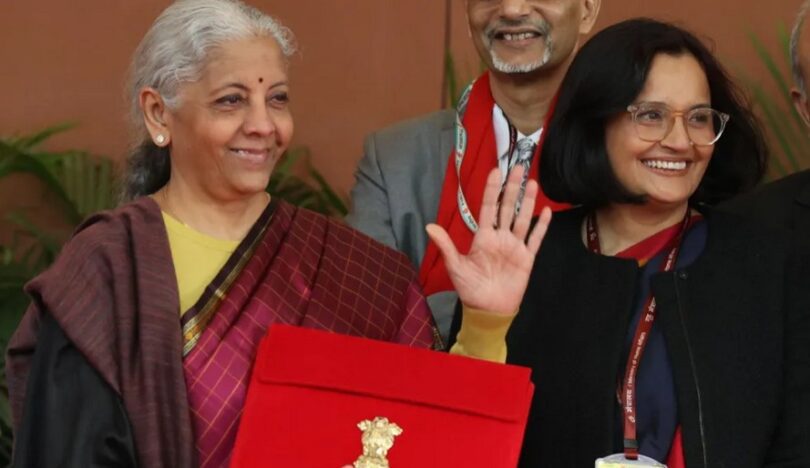
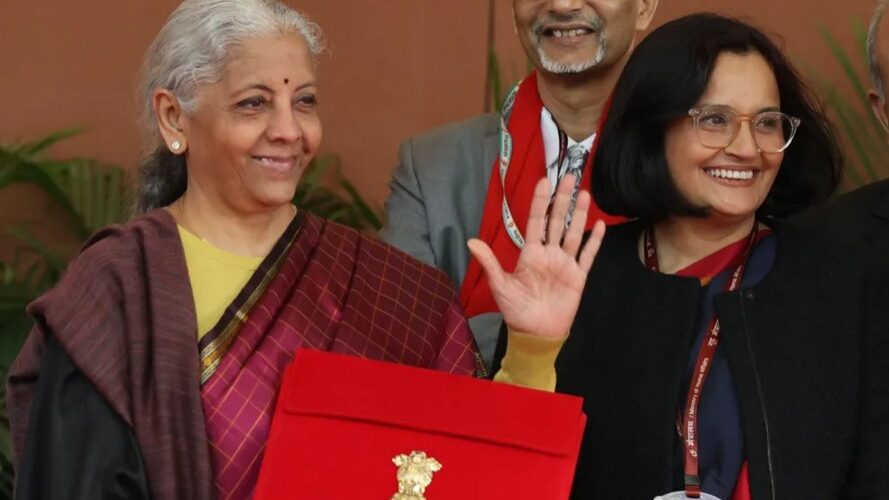
Presenting India’s 2026-2027 Union Budget, Finance Minister Nirmala Sitharaman, did not specifically mention defence allocations; same as on earlier occasions – this being her 9th budget presentation. But she took time to mention the issue of taxing the disability pension of military personnel. Other variations were instead of her photo-op of making halwa before the presentation, she met President Draupadi Murmu who fed her curd and sugar. Being fed curd and sugar by President Murmu, she invoked birthday of Guru Ravidas at the beginning of her speech - part of the campaign to woo Dalit votes.
The defence allocation (excluding pensions) for FY 2026-27 is INR 6,13,340 crore (USD 67.03 billion); allocation towards capital expenditure is INR 2,19,306 crore (USD 23.9 billion) and revenue expenditure allocation is INR 3,65,479 crore (USD 39.9 billion). This is rated a 15.18% increase over FY 2025–26 (BE), although inflation and fall of the rupee versus dollar tell a different figure. The accent is on capital outlay surging by 22%, compared to 17% surge in revenue expenditure for operational readiness, troop sustenance and logistics.
About 37% of the INR 1,71,338 crore for defence pensions goes to civilian defence employees and finance ministry personnel on deputation to the Ministry of Defence (MoD). Overall defence allocation is 1.997% (just short of 2%) although higher than FY 2025-2026 when it was at 1.91%. This allocation is the highest-ever by any BJP government; considered adequate to cope with the China-Pakistan threat - while China's estimated defence budget for 2026 is projected to be approximately USD 542.7 billion, and we are way behind China in R&D, defence technology and manufacturing.
Defence Minister Rajnath Singh refused to give any order when asked by the then Army Chief Gen Naravane in 2020 for orders against advancing PLA tanks in Eastern Ladakh. Caught on the wrong foot in Parliament now, Rajnath wants the book to be produced, knowing full-well its publication was stopped by the government. Isn’t he aware government took this action after excerpts of the book were released in media by the publisher in 2023; indicating political pusillanimity, with Rajnath claiming he had spoken to the prime minister (https://www.thecitizen.in/opinion/undersoldiers-unraveled-983318)? Rajnath Singh even told Parliament on July 1, 2024, that 158 organizations were consulted before imposing the Agnipath scheme – did these include the ISI and MSS?
In 2023, EAM S Jaishankar, publicly said, “Look, they (China) are the bigger economy. What am I going to do? As a smaller economy, I am going to pick up a fight with the bigger economy? It is not a question of being reactionary, it’s a question of common sense.”. But why did Jaishankar advise Prime Minister Modi to say Koi Na Aya, Koi Na Ghusa, and prompted Rajnath to say, “Not even an inch of territory lost”?
But Jaishankar is right about China’s bigger economy; with analysts noting China’s USD 30 trillion economy slowdown doesn’t guarantee Indian economy will match before the middle of the century, if at all; India would need to grow consistently at 8% annually over the next 25 years while China grows at a glacial 2%, which is unlikely. Can we stop bragging about out a USD 4 trillion economy – especially when 1% of our population holds over 40% of India’s wealth and our GDP per capita is USD 2.818, compared to China’s USD 13.806?
The emphasis on capital acquisitions in this budget should also be seen in the backdrop of 1.8 lakh manpower shortages in Indian Armed Forces – 1 lakh in the Army alone. News indicates youth from Punjab are not joining the Army and plans are afoot to make up the manpower shortages of Gorkha Regiment by including Kumaoinis / Garhwalis. But the political apex refuses to acknowledge that youth are charry to join as Agniveers with an uncertain future, despite assurances some would be later absorbed in CAPF, or serve as security guards with political parties or corporates. The fact that Agniveers are made to join the 1.4 million Indian Armed Forces but not the 2.16 million civil, armed and special police forces, indicates Machiavellian intent; is the military considered a necessary evil? One reason to stop the publication of Gen Naravane’s book also is; it brings out the military was never consulted about the Agniveers issue and it came as “bombshell” to the Services – don’t mind 168 organizations consulted by Rajnath, who didn’t have the courage to respond to the Army Chief how to respond, but keep singing that Pakistan occupied Kashmir (PoK) will automatically fall in his lap.
In July 2019, Nirmala Sitharaman, when questioned about the finance ministry decision to tax disability pension of military personnel, put the onus on the Army (https://www.thehindu.com/news/national/army-nod-to-tax-pension-for-disability-nirmala-sitharaman/article28264190.ece). Being a JNU-product, Sitharaman is also darling of India’s deep-state because she grabbed a huge amount of defence land. Report of the Justice LN Reddy (One-Man Judicial Committee) on One Rank, One Pension (OROP), which favoured the military, has been in the freezer since its submission in October 2016. But when a veteran colonel raised a question about OROP during Sitharaman’s pre-election rally in early 2019, she shouted him down, screeching and gesticulating; her photo of that moment appeared in newspapers (inset). Little wonder social media calls her “Bulbul-e-Hindostan” – India’s Nightingale.
As finance minister, Sitharaman gave the Non-Functional Upgradation (NFU) even to the Railways but is loath to give it to the Armed Forces despite judicial approval. Sitharaman is now terminating income tax exemption on disability pensions for all but "boarded out". A veteran-strategist calls it wholesale retreat from honour and by narrowing the definition of those "worthy" of support, government abandoning thousands of soldiers who sacrificed their physical well-being in the line of duty.
An excellent write up on the withdraw of Income Tax exemption to all but those boarded out.
— Brig V Mahalingam (@BrigMahalingam) February 2, 2026
AN OPEN LETTER TO THE NATION
" Devaluation of Sacrifice and the Death of the Moral Contract"
To
The Citizens of India,
The Military Leadership,
The Policy Makers of this…
This is in backdrop of freebies galore being distributed to influence votes, purchasing votes before elections; INR 10,000 to every woman of Bihar and now Assam Chief Minister Sarma announcing INR 8,000 to every woman in Assam – are women in Assam inferior to the ones in Bihar? In any case, no one will know how many women did receive this amount. Then there are central funds, including some not audited, with on-line distribution, the actual execution of which can hardly be fully monitored. But Sitharaman hasn’t mentioned amount of savings by taxing disability pensions - will it help create another 100 smart cities? Of the 1.4 billion Indians only about 5% (including Armed Forces personnel) pay income tax, and after poodle-faking for 12 years as finance minister, she now talks of widening the tax base?
The talk of cutting red-tape and ease of business has been ongoing for several years. CDS Gen Anil Chauhan, himself in defence ministry and member of the Defence Acquisition Council, urged the defence industry at the 2025 Chanakya Defence Dialogue to be truthful about capabilities and deliver at globally competitive costs on time, saying, "We have problems like our procurement procedures are so slow, that it is difficult to imbibe technology at the rate the Armed Forces would want to.” Is the CDS as helpless as a wet kitten?
The focus on MSMEs, new funds/schemes etc is good. But India had over six crore (60 million) MSMEs registered in early 2025, of which only about 40% received bank credit. With the sector under stress, over 35,000 MSMEs shut down in FY 2024-25 and 75,000+ in the last five years. Does this bode well for India? Isn’t it a shame that the government used only 5% funds in FY 2025-2026 allocated for employment and job skilling?
R&D directly relates to national security and India’s rise and development. But Sitharaman didn’t give any figures for R&D investment, present or planned. India spends about 0.6%-0.7% of its GDP on R&D, compared to over 2.4% by China and over 3.5% by the US. 2024-2025 data showed total R&D investment by India, China and the US was USD 17 billion, USD 496 billion and USD 886 billion respectively. This despite India being the 4th largest economy globally, and soon to become 3rd as mentioned by Modi. Moreover, India’s private sector contributes only 36% to R&D, compared to over 70% by the US, China and Germany, while India writes off bank loans to the Corporate because they fund elections. With roughly 26% of global R&D output, Beijing enjoys an overwhelming edge in new age warfare; drone swarms, electronic warfare, quantum decryption, and the like.
With all the emphasis on Atmanirbhar Bharat (self-sufficient India), what is happening in terms of defence and national security? Nobel Laureate David Gros, speaking at the Quantum India Bengaluru Summit 2025, said "You can't just ‘Make in India’ by using science done elsewhere"; emphasizing India must "discover, invent, and then make”; increase R&D and promote a culture of scientific inquiry, not rely on foreign technology, also pointing out lack of enabling infrastructure preventing India’s vast talent from leading in global scientific progress.
What are we up to?
- Over the last decade plus, the Comptroller and Auditor General (CAG) periodically pointed out excessive time delays by DRDO, sub-standard products, many priced more than the same category available off-the-shelf, and lack of accountability. But the reorganization of DRDO continues to drag on.
- A CAG report tabled in Parliament (December 2025) pointed out 72% Army contracts under emergency procurement (EP) not delivered within stipulated time and deviations regularising violating procurement processes/rules.
- Another CAG report labelled combat free-fall parachutes, developed by DRDO at a cost of INR 10.75 crores over 13 years and claimed successful, failures and “seriously life threatening” (https://timesofindia.indiatimes.com/india/indigenous-military-parachutesunsafe-drdo-lab-under-cag-scanner/articleshow/52661309.cms).
- An article in ‘Swarajya’ details how India is “botching” its military worse than the US (https://swarajyamag.com/defence/india-is-botching-its-military-the-way-america-did-only-with-far-deadlier-consequences).
- The article ‘After 10-Year Delay, India Set To Import German AIP Submarines In $8 Billion Deal; Setback For Atmanirbhar Bharat’ (https://www.eurasiantimes.com/india-forced-to-import-8b-german-aip-submarines/#google_vignette) points out how six submarines for Project 75I could have been indigenously developed by Larsen and Toubro instead of importing German technology.
- At the 2025 Chanakya Defence Dialogue, the CDS doubted the percentage of indigenous content under ‘Make -in-India, which in many cases perhaps only amounts to “assembling” foreign products with minor tinkering. But what takes the cake is the Advanced Medium Combat Aircraft under development will forever remain hostage to foreign blockages which amounts to outsourcing national security (https://swarajyamag.com/commentary/design-simulation-operation-the-three-layers-of-software-dependency-that-leave-indian-industry-vulnerable-to-foreign-chokepoints). So much for Atmanirbhar Bharat.
Why should the finance minister worry, if the defence minister is not? As to how “progressive” is the 2026-2027 budget presented by Nirmala Sitharaman, readers would do well to read the article by her JNU-mate at the following link (https://newstral.com/en/article/en/1275494857/the-bland-banquet-nirmala-sitharaman-s-ninth-budget-and-the-limits-of-endurance#google_vignette).
The author is an Indian Army veteran. Views expressed are personal.







2026-27 Budget very well analysed. The voids in the allocated budget for Defence are dangerously staring in one’s eyes,especially when the threats from the neighbourhood have increased multifold.