

The changing world after the Cold War
Geopolitics has two basic ingredients, geography and power, both of which tend to compete with one another. Geography taught in schools was the seafarer’s geography, which focused on conservative and traditional notions of territorial boundaries & frontiers, physical features, the waterways provided by the rivers, seas & oceans; the natural barricades provided by mountains & deserts, and the possession of natural resources where civilization had taken root.
Famous explorers discovered these world resources by undertaking arduous journeys, armed with weapons, state funds & technological innovation, sometimes supported by indigenous knowledge, and used their power to acquire these resources. In this very context, two eminent theorists, Mahan from the USA and Mackinder from the UK, expounded two well-known but divergent theories on sea control and land-based Heartland, respectively. The European colonialists followed the maxims to the letter in their quest for world resources.
The collapse of the Soviet Union made America the world’s sole superpower, giving it the license to ‘throw its weight around’ the world, while attracting more and more countries into its orbit. For them, sea control implied protection of sea lanes of communication, domination of global maritime trade, its propensity to make or break rules, deny access to inimical powers, and, at times, shape their behavior to conform to these rules. Its continental geography gave it the ability to wage war without the fear of its supply lines being cut, while denying any outside power the capability to wage war against it.
Most nations found it profitable to access the international trading system to obtain the right to trade in the Western economy. Good statesmanship ensured the right mix of power and legitimacy. Even though major changes in the power equations have taken place across the globe, the trade patterns remain the same. In a unipolar world, every nation faces economic challenges to protect its national interests. In this pursuit, when there is a proper relationship between “means to an end”, the economically weaker nations can only aspire for area access (AA) and area denial (AD) of their vital interests while seeking established trading norms, no protectionist sentiment, and without having to impose tariffs.
Today, power projection, as an essential component of national security, aims to dominate the sea lanes for unhindered trade. This has led to the acquisition of overseas bases, deployment of huge naval power complemented by land and air forces.
The US as a sole dominant power
Both US trade routes, the trans-Pacific and trans-Atlantic, are profitable, safe routes. The third route, with 30 % of the land area and 50 % of the world population, constitutes the global hub for trade & commerce, generally referred to as the Asia Pacific. It has the Middle East on its western periphery and stretches from the Indian Ocean to the island nations of the Pacific. The fourth, through the Arctic Circle, also promises to be another profitable one, though it is fiercely contested by Russia.
All these routes hinge around sea lanes; therefore, sea control assumes great significance, at a cost, which could vary from reasonably low to an enormous one, depending on the envisaged role and the quantum of resources to be deployed.
The control of two oceans, the Pacific & Atlantic, is a challenging task for any nation, even if port facilities, maintenance/refuelling bases, and airfields are provided all along the shorelines. When control of the Eurasian Heartland was thought of, the US strategic interests needed many forward-deployed military personnel and assets, so that power was projected for the protection of its strategic interests.
That led to the acquisition of 750 overseas bases in 80 countries across the globe. Bases such as Guam in the Pacific & Diego Garcia in the Indian Ocean, and Qatar in the Middle East exist for the US along the sea lanes. This also makes North America the ‘Centre of Gravity’ of the international system, deeply rooted in economic, technological, and cultural realities. US Carrier Battle Groups provided unmatched firepower and force projection capabilities in the Cold War scenarios and came to be recognized as ‘sure shot’ battle winners.
The Middle East and Iran
Most of the Middle East states are more a product of colonial-era map drawings than the sturdy basis of geography. The West has long treated the Middle East as the geopolitical backyard, given its vast energy reserves, the strategic waterways, and the opportunities offered by forging various alliances with the monarchies in place. They tend to see their actions through the old lens; their military strength, possession of new weapons & innovations, the domination of hi tech on earth and space, could potentially prop up & transform these “weak monarchies” into ever-willing surrogates.
The West, chiefly the UK & US, dominated Iranian politics from 1906 onwards till 1979 revolution. The US still believes, after almost five decades, that state-driven social controls, surveillance, suppression of protests, and manipulation of information have totally eroded the traditional Persian and Shia Islam culture and economic development in Iran. Lack of specialized professionals, fragmented infrastructure due to prolonged Western sanctions, has created conditions for a ‘popular uprising’ against the repressive mullah rule.
This is far from the truth; Iran has a very long history of internal struggles for freedom and political reforms. Changes in Iran have always emerged from within, ie, from sacrifices, internal social movements, intellectual debates, and political struggles. Iranian society is very civilized, highly cultured & educated, and well informed to fall prey to any foreign ideology, whether it came from its neighborhood or from the West.
The American strategy in conjunction with Israeli objectives
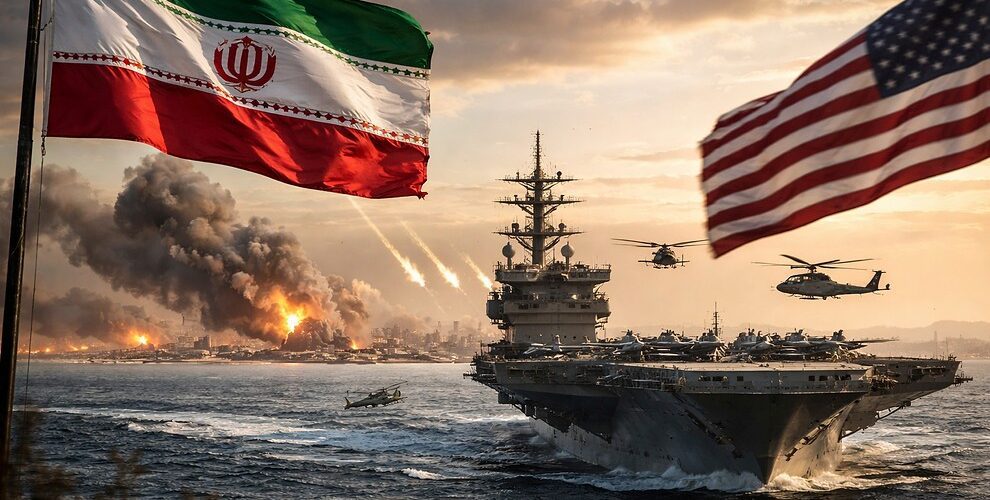
The Pentagon has placed economics and geopolitics on a higher plane than strategy, which implies a perceptible shift from tactical manoeuvring to understanding the geography of power. The foreign policy establishment built by and for the multinational corporations in the Beltway Blob, having an eye on the Middle East oil reserves, holds economic stakes for the military industrial complex, and has always appreciated the importance of the shipping lanes emanating from Iran.
The first one, radiating from Shatt al Arab, across the Straits of Hormuz to Chah Bahar on the Arabian Sea, spanning 1356 nautical miles, the second, the two gas pipelines, one which radiates from the Caspian Sea region to the Mediterranean and another, from Black Sea to the Central Asian Republics. The fact that the Iranian coastline has bays, inlets, coves, and islands which provide excellent hiding places for hundreds of fast-moving mine-laying, suicide/tanker ramming speed boats, is also not something new.
Iran’s tribal Kurds, Azeris, Turks, Turkmen, and other minorities in the North, Pashtuns & Baluchis in the South are linguistically and culturally compatible with the Iranian culture, and the legitimacy of the mullah regime is fully established. The appeal of the Ayatullah to the unemployed legions of Shia youth in ghettos of Beirut, by lanes of refugee habitations in Gaza, southern regions of Iraq, especially Karbala & Najf, is a fact.
The US & Israeli planners have relied heavily on their interpretations of graphics simulation tools, which recommended rapid escalation through precision strikes targeting Iranian leadership to initiate regime collapse, dismantle Iran’s nuclear and ballistic missiles capabilities, destroy Iran's proxies in Gaza, Lebanon, and Syria, and provide deterrence to Israel’s security.
For the US. fears of a rising China, securing 90 % of Iran’s oil exports all paid in Yuan, its impressive strategic development, and the “de-dollarization” and threats to the reserve currency, have always rankled the minds at DC. Understandably, the US went to war to checkmate the Chinese & Iran and not for the opening of the Straits of Hormuz, which followed thereafter, its closure. When nations and their allies go to war, they always select and maintain their common aim before the commencement of the conflict. The Selection & Maintenance of Aim, as Clausewitz’s principle of war, does not appear to be the same, as both the US & Israel are fighting the war with different aims.
After three weeks, it is now amply clear that the US is actually fighting Israel’s war after having achieved its singular aim of effectively denying Iran’s oil supply to China.
Iran is different
With its 93 million population inside mountainous borders the barricade provided by Zagros ranges, Iran is a virtual fortress, makes a direct invasion impossible. Iran has brilliantly consolidated a modern military empire on the bulwark of old military hardware and ageing aircraft inherited from the pre-1979 era. There was a fundamental shift from a conventional powerhouse of sophisticated weaponry of tanks, guns, and aircraft carriers to a more self-reliant master of asymmetric warfare; a highly effective proxy network projecting power well beyond its frontiers, to assist Shias in Iraq, Hamas in Gaza, Hezbollah in Lebanon & Houthis in Yemen.
Full of national pride, the Iranians possess the largest and most diverse missile program in West Asia, swarm drones & speed boats, manned by the highly motivated Islamic Revolutionary Guard Corps (IRGC), which has enhanced their capability to impose high costs of war, through unconventional means, despite four decades plus of sanctions.
Iran’s Mosaic Deployment strategy, in its 31 independent and tactically self-contained district entities, commenced its operations almost immediately following the Supreme Leader’s elimination. First, with horizontal escalation to widen the geographic scope of war, followed by vertical escalation in a graduated response manner. The selection of targets, tactics, and weapons could not have been executed better, given the heavy bombardment they were subjected to.
The decapitation of the Iranian hierarchy, on the contrary, has strengthened the national resolve to defeat the common enemy. The Iranian tactics to force the US to draw out all its expensive interceptors against small, inexpensive drones and short-range missiles appear to have paid off. Iran has conserved its superior hypersonic for longer-range and more lucrative targets.