

The United States’ strategic interest in Greenland can be comprehended on basis it being a “keystone” of Arctic defence. Its strategic importance extends far beyond its size or population. It is essential with regard to it strategic positioning in terms of modern warfare, missile defence, and great-power competition which revolves around detection, proximity, and timing, precisely where Greenland matters most.
Between 2019 and 2026, United States engagement with Greenland has transitioned from episodic strategic interest to a consistent political pressure with significant implications for NATO cohesion, Arctic governance, and transatlantic relations. Even though the US objectives have been perpetually framed in terms of national and allied security especially concerning Russia and China, the methods and rhetoric employed after 2025 generated resistance from Denmark, Greenlandic authorities, and European partners. This period illustrates the tension between strategic imperatives and principles of sovereignty and self-determination.
In order to further analyze the US approach, the method is broken into phases below for comprehension:
Phase I: Disruptive Signalling (2019)
In August 2019, President Donald Trump publicly raised the possibility of U.S. acquisition of Greenland. Although framed informally, the proposal represented a departure from established diplomatic norms. This led to immediate rejection by Denmark and Greenland. This became an international cause of concern regarding respect for sovereignty and highlighting Greenland’s strategic value.
Phase II: Strategic Continuity without Political Escalation (2020–2024)
During this period, U.S.–Greenland engagement remained largely within established defence and diplomatic frameworks. Operations continued at Pituffik Space Base under existing agreements. There were talks of inclusion of Greenland in U.S. Arctic strategy and defence planning. At the time, it was assumed that U.S. strategic objectives could be pursued effectively without challenging existing political arrangements.
Phase III: Renewed Political Pressure and Institutionalization (2025)
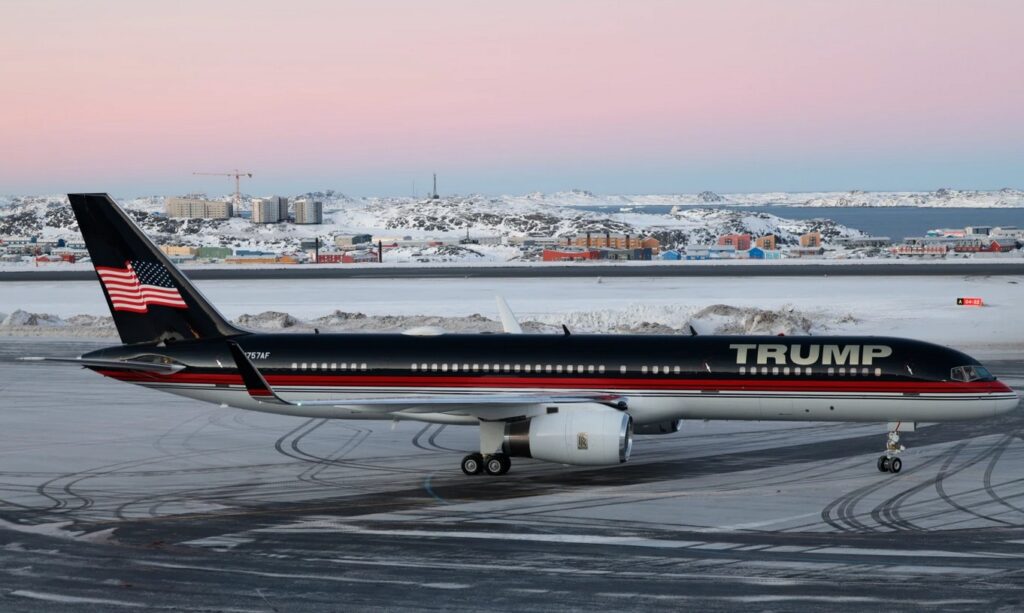
Post the January 2025 inauguration of President Trump’s second term, U.S. engagement with Greenland intensified markedly. There were public assertions that U.S. control of Greenland was imperative for national security.
In December 2025, President Donald Trump appointed Louisiana Governor Jeff Landry as the United States’ special envoy to Greenland. Trump said the envoy would promote US interests regarding Greenland’s strategic importance and “lead the charge” in advancing U.S. national security objectives tied to the Arctic region.
According to Reuters, the position was created by the Trump administration with a mandate tied to strengthening U.S.–Greenland engagement, but the appointment also revived debate about U.S. intentions and respect for Danish sovereignty.
During this phase, the US policy transformed from strategic advocacy to a coercive diplomacy, increasing resistance and diplomatic cost.
Phase IV: Escalation and Allied Pushback (2026)
In early 2026, US rhetoric escalated further, with statements suggesting inevitability of US acquisition of Greenland. Following this rhetoric, Denmark warned of serious consequences for NATO cohesion. The Nordic governments have rejected US claims of external maritime threats while the European leaders ruled out support for unilateral or military action.
Factoring Greenland’s Strategic interest for the US:
Geographic and Geostrategic Importance: Arctic Location
Greenland sits between North America and Europe, in middle of the GIUK Gap (Greenland–Iceland–UK) which is an important maritime and air corridor. This gap has been historically critical for monitoring and maintaining surveillance of Soviet/Russian submarines transiting from the Arctic into the Atlantic. Given this primary reason, US control or influence over Greenland would bolster US capability in protecting Atlantic sea lanes, monitoring transpolar air and missile routes and countering any attacks from northern approaches. Long-range weapons including ICBMs, SLBMs, and hypersonic missiles travel along high-latitude or polar routes. Early detection of these weapons depends on forward-positioned radar and sensor systems capable of monitoring such trajectories. Arctic is no longer treated as a peaceful periphery or a buffer, it’s recognized as a primary axis along which great-power threats would unfold.
Missile Defence and Early Warning
Thule Space Base (now called the Pituffik Space Base).
US has maintained a military presence in Greenland since World War II, marking the Pituffik Space Base in northwest Greenland as an important military instalment. The base plays a crucial role in detecting, tracking and monitoring activities significant to US interest. It is the northernmost Department of Defence base in the world, roughly 750 miles north of the Arctic Circle and less than 1,600 miles from the North Pole.
Its role includes the Ballistic missile early-warning radar, Space surveillance and tracking and also detection of ICBMs potentially launched from Russia over the Arctic. The shortest missile path between Russia and the US is over the North Pole passing over the territories of Greenland. Hence Greenland becomes indispensable for its Strategic warning time, Nuclear deterrence stability and Integration into North American Aerospace Defense Command (NORAD). NORAD is a United States and Canada bi-national organization assigned to missions of aerospace warning and aerospace control for North America.
The logic behind acquiring Greenland remains conducive to Detection first, interception later ideology. Greenland’s location provide the earliest possible detection of polar flight paths.
Additionally, hypersonic weapons traveling at speeds exceeding Mach 5 and manoeuvring unpredictably reduce the warning time and increase the requirement for advanced, forward-positioned sensors. Hence this also becomes an important factor in US interest. Furthermore, the Arctic is essential not simply to missile warning but also for space surveillance. Greenland’s radars help track satellites, debris, and other space objects, feeding into broader defence and deterrence systems. This may provide to be largely useful to US Space Force (USSF) also. It is the newest branch of the U.S. Armed Forces, established in 2019, focused on protecting American interests in space, securing vital space-based infrastructure like GPS and communications, and ensuring military superiority in the space domain.
Thus, Greenland serves a vantage point in the layered architecture which supports missile defence, space monitoring, and early strategic decision-making.
Great-Power Competition (Russia and China)
Russia
Russia has heavily militarized the Arctic, reopening bases, expanding its icebreaker fleet, and deploying advanced weapons systems. It may be deduced that US interest in Greenland is partly about counterbalancing Russian Arctic dominance and maintaining freedom of navigation.
China
China labels itself a “near-Arctic state” and has sought mining investments in Greenland and infrastructure projects (airports, ports). US has strongly opposed Chinese involvement in Greenlandic infrastructure. US concerns stem from the possibility of China exploiting its investments in Greenland as Dual-use facilities, for intelligence gathering and potential strategic leverage.
According to reports, US actions such as opening a consulate in Nuuk (2020) were precisely undertaken to counter the Chinese influence.
Natural Resources and Economic Security
Greenland possesses significant untapped resources such as minerals, rare earth elements such as Uranium, Zinc, iron ore, and gold to name a few.
These resources are strategically valuable for Defence technologies and renewable energy systems. This provides US an opportunity to reduce, if not limit its dependency on Chinese supply chains, especially for rare earths. While the US may or may not seek direct control, it is evident that it tends to take preventive measures against adversarial monopolization and also aid allied access and development under what it may consider as Western norms.
Climate Change and New Sea Routes
Climatic changes has become a catalyst in altering the Arctic. The Ice melt is opening new shipping routes, extracting resources in the area has become viable and military mobilization in the area is giving rise to potential war theatre.
Bearing these potential factors, Greenland becomes crucial for US for monitoring emerging Arctic sea lanes, maintaining operational presence in a newly accessible region and for making sure that Arctic governance remains aligned with US and NATO interests.
NATO and Alliance Considerations
Despite Greenland being positioned geographically in North America, it is politically tied to Denmark, which is a NATO ally. According to analysts, the US interest may seek to strengthen NATO’s northern flank, thus bolstering the transatlantic security integration.
Sovereignty, Autonomy, and Political Sensitivity
Greenland is an autonomous territory within the Kingdom of Denmark which is on a path towards possible independence.
The US action may prove contrary to its efforts if it fails to consider the respect for Greenlandic self-determination and Danish sovereignty. The possibilities of investment and cooperation along with local engagement without Mr Trump’s colonial or coercive optics would possibly yield better results.
Greenland was utilized by US to prevent Nazi Germany from using it. During the Cold War era, Greenland became a focal point to nuclear deterrence and early warning. By the 21st century, the Arctic competition revived US strategic interest.
The 2019 proposal to buy Greenland though widely criticized highlighted how central the island remains to US strategic thinking.
According to AP News, NATO allies, including Italian leadership, have reiterated that a strong collective presence in the Arctic is preferable to unilateral manoeuvring which Trump has been pushing for.
While President Donald Trump’s interest in Greenland has brought renewed attention to the island’s strategic importance in Arctic security and great-power competition, the underlying concerns shared among US allies, the administration’s public acquisition rhetoric and unilateral signalling has shifted from established diplomatic practice and has generated a significant political resistance in Greenland, Denmark, and across Europe. The US action indicates that it has already met core defence objectives, and it attempts to expand influence without local consent imposed diplomatic costs disproportionate to potential gains.
More on Trump’s expansion policies:
Lessons from the Venezuela Takeover: When Laws Are Irrelevant Without Enforcing Mechanism: https://www.thestrategicperspective.org/lessons-from-the-venezuela-takeover-when-laws-are-irrelevant-without-enforcing-mechanism/
US Capture of Nicolas Maduro and Erosion of Sovereignty: https://www.thestrategicperspective.org/us-capture-of-nicolas-maduro/