
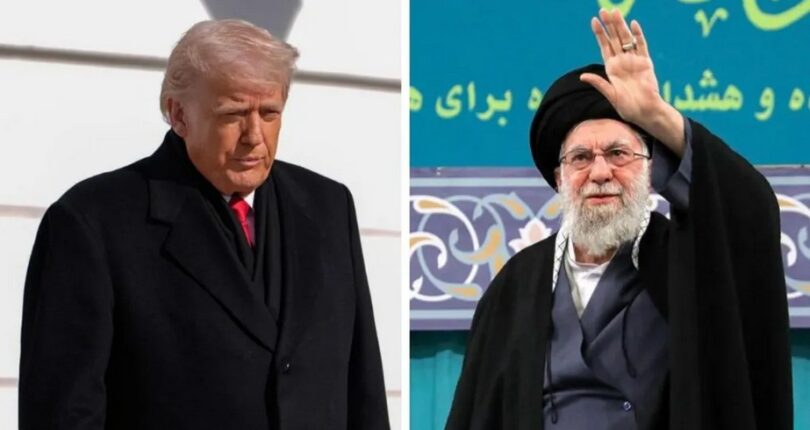

The US Department of War published the updated National Defense Strategy (NDS) on 23 January 2026, where it outlined its main objectives and the key lines of effort in the following years. The document gave light into the reasoning for Operation Absolute Resolve (the US intervention in Venezuela capturing its leader) and pointed out where the next steps will be according to the logic of that strategy. It is in line with the National Security Strategy published in November 2025, which many news outlets labelled as one having a soft approach on China. Many of those analysts, however, might have failed to understand that perhaps the Trump’s administration is acknowledging the dependencies that US has grown to have from China and a deeper approach in countering with the new status quo is needed. Hence, the Venezuela intervention does not look like an ego-boosting act of power projection, but rather as a calculated step towards carving out their own zone of influence and diminishing the ability of the main counterparties (China and Russia in this case, even if the theatre was Venezuela) to project their influence there. This is where Iran stands out.
The Iran Question
US does not want Iran’s leadership to be out, it needs it to function differently. The regime has been there for the last 46 years and realistically the US has always had the capacity to remove it. The big warning signs came when the efforts to enrich uranium became more focused, audits over the nuclear programme were suspended and the chance that Iran, with its rocket technology would have a clear platform for a full functioning nuclear weapon became very high. The strikes on 22 June 2025 on Fordow Uranium Enrichment Plant as part of Operation Midnight Hammer, while portrayed as successful to the general public, left many questions about the complete destruction of the facility. In fact, Israeli intelligence confirmed that the nuclear program had not been destroyed.
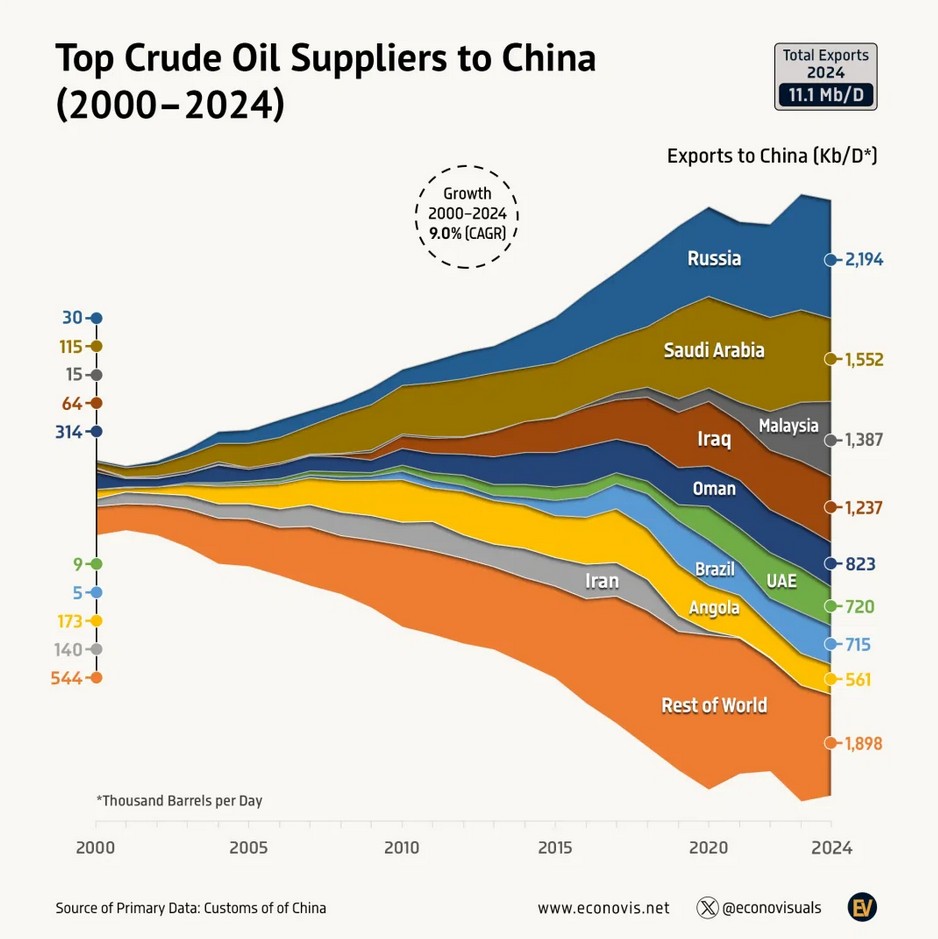
Similarly to Venezuela, Iran has built a strong proximity to China. Officially, oil from Iran accounts for almost nothing, but proxies in Malaysia have been used to avoid sanctions. The oil trade timeline shows the declining imports from Iran to near zero and the growing imports from Malaysia from zero to the third largest supplier. Other reports suggest that Iran’s share is even slightly bigger.
Additionally, the control over the Strait of Hormuz is a strategic chokepoint, which Iran has been threatening to weaponize. The passage, which is between 56 and 96 km wide handles 20% of the world’s LNG and 25% of all seaborne oil trade. As such, it is a major lifeline for the Chinese economy and presents a systemic risk for them, which they have not been able to hedge yet. This is the reason, why Beijing has been courting Iran with the participation in the Belt and Road Initiative, where investments in the magnitude of USD 400 billion were planned – USD 280 billion for oil and gas and USD 120 billion for infrastructure and manufacturing. The sluggish pace, the possible corruption on the ground and so on have led to less than 1% of those funds being utilized, even if the Iran-China comprehensive strategic partnership started in 2021.
US control of the area would also hinder the Chinese influence in the area. This could be another reason why the crown prince in exile, Reza Pahlavi, has been given such vocal support even if he is not the most supported anti-establishment figure among the Iranians. What transpires, however, is yet to be seen.
Likely Scenarios:
Path 1: US directly conducts strikes on 30 Jan 2026 – 1 Feb 2026
- option A: heavy strikes targeting government facilities and those operated by the Islamic Revolutionary Guard Corps (IRGC), involving engagement by both US Air Force and US Navy
- option B: lighter strikes on symbolic spots, which would aim to prove to the regime, that a change in policy is required
Path B: US works in conjunction with Israel, following the success in 2025:
- Push for diplomatic solution on 30 January 2026
- If negative, Israel disarms the majority of the radar systems and anti-aircraft systems deeming the country defenseless
- Possible further push for diplomacy
- If negative, heavy strikes seeking regime change and IRGC destruction
Recent developments around Iran
The first big warning sign was the deployment of the Abraham Lincoln Carrier Strike Group [which included the USS Spruance (DDG-111), USS Michael Murphy (DDG-112), and USS Frank E. Petersen Jr. (DDG-121)] from South China Sea to the Middle East last week and its recent arrival in the region. Additionally, several other Arleigh Burke-class guided-missile destroyers have also arrived in the region, including the USS Delbert D. Black (DDG-119), which recently crossed the Suez Canal into the Red Sea.
There have been increasing number of reports over the last week of relatives to IRGC personnel, who are trying to find ways out of Iran, some carrying briefcases with cash for their new lives.
On 14 January 2026 in a call to Trump, Netanyahu urged him to delay attacks in order to secure the defense of Israel and allow for a bigger buildup of American assets in the region.
On 27 January 2026 IDF intelligence chief Maj. Gen. Shlomi Binder and Mossad director David Barnea visited the US on how Iran should be approached.
On 29 January 2026
- Donald Trump mentions: “We have a lot of very big, very powerful ships sailing to Iran right now – and it would be great if we didn’t use them.”
.@POTUS on Iran: "We have a lot of very big, very powerful ships sailing to Iran right now — and it would be great if we didn't have to use them." pic.twitter.com/hh9r4kpcrT
— Rapid Response 47 (@RapidResponse47) January 30, 2026
- the European Union officially designated IRGC as an International Terrorist Organization
- aside from the Israelis, the Saudi intelligence chiefs have also arrived in Washington but looking for a diplomatic solution. Defense Minister Prince Khalid bin Salman is expected to hold meetings focusing on Iran. Prince Khalid, the crown prince's younger brother and closest confidant, is expected to be in Washington on 29-30 January.
- a plane usually reserved for senior members of the Iranian government departed towards Moscow. If it is not the ayatollahs, it is senior diplomats seeking support. If Moscow is silent, then agreement with Washington must had been made.
An Airbus A321-231 operated by Meraj Airlines and going by the callsign IRAN07, usually reserved for senior members of the Iranian Government, has departed Tehran within the last hour bound for Moscow, Russia. pic.twitter.com/mg4iEW8eTW
— OSINTdefender (@sentdefender) January 29, 2026
- four KC-46A Pegasus tankers, six EA-18G Growler EW aircraft, six F-35A fighter jets, nine C-17 Globemaster III transport planes, one MC-130J Commando II SOCOM, two HC-130J Combat King II (CSAR), one WC-135R Constant Phoenix (nuke sniffer), two E-11A BACN Battlefield Airborne Communications Node) and Several C-5 giant transport planes – all high capability military aircrafts have all been flowing from the US across the Atlantic from early morning 29 January 2026. The MC-130J Commando II mentioned above is a specialized multimission combat transport and aerial refueling tanker operated exclusively by the United States Air Force Special Operations Command (AFSOC), developed for infiltration and exfiltration operations. It’s a highly modified variant of the Lockheed Martin C-130J Super Hercules turboprop aircraft, purpose-built for clandestine special operations (SOF) in politically sensitive, hostile, or denied territories. Currently landed in Azerbaijan.
- First Vice President of Iran, Mohammad Reza Aref indicated that they are ready to enter into negotiations only if there are guarantees that they would not be attacked during the diplomatic process.
- Iran declares they have complete control over the Strait of Hormuz. Senior army official declares they had been instructed to target US assets in the Middle East automatically after US attack.
- The mayor of Teheran has issued order to convert metro stations and parking garages into war shelters.
- France, the UK, Israel and the US have coordinated efforts to clear out a strategy for targets to be taken out.
The Venezuela scenario
Was it the oil?
When the US launched Operation Absolute Resolve nearly all analysts came up with boasting numbers that Venezuela has the largest proven oil reserves and that must have been the reason for ousting Maduro and possibly installing its own favorable government. Interesting enough, even the direct statements by the US Secretary of State Marco Rubio, that the US does not need the Venezuelan oil per se, were insufficient in breaking this narrative.
Marco Rubio makes the exact same point on Venezuela that Russia did wrt Ukraine: “we’re not going to allow Venezuelan oil to be controlled by adversaries of the US, why do China, Russia & Iran need their oil. This is the western hemisphere and we’re not going to allow it to be… pic.twitter.com/gqmJegdHfH
— Abhijit Iyer-Mitra (@Iyervval) January 5, 2026
General news media, in pursuit of sensationalism, favored analysis by news anchors and even comedians, over experienced energy experts. Any deeper dig into the matter shows that while Venezuela does in fact have the largest proven oil reserves, getting the benefits of it would be a different story.
Earth extracted oils have API (American Petroleum Institute) gravity rating, which is a standard, inverse measure of petroleum liquid’s density relative to water, expressed in degrees. The formula is that API = (141.5 / (Specific Gravity at 60F)) – 131.5. As such, light oils are above 31.1 API, Medium oils are between 22.3 and 31.1 API, Heavy oils are between 10 and 22.3 API and Extra heavy (Bitumen) are less than 10 API. API gravity is essential for oil pricing and transportation. Light crudes flow easily, yield more gasoline and distillates, and clear global refineries with minimal processing, hence their higher prices. Heavy crudes, on the other hand, require dilution, complex upgrading, high capex (large investments to be able to process such crudes) and specific refinery compatibility (few of the existing refineries are able to process such crudes). Considering all this, even if Venezuelan oil is taken at a severe discount, the required oil price on the international markets, which make production economically feasible must be exceeding $60 per barrel.
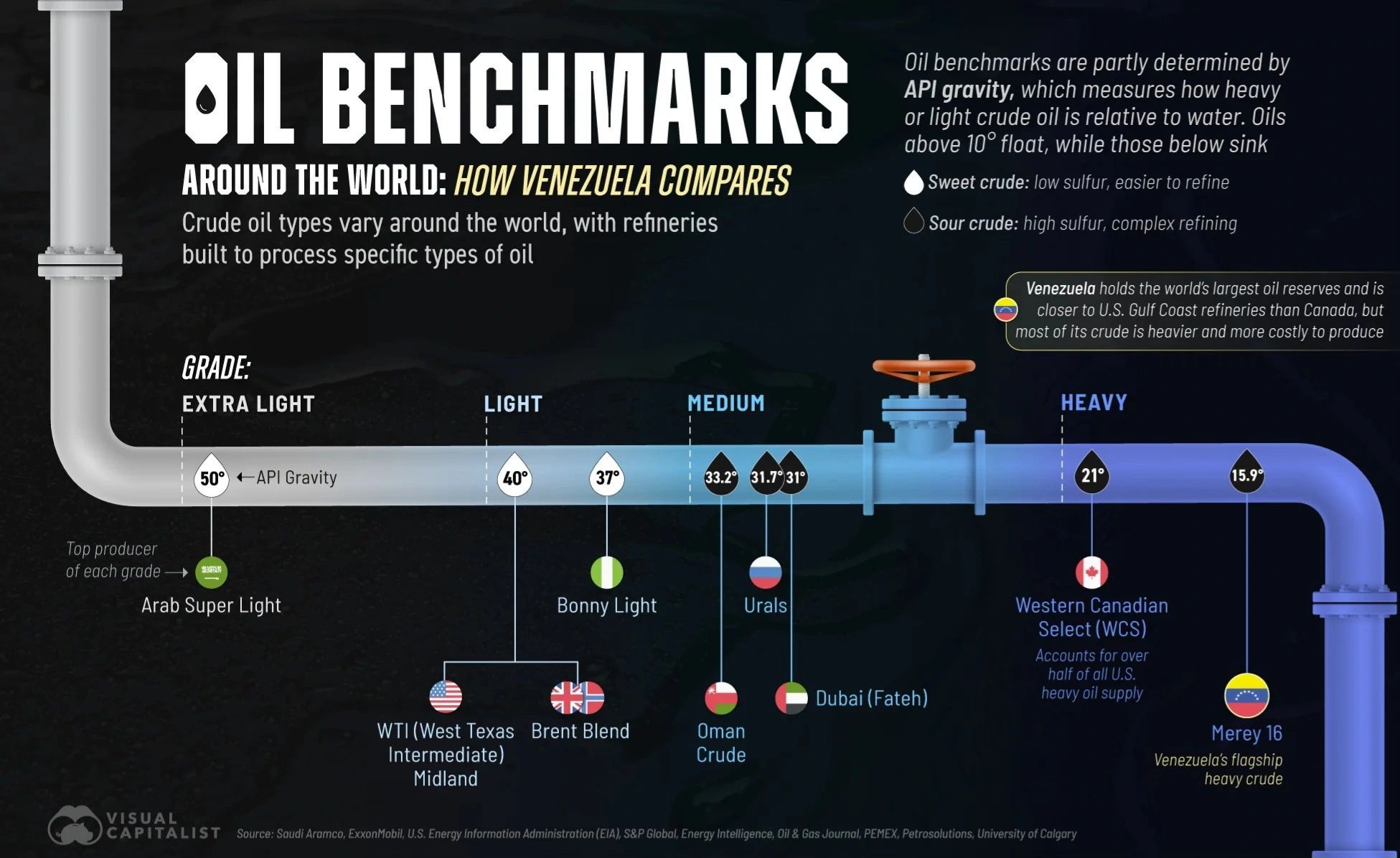
It is the constraints, not the availability, which lead to the pricing. Existing oil infrastructure in Venezuela is in shambles after more than a decade of neglect and limitations. Increase of production to previous levels (3x existing production) would take years, if not more than a decade and would require massive investments. After all this, the extracted oil will still be priced at a discount factoring in the required dilutants and process upgrades.
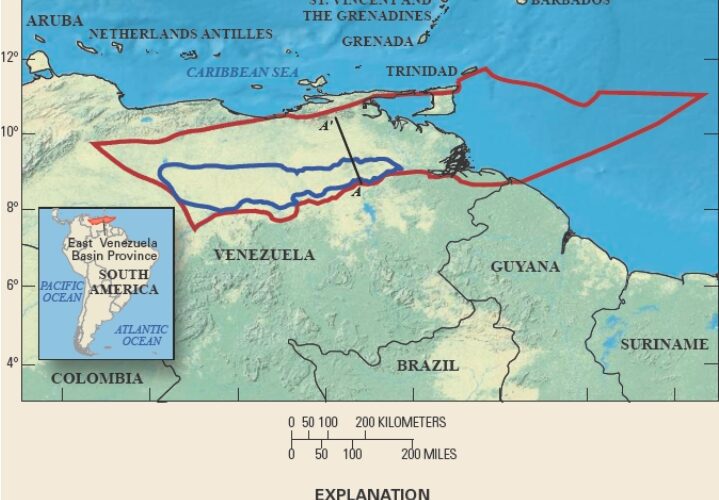
Additionally, let’s not forget that that the famous Orinoco Belt is in hard to access and hard to operate environment – some of the thickest jungles on earth. While this is a factor for the high costs mentioned above, it is also a factor for an increased risk of sabotage, should the political control of Venezuela slips out of US control. The decades of asymmetric warfare in Colombia, where large swaths of the country were de facto out of government control, show the difficulties in controlling such landscapes. Not surprisingly, calculating the large CAPEX required, the decades of planning and the possible upkeep, the major oil companies were not eager to propose their involvement.
The Chinese proximity
It was the increasing Chinese footprint in Venezuela in relation to the updated Monroe Doctrine (labelled the Trump Corollary), which was the motivating factor behind Operation Absolute Resolve. The Venezuelan oil, if included the proxies like Brazil and Malaysia, which help bypass sanctions, would amass to 4-4.5% of all Chinese oil imports and in a case of disruption, such supplies could be compensated from countries like Canada, Iran and Iraq. But Chinese companies had massive presence in multiple critical infrastructure sectors, which include irrigation, power generation and transmission, ports and water. Huawei and ZTE were instrumental in building and upgrading Venezuelan telecom infrastructure. ZTE further developed the “Fatherland Card” system, which is used to track voting patterns, ration food and supplies and monitor social media accounts. Additionally, the China National Electronic Import and Export Corporation (CEIEC) created a version of China’s “Great Firewall”. Clearly, the control over the population would only become greater with time.
From the point of view of military cooperation, Venezuela has been the largest buyer of Chinese weapons in South America. They also constructed two satellite ground stations in the country – the El Sombrero Satellite Ground Station (in Captain Manuel Rios Aerospace Base) and the Luepa Satellite Control Ground Station. They both handle telemetry, tracking and command of Venezuelan civilian satellite. However, reports surfaced, including from Chinese sources, that Beijing is able to remotely access these facilities, which could be a factor in the resilience of the system in a hypothetical conflict. The remote access possibilities have been an ongoing problem for Huawei and every PLA linked telecom equipment producer.
Clearly, creating a place with such strong PLA influence in the US backyard creates much greater problems for Washington than the benefits of possible oil and mineral extraction years ahead.
https://media.defense.gov/2026/Jan/23/2003864773/-1/-1/0/2026-NATIONAL-DEFENSE-STRATEGY.PDF
https://www.whitehouse.gov/wp-content/uploads/2025/12/2025-National-Security-Strategy.pdf
https://www.washingtonpost.com/world/interactive/2023/china-space-program-south-america-defense/
https://www.uscc.gov/research/china-venezuela-fact-sheet-short-primer-relationship
https://www.ft.com/content/f64826fa-5c36-4fb3-8621-ee0b9d9a1ff5;
https://www.reuters.com/business/energy/chinas-oil-investments-venezuela-2026-01-05.





Widely researched and well brought out, it also indicates that much of Trump’s claims may be blister. It should be recalled how US sent it’s 7th Fleet into Indian waters but did not try to do anything further, while India did whatever it felt was necessary to deal with Pakistan which resulted in the it’s loss of East Pakistan which became Bangladesh