
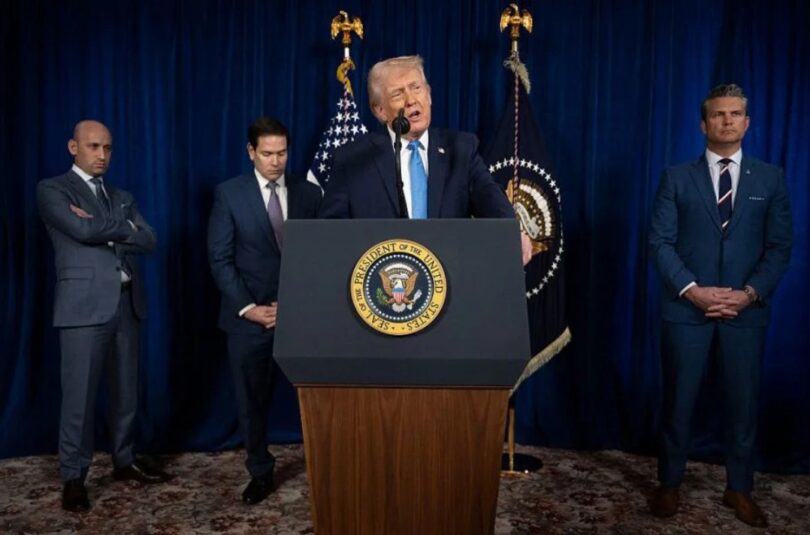

The Donroe Doctrine is regarded as or referred to as the “Trump Corollary to the Monroe Doctrine”. It is a contemporary geopolitical concept which is often used to characterize the foreign policy structure affiliated with the second administration of the U.S. President Donald Trump beginning in 2025. The word Donroe is a portmanteau incorporating the name of President Trump and the Monroe Doctrine (1823).
The doctrine elucidates a contemporary strategy through which the United States is looking to reinforce its dominance across the Western Hemisphere while countering the growing influence of notably China and Russia. It can be inferred that the objective of the Donroe Doctrine is to build upon the principles of the Monroe Doctrine (1823) and the Roosevelt Corollary (1904). The Doctrine focuses on hemispheric security, economic control of strategic infrastructure, and aggressive action against criminal networks and hostile governments.
Since the 1800s, the U.S. has invaribly intended to influence the political and strategic landscape of the Western Hemisphere. This was evident when in 1823, President James Monroe announced to the U.S. Congress the official formulation of the Monroe Doctrine. The doctrine emphasized on the American rejection of European colonization and cautioned foreign powers against interfering in the affairs of the region. Since then, the principle grew into a broader assertion of American leadership throughout the hemisphere.
In recent times, renewed global competition has reignited across the Americas, driven by China’s expanding economic influence and Russia’s intensifying diplomatic and military engagement. This transition has promulgated the U.S. to fortify its influence in the Western Hemisphere.
Gaining prominence at the start of the second Trump presidency in January 2025, his administration was swift to point the analogy of “Trump Corollary” to the 19th-century Monroe Doctrine. The initiative which they indicated was aimed on consolidating regional leadership and stability.
Historical Foundations
The Monroe Doctrine (1823)
On December 2, 1823, President James Monroe addressed the United States Congress and announced the Monroe Doctrine.
The doctrine emphasizes on two core principles:
- Rejection of European powers from establishing new colonies in the Americas.
- The Western Hemisphere was to be considered a distinct and independent political arena separate from European power struggles, as Monroe stated:
“The American continents… are henceforth not to be considered as subjects for future colonization by any European powers.”- President James Monroe
The Roosevelt Corollary (1904)
In 1904, President Theodore Roosevelt further developed the Monroe Doctrine through what became known as the Roosevelt Corollary.
The corollary emphasized that the United States had the right to intervene in Latin American countries to maintain stability and protect U.S. interests.
Roosevelt explained this policy in his annual message to Congress by stating “Chronic wrongdoing… may require intervention by some civilized nation, and in the Western Hemisphere the adherence of the United States to the Monroe Doctrine may force the United States… to the exercise of an international police power.”
This shift clearly transformed the doctrine from a defensive policy into one that justified American intervention.
Emergence of the Donroe Doctrine
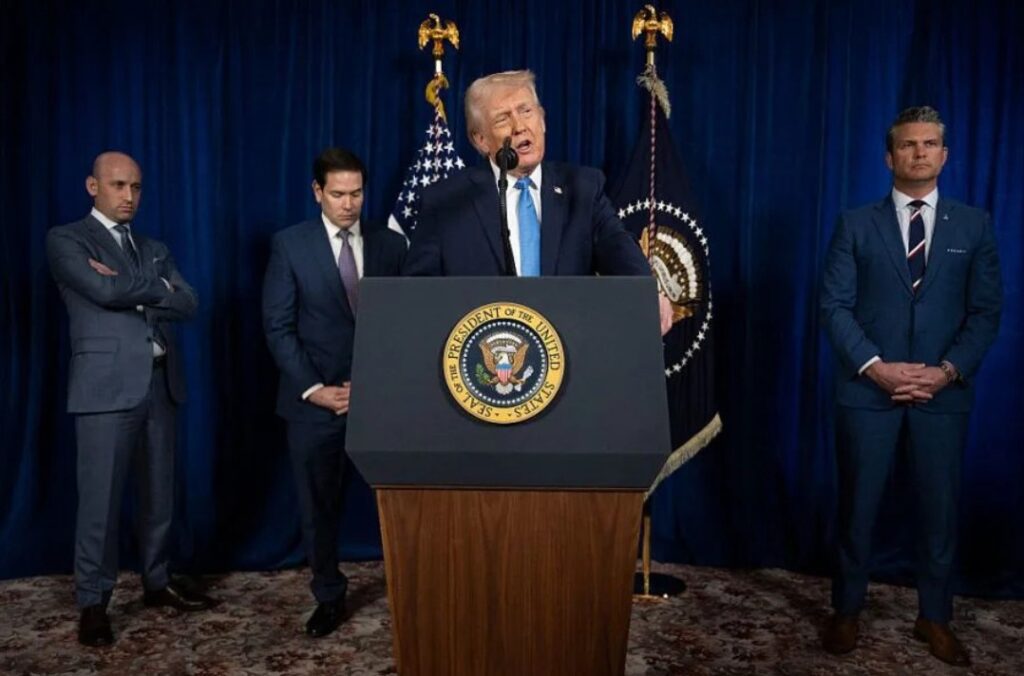
in January 2025 soon after Donald Trump began his second presidential term, which became popularised with regards to his foreign policy strategy in the Americas.
Strategic Context (2025–Present)
By 2025, on basis of the recent geopolitical developments, the anticipated competition in Latin America intensified. According to analysts, China’s investment in infrastructure projects, including ports and telecommunications and the Russian diplomatic and military cooperation with certain regional governments were the primary factors. While others also highlighted, the rise in drug trafficking and transnational criminal organizations prompted the Trump administration to stress on building a stronger regional leadership by the United States.
In the National Security Strategy released in November 2025, the U.S. administration argued that the United States must “reassert the Monroe Doctrine and ensure that hostile powers do not establish strategic footholds in the Western Hemisphere.”
Although not codified in a single legal document, the Donroe doctrine reflects several policy themes such as hemispheric dominance, limiting external powers in the region, enforcement of U.S. military and security while maintaining access to important regional assets.
In regards to the hemispheric dominance, the doctrine views the United States as the dominant political, economic, and military power in the Western Hemisphere. It elucidates the implications on the U.S. owing to the instability in neighbouring nations. Hence justifying, Washington’s intention to maintain strong influence over regional governments and institutions.
Another crucial aspect of the doctrine is to counter the growing presence of rival powers in the Americas such as Russia and Republic of China.
U.S. officials argue that foreign control of infrastructure such as ports, energy systems, and telecommunication could create potential strategic vulnerabilities. This is factored into the doctrine which clearly encourages economic and diplomatic pressure to limit such involvement in the surrounding nations.
Another major factor is a stronger security approach toward transnational crime. According to the U.S., drug cartels and organized criminal groups are on the rise posing a threat to its national security. This perspective is presented as the justified reasoning for the use and deployment of military resources in operations against criminal organizations operating across borders.
The Donroe Doctrine has also emphasized on maintaining access to important regional assets which includes key shipping routes, canal systems, rare mineral deposits, energy infrastructures and assets which U.S. deems essential for economic security and global trade.
Under this Policy implementation, the Venezuela Operation (2026) was validated.
In January 2026, U.S. forces conducted an operation targeting Venezuelan leadership. As a result of the operation the Venezuelan president Nicolás Maduro was captured. The action was warranted by U.S. officials as a response to alleged narcotics trafficking and threats to regional stability. Post the operation, President Trump stated “The Monroe Doctrine is a big deal… but we’ve superseded it by a lot. They now call it the ‘Donroe Doctrine.’ American dominance in the Western Hemisphere will never be questioned again.”
Under this doctrine, United States has also increased naval patrols and anti-smuggling operations in Caribbean waters.
Another implementation strategy involves diplomatic and economic pressure on governments perceived as hostile or unstable by the U.S.
This can be ascertained by the U.S. sanctions against certain political leaders, followed by an increase in support for pro-U.S. administrations and also the provision of trade incentives for cooperative governments by U.S.
Through these measures, the U.S. is seeking to shape political outcomes in the region.
However, such strategic thinking seems contrary to what it states, especially in regards to Iran, a key actor in the Middle East whose policies often conflict with U.S. objectives. Even though Iran is not in the Western Hemisphere, American policymakers and commentators occasionally frame U.S. actions toward Iran within a broader doctrine of strategic containment of rival powers.
The question whether the “Donroe Doctrine” intersects with U.S. policy toward Iran, has invited major criticisms from several analysts and policymakers.
Since the Iranian Revolution, the relations between the United States and Iran have remained tense. American policymakers often describe Iran as a state whose regional influence through its alliances, military activity, and nuclear aspirations threaten U.S. allies and its interests.
It is apparent that Iran’s strengthened diplomatic and economic ties with both Russia and China have been a concern for the U.S. For many U.S. strategists, this alignment raises concerns that Iran could become part of a broader geopolitical bloc opposing American influence.
Within this context, some commentators argue that the logic associated with the “Donroe Doctrine“ of maintaining U.S. strategic dominance and limiting rival power expansion is appropriate and justified with regards to American policies toward Iran.
One of the instruments utilized by the U.S. against Iran has been extensive economic sanctions which targeted Iran’s banking sector, oil exports, and financial transactions. Washington has consistently maintained that such measures are intended to pressure Iran to curbing its nuclear program and reduce its support for regional militant groups. However, it may be also be attributed heavily to the Chinese and Russian influence. The sanctions had notably intensified since the U.S. withdrawal from the Joint Comprehensive Plan of Action in 2018 under President Donald Trump. The administration introduced a “maximum pressure” campaign designed to limit Iran’s economic capacity and regional influence.
The United States maintains a significant military presence across the Middle East, including naval forces in the Persian Gulf and military bases in allied states.
Another approach employed by the U.S. was to strategically isolate Iran diplomatically through international coalitions. U.S. administrations have persistently worked with European and Middle Eastern partners to limit Iran’s influence in regional conflicts, including in Syria and Yemen.
Overextension of a Regional Doctrine
One criticism is that applying the logic of the Monroe Doctrine outside the Western Hemisphere stretches the original concept too far. Critics argue that the doctrine historically focused on the Americas and should not be interpreted as a justification for global intervention. This was foreseen as a method to legitimize excessive military or political involvement in distant regions as seen in Venezuela, Syria and Iran.
This aggressive containment policies toward Iran has attributed to an increased global instability. Critics argue that economic pressure and military confrontation had only escalated tensions resulted in the armed conflict.
The unilateral sanctions and interventions by U.S have undermined international legal norms. Critics say that global security challenges require multilateral diplomacy rather than strategies centred on maintaining dominance.
Conclusion
In discussions about Iran, analysts sometimes interpret U.S. policies such as sanctions, military deterrence, and diplomatic pressure—as part of a larger effort to maintain geopolitical influence and limit the expansion of rival powers.
At the same time, these strategies remain controversial. Critics question whether extending the logic of the Monroe Doctrine beyond the Western Hemisphere is historically justified or strategically wise.
More on related topics:
US National Defense Strategy and Iran: https://www.thestrategicperspective.org/us-national-defense-strategy-and-iran/
PRAHAAR — India’s First National Counter-Terrorism Policy: https://www.thestrategicperspective.org/prahaar-indias-first-national-counter-terrorism-policy/
Lessons from the Venezuela Takeover: When Laws Are Irrelevant Without Enforcing Mechanism: https://www.thestrategicperspective.org/lessons-from-the-venezuela-takeover-when-laws-are-irrelevant-without-enforcing-mechanism/
US – Greenland Strategy Under Trump: https://www.thestrategicperspective.org/us-greenland-strategy-under-trump/
US Capture of Nicolas Maduro and Erosion of Sovereignty: https://www.thestrategicperspective.org/us-capture-of-nicolas-maduro/