

Executive Summary
Pakistan has transcended into being increasingly viewed as a core hub for jihadist interactions, where international and regional terrorist organizations have converged. Several Reports of a growing nexus between Palestinian terror outfit, Hamas and Pakistan-based groups such as Lashkar‑e‑Taiba (LeT) and Jaish‑e‑Mohammed (JeM) have emerged.
Public meetings, invites and visits by Hamas representatives to Pakistan and PoJK, and joint events with Pakistani Islamist leaders indicate that the groups not only share ideological solidarity but also seek potential operational collaboration. These developments are proving to be a potential threat for South Asian neighbourhood in regards to regional stability, and global counterterrorism efforts.
Hamas in Pakistan: Public Meetings Signal Increasing Linkages
High-profile Conferences
In February 2025, the “Kashmir Solidarity & Hamas Operation ‘Al Aqsa Flood’ Conference” in Rawalakot, Pakistan-occupied Kashmir (PoK) was reported as the first known public engagement of a Hamas official with Pakistani jihadists. The attendees included JeM leaders (including Talha Saif), Senior LeT commanders, Dr. Khalid Al‑Qadoumi (Hamas representative based in Iran). The event was specifically based on the shared ideological narrative to showcase commonality in regards to Palestinian and Kashmiri narrative projected by the groups. This also marked the potential groundwork for tactical exchanges amongst the attending outfits/groups.
Follow-up Engagements
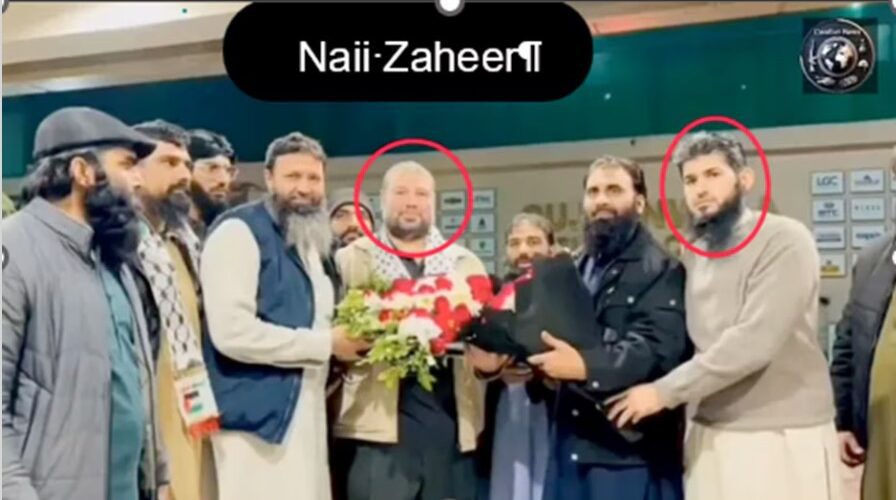
Hamas operatives such as Naji Zaheer, were also reported in multiple encounters with LeT leadership in Gujranwala and other Pakistani cities. It is to be noted that these meetings coincided with rallies and events hosted by Islamist political parties such as the PMML. (www.satp.org , www.ndtv.com)
Observation: Hamas representation in Pakistan indicates an intentional, ongoing engagement strategy which is not random or sporadic.
Ideological and Operational Convergence
Shared Narratives: Pakistan-based jihadist groups frame Kashmir as a broader Islamic cause, while Hamas brings its expertise from Gaza operations.
Operational Insights: Several similarities can be noted in the tactics employed by the Pakistan based terror outfits and Hamas. This was seen in attacks in Pahalgam, Kashmir (April 2025).
Pakistani Support Structures: Outfits like LeT and JeM have historically operated with tacit understanding and support from Pakistani security agencies, providing space for training, recruitment, and logistical planning. This has been more pronounced since the Pahalgam terror attack.
Timeline: Key Events in Hamas–Pakistan Terror Convergence (2024–2026)
Feb 2025, Kashmir Solidarity & Hamas Operation “Al Aqsa Flood” Conference
Attendees: JeM leaders (Talha Saif), LeT commanders, Hamas rep Dr. Khalid Al‑Qadoumi
Location: Rawalakot, PoJK
Significance: First public meeting linking Hamas and Pakistani jihadists
Mar–Apr 2025, Follow-up coordination meetings
Attendees: Naji Zaheer (Hamas), LeT leadership
Location: Gujranwala, Pakistan
Significance: This confirmed the repeated engagements.
Apr 2025, Pahalgam terror attack
Involvement: Local JeM/LeT cells, Hamas-inspired tactics
Location: Pahalgam, J&K, India
*Evidence of operational cross-pollination
Jul 2025, PMML political-social meet
Attendees: Naji Zaheer, LeT figures
Location: Karachi & Islamabad
Significance: Hamas presence alongside Islamist politicians ascertained.
Oct 2025, Hamas visit to PoJK & local groups
Attendees: Dr. Khalid Al‑Qadoumi, JeM & LeT leaders
Location: PoJK
Significance: strengthening networking and strategic linkages.
Nov–Dec 2025,Security briefings & media reporting
Analysts & security agencies have acknowledged Hamas–LeT–JeM nexus as emerging threat.
Jan 2026
Reports from several think tanks and analysts emerge labelling Pakistan as potential “jihad hub” bridging Middle East and South Asia
- Country-wise Counterterrorism Responses
India
Intensified surveillance of PoJK and Kashmir, Intelligence monitoring, counter-radicalization programs, financial tracking, targeted operations
Pakistan
Official denials; domestic anti-terror operations, Military campaigns against TTP and domestic threats; denies harbouring LeT/JeM/Hamas
United States
Diplomatic and intelligence pressure, listed LeT & JeM as FTOs; monitors Hamas funding and networks; collaborates with India
Israel
Strategic intelligence and advocacy, tracks Hamas international outreach; liaises with India & US; warns of operational cross-pollination
UN / International agencies
Sanctions and reporting, observes proscribed groups, issues alerts on terrorist financing, recruitment, and cross-border operations
Analysis:
While nations actively monitor and respond, Pakistan’s dual approach and duplicity in domestic counterterrorism vs external tolerance facilitates network persistence. Other key players such as Turkey and Turkish funds to Pakistan in official capacity should be subjected to monitoring. Several reports of Turkish intelligence agencies (like MIT) training Pakistani militants, hosting militant training camps for Pakistan’s proxies against India are emerging in the security circles.
It is imperative to also highlight the Hamas–Hizbul Mujahideen–Harkat Axis in terms of ideological alignment, tactical inspiration, and facilitation networks to indicate the expanding Islamist jihadist convergence with implications for Kashmir and regional security.
Recent intelligence assessments and open-source reporting point to a growing convergence between Hamas, Hizbul Mujahideen (HM), and Harkat-ul-Ansar/HuJI, referred to as the HHH axis. While direct operational control by Hamas over Kashmir-focused groups has not been conclusively established, ideological synchronization, tactical emulation, propaganda alignment, and facilitation via Pakistan-based networks are increasingly confirmed.
This convergence reflects a broader trend that Palestinian jihadist narratives and urban warfare tactics are being utilized into South Asian militant ecosystems, particularly those targeting India.
It has been established that Hamas operatives do not need physical presence in Kashmir for influence to spread narrative. The strategy employed focuses on “inspiration + facilitation,” model which does not require deployment.
Pakistan, however, remains the regional and logistical enabler of this Islamist convergence. HM and HuJI continue to operate through PoJK and mainland Pakistan.
Pakistan has denied its support in official capacity, but its actions reflect selective enforcement/security actions in certain areas where the terror groups remain operational. Thus, creating a political space for narratives against India
Hybridization of Militancy is also evident as Kashmir militancy has transcended from local insurgency to globally inspired jihad. Other reports of Palestine narratives used to radicalize Indian youth online has also surfaced.
India must focus on counter terrorism as well as counter convergence where it is viable to disrupt the flow of ideas, tactics, and legitimacy across jihadist theatres.
References
MEMRI: Pakistan Jihad Hub – Hamas–LeT–JeM Meetings
SATP: Terror Leaders Event in PoK
NDTV: Hamas Leaders Meet in Pakistan
Times of India: Hamas and Kashmir
Wikipedia: Pakistan and State-Sponsored Terrorism
Brighter Kashmir: Hamas–Pakistan Nexus