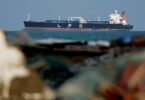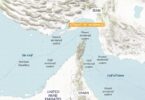

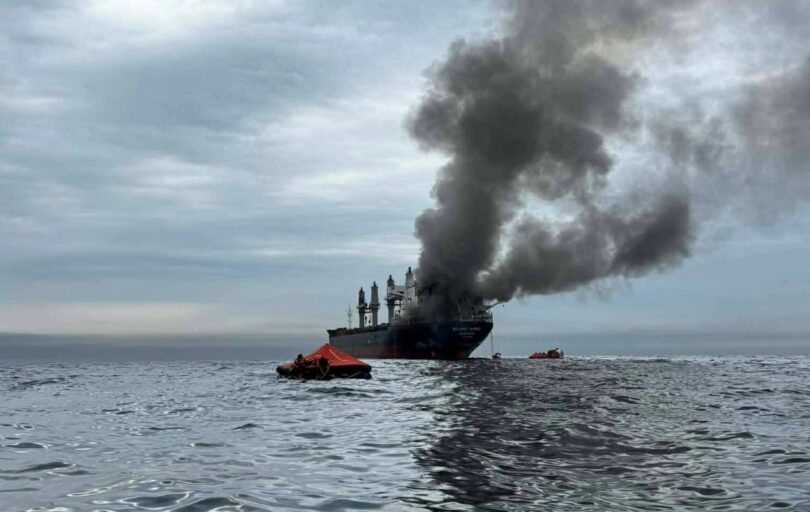

The bulk carrier MV Mayuree Naree, owned by Precious Shipping Public Company Limited, was sailing from Khalifa Port in the United Arab Emirates toward Kandla Port in India when it was attacked by projectiles while transiting the strategic Strait of Hormuz on 11 March 2026.
According to reports, twenty of the vessel’s 23 crew members were rescued following the attack, while three sailors remain unaccounted for. The incident is the latest development in the intensified maritime security crisis in the Gulf, a corridor responsible for transporting roughly one-fifth of the world’s oil supply.
The Attack at Sea
According to the Royal Thai Navy, the vessel came under attack shortly after leaving Emirati waters. Initial reports suggest that at least two projectiles struck the ship near its stern, igniting a fire in the engine room.
The crew swiftly issued distress calls before abandoning ship as flames engulfed the lower sections of the vessel.
Rescue efforts were carried out by the Royal Navy of Oman, which responded to the emergency and recovered 20 sailors from lifeboats drifting in nearby waters. The survivors were transported safely to the Omani coast.
The three missing crew members were believed to have been working in the engine compartment at the time of the strike.
According to the Maritime authorities search operations continued overnight amid difficult conditions and heightened military tensions in the region.
Iran Claims Responsibility
The Islamic Revolutionary Guard Corps (IRGC) has claimed responsibility for the attack, stating the vessel had failed to heed security warnings related to restricted maritime zones.
Iranian officials have emphasized that ships transiting the strait at the time of the current crisis must comply with instructions issued by Iranian naval authorities.
Tehran has issued repeated warnings to vessels entering the waterway without coordination risk stating that they would be targeted as precautionary defensive measures conducted by Iran at the time of heightened regional conflict.
Iran has clearly claimed the responsibility of the attack indicating Iran’s determination towards a direct action against a commercial vessel during the current tensions.
Thailand Responds
Thailand has confirmed the attack and coordinated rescue operations. The Royal Thai Navy has stated that the Thai government was working closely with international partners to ensure the safety of the surviving crew members and locate the missing sailors.
Thailand’s Ministry of Transport said the vessel’s owner, Precious Shipping, had established contact with the rescued crew and was cooperating with authorities to determine the extent of damage to the ship.
The Thai government also called for restraint in the region and stressed the importance of protecting commercial shipping routes.
India Condemns the Strike
The attack has drawn a sharp response from India, as the vessel was bound for one of its major ports in Gujarat. India’s Ministry of External Affairs has condemned the targeting of commercial shipping and called for greater protection of international trade routes.
Kandla Port, located in the western Indian state of Gujarat, is one of India’s busiest cargo terminals and handles large volumes of bulk commodities transported across the Arabian Sea.
Joint Secretary for the Ministry of Petroleum and Natural Gas Sujata Sharma has also stated that India’s crude supply is secure and about 70 percent of the country’s crude import is now coming from outside the Strait of Hormuz.
At the Inter-Ministerial briefing on recent developments in West Asia in New Delhi, she further added that the volume of crude oil secured by government exceeds what normally would have arrived through Strait of Hormuz. She indicated that India now imports crude oil from 40 countries and oil marketing companies.
Spokesperson of the External Affairs Ministry Randhir Jaiswal stated that the government remains committed to the welfare of Indian nationals who reside in GCC and West Asian countries. Mr Jaiswal also confirmed the deaths of two Indian nationals while one person remains missing.
Rajesh Kumar Sinha, Special Secretary in Ministry of Ports, Shipping and Waterways stated that currently 28 Indian flag vessels, having 778 Indian Seafarers are operating in Persian Gulf. He added that the Indian government is monitoring all these vessels and crew to ensure safety and security. Authorities, Ship Managers and Recruitment Agencies are also closely working with Indian embassies and local authorities in these regards. He suggested that overall port operations across India remain stable.
In the aftermath of the attack on the Thai-flagged vessel in the Strait of Hormuz, reports have confirmed the Indian Navy has been extremely active in responding to distress calls in the region, with External Affairs Minister S. Jaishankar emphasizing a "Humanity First" approach under maritime law.
[Update] 20 crew rescued after Thai-flagged vessel attacked near Strait of Hormuz
— Thai Enquirer (@ThaiEnquirer) March 11, 2026
Twenty crew members have been rescued after a Thai-flagged cargo vessel was fired upon near the Strait of Hormuz, while three others remain on board as authorities assess the situation, Thai naval… pic.twitter.com/FLfy2J6P78
The UAE and Regional Concerns
Authorities in the United Arab Emirates have stated that they were closely monitoring the situation and coordinating with maritime security partners. UAE has invested heavily in maritime safety and logistics infrastructure, and disruptions in nearby shipping lanes could have significant economic impact for the region’s trade network.
There are no damages reported as of yet within Emirati waters but there is an increase in surveillance with regards to vessels departing Gulf ports.
Oman’s Role in the Rescue
The Royal Navy of Oman deployed vessels to the area where the Thai vessel was attacked, soon after receiving distress signals and were successful at rescuing the majority of the crew.
Oman has not commented on the attack itself but have confirmed that rescued sailors were provided medical care and temporary accommodation.
A Strategic Chokepoint Under Pressure
The Strait of Hormuz being one of the vital maritime chokepoints in the world with roughly of 20 percent of global petroleum consumption passes through its waters each day, links oil producers in the Persian Gulf with markets in Asia, Europe, and beyond. Hence the recent developments have exposed the vulnerabilities in commercial shipping. Even limited disruptions in the strait can cause global shipping insurance rates to spike and push oil prices higher.
Over the past weeks, several commercial vessels have reported drone sightings, missile launches, and attempted boardings in waters surrounding the strait. Iran has also threatened to restrict passage through the corridor if its security demands are not met.
Western governments and regional partners have increased naval patrols in response, but the vast volume of maritime traffic makes comprehensive protection difficult.
Insurance premiums for vessels traveling through the Strait of Hormuz have already begun to rise, and some shipping operators are reportedly reconsidering routes.
More on the US – Iran conflict:
The Donroe Doctrine: A Modern Corollary to the Monroe Doctrine in U.S. Foreign Policy: https://www.thestrategicperspective.org/the-donroe-doctrine-a-modern-corollary-to-the-monroe-doctrine-in-us-foreign-policy/
US National Defense Strategy and Iran: https://www.thestrategicperspective.org/us-national-defense-strategy-and-iran/
Venezuela Freezes Oil Deals Amid Policy Reset and Investment Push: https://www.thestrategicperspective.org/venezuela-freezes-oil-deals-amid-policy-reset-and-investment-push/
Somaliland Sparks Turkey–Israel Clash: https://www.thestrategicperspective.org/somaliland-sparks-turkey-israel-clash/
US – Greenland Strategy Under Trump: https://www.thestrategicperspective.org/us-greenland-strategy-under-trump/
US Capture of Nicolas Maduro and Erosion of Sovereignty: https://www.thestrategicperspective.org/us-capture-of-nicolas-maduro/