

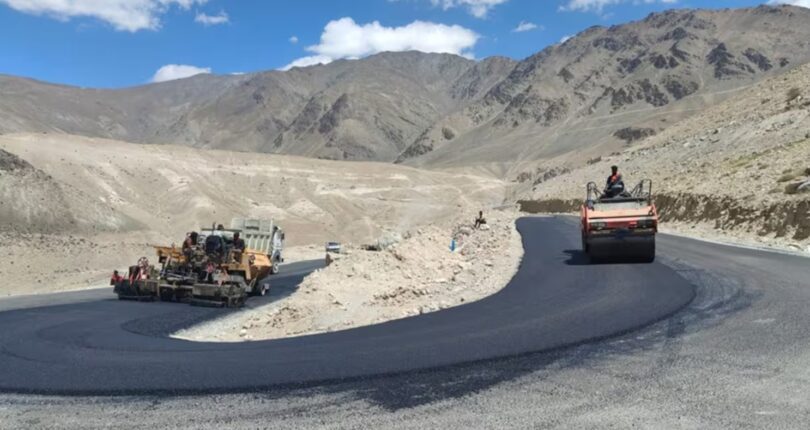

On December 7, 2025, Defence Minister Rajnath Singh inaugurated 125 of Border Roads Organisation (BRO) infrastructure projects worth approximately Rs 5,000 crore across seven States and two Union Territories. The projects include 28 roads, 93 bridges, and 4 miscellaneous projects, featuring the crucial 920-metre Shyok Tunnel in Ladakh to ensure all-weather connectivity and enhanced military mobility in high-altitude areas. These projects enhance connectivity for both the Indian Armed Forces and local communities in remote areas of Ladakh, Jammu & Kashmir, Arunachal Pradesh, Sikkim, Himachal Pradesh, Uttarakhand, Rajasthan, West Bengal, and Mizoram.
Deserving special mention is the 920-metre Shyok Tunnel on the Darbuk–Shyok–Daulat Beg Oldie (DSDBO) road which will make a great difference by ensuring all-weather, rapid troop deployment in very tough terrain. Like many challenging constructions by BRO, this tunnel in tough high altitude and snow-bound mountainous terrain is an engineering marvel built using "cut-and-cover" technology to withstand high-altitude, extreme temperatures and high-risk geological conditions.
Established in 1960, BRO is the Government of India’s premier border infrastructure agency, building and maintaining vital connectivity in remote and border regions. While earlier BRO was partially under the Ministry of Road Transport and Highways, since 2015–16, it began functioning fully under the Ministry of Defence.
Raised by deputing Indian Army Corps of Engineers officers to the General Reserve Engineer Force (GREF) and supported by essential civilian personnel and Casual Paid Labourers (CPLs), BRO’s achievements are a result of a distinctive fusion of military precision and civilian craftsmanship. Functioning under a simple yet stirring credo “Shramena Sarvam Sadhyam” (“through hard work, everything is possible”), from its humble start with just two projects- Vartak in the East and Beacon in the North, BRO now commands 18 dynamic projects: 9 in North West India (J&K, Ladakh, Himachal Pradesh, Uttarakhand, Rajasthan); 8 in North East and Eastern India (Sikkim, Arunachal Pradesh, Nagaland, Mizoram, Meghalaya).
Beyond India’s borders, the BRO’s footprint extends to Bhutan, Myanmar, Afghanistan and Tajikistan, where roads and airfields serve as instruments of regional connectivity and strategic cooperation. Landmarks such as the Delaram–Zaranj Highway in Afghanistan stand not merely as feats of engineering, but as enduring symbols of partnership and trust. Dantak, BRO’s overseas arm in Bhutan, reinforces bilateral ties through extensive road, bridge, and infrastructure development.
Constructing and maintaining strategic roads, bridges, tunnels and airfields in border and inaccessible regions to meet both military and civilian needs since its inception in 1960, BRO has built over 64,100 kms of roads, 1,179 bridges, 07 tunnels and 22 airfields across India’s border areas and in friendly neighbouring countries.
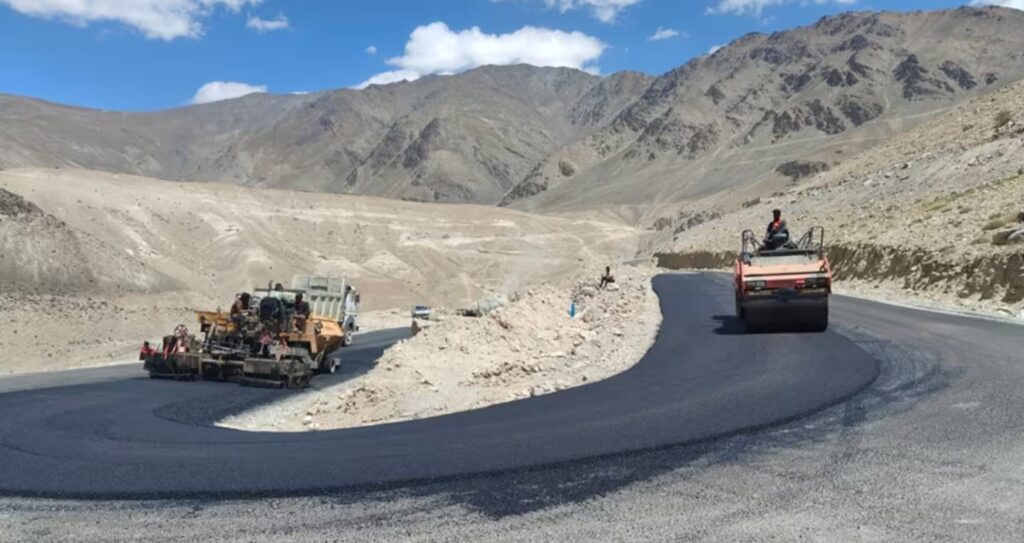
In Arunachal Pradesh, BRO projects such as Vartak, Arunank, Udayak, and Brahmank tackle some of India’s most challenging frontiers, connecting remote villages to the Line of Actual Control (LAC) through critical infrastructure including Sisseri Bridge, Siyom Bridge, Sela Tunnel, and Nechiphu Tunnel.
In Ladakh, projects like Himank, Beacon, Deepak, Vijayak, and Yojak maintain vital lifelines to Kargil, Leh, and the Karakoram region, covering strategic routes such as the Srinagar–Leh highway, Darbuk–Shyok–DBO (DS‑DBO) Road, Atal Tunnel, and the ongoing Shinku La Tunnel, ensuring all‑weather connectivity.
In the Northeast there are projects like Swastik in Sikkim, Pushpak in Mizoram, Setuk in Assam and Meghalaya, and Sewak in Nagaland and Manipur strengthening regional access. On the western borders, Sampark in Jammu and Chetak in Rajasthan enhance strategic mobility.
Beyond the Himalayas, Shivalik ensures reliable access to the Char Dham Yatra in Uttarakhand, while Hirak extends connectivity into Left-Wing Extremism-affected areas of Chhattisgarh.
Bhutan: BRO’s oldest project beyond India’s borders, Dantak, launched in 1961, has built bridges, developed key airports such as Paro and Yonphula, and supported telecom networks and hydropower infrastructure, contributing directly to Bhutan’s socio-economic development and symbolizing the deep India-Bhutan partnership.
Myanmar / Southeast Asia: BRO has advanced regional integration through projects such as the 160 km India-Myanmar Friendship Road, inaugurated in 2001, connecting Moreh in India to Tamu and Kalewa in Myanmar.
Afghanistan: BRO constructed the 218 km Delaram-Zaranj Highway (Route 606), providing Afghanistan with direct access to Iran and the Port of Chabahar. This project enhanced regional trade options and demonstrated India’s commitment to development-led diplomacy.
Tajikistan: BRO undertook strategic reconstruction at the Farkhor and Ayni air bases, including runway expansion, air traffic control systems, hangars, and navigational upgrades, strengthening India’s strategic reach and reinforcing its role as a trusted regional partner.
When disaster struck, like the 2004 tsunami, the Kashmir earthquake, or flash floods in Ladakh, the BRO was among the first to arrive, restoring broken lifelines and hope itself. It has continued reacting with alacrity to disasters.
In the years 2024 and 2025, 356 infrastructures projects executed by the Border Roads Organisation (BRO) have been dedicated to the nation, setting a significant benchmark in the development of strategic border infrastructure. In recognition of BRO’s vital contribution to national security and regional development, the government has increased its allocation from ₹6,500 crore in the Union Budget 2024–25 to ₹7,146 crore in the Union Budget 2025–26. In FY 2024–25, the Border Roads Organisation (BRO) achieved its highest-ever expenditure of ₹16,690 crore. Continuing this upward trajectory, an expenditure target of ₹17,900 crore has been set for FY 2025–26.
Many of these projects recently inaugurated by the Defence Minister, particularly in Ladakh, J & K, Arunachal Pradesh and Sikkim are those which provide much needed smooth and speedy approaches to the Line of Actual Control to counter China’s Peoples Liberation Army’s (PLA) deployment. This progress has rattled PLA and the Chinese Communist Party, who till over a decade ago felt quite complacent about the infrastructural development in their area of deployment.
Also, according to online inputs, under BRO’s perspective plan, 470 roads covering about 27,300 km are planned in border areas. The Trans-Kashmir Connectivity project, spanning about 717 km, has been approved for development to NHDL (paved shoulders) standards. The alignment will run from Poonch to Sonamarg, strengthening strategic road infrastructure across key mountain passes. Tunnels are planned at Sadhna Pass, P Gali, Z Gali, and Razdhan Pass to ensure all-weather connectivity to connect the Kashmir Valley with remote border regions, such as Karnah, Tangdhar, and Machil. Expected to be completed by 2028, this progress will further extensively enhance forward connectivity, improve inter-sector movement, and strengthen inter-valley linkages. Overall, the project will play a critical role in not only boosting operational preparedness but also long-term regional integration.
The author, a strategic affairs analyst and former spokesperson, Defence Ministry and Indian Army, can be contacted at wordsword02@gmail.com, https://www.linkedin.com/in/anil-bhat-70b94766/ and @ColAnilBhat8252, https://www.youtube.com/channel/UCPJKaZOcAt9K8fcDkb_onng
More on India border policies:
With eye on China, India enhances strategic border infrastructure with world-class construction: https://www.thestrategicperspective.org/with-eye-on-china-india-enhances-strategic-border-infrastructure/
Indian Coast Guard’s first pollution control vessel with maiden appointment of women officers: https://www.thestrategicperspective.org/indian-coast-guards-full-pollution-control-vessel-with-maiden-appointment-of-female-officers/