

With the situation escalating in the Middle east owing to the Iran war, a controversial incident in Bahrain has come to light drawing international scrutiny over the risks of advanced air defence systems. On 9 March 2026, a massive explosion in a residential area in the Mahazza neighbourhood in Sitra, Bahrain, injured dozens of civilians. Bahrain presumptuously blamed the blast on an Iranian drone attack. However, subsequent analysis suggests a different and more contradictory situation. It was inferred that the explosion was likely caused by a U.S.-operated Patriot missile interceptor.
The Incident: Explosion in a Civilian Area
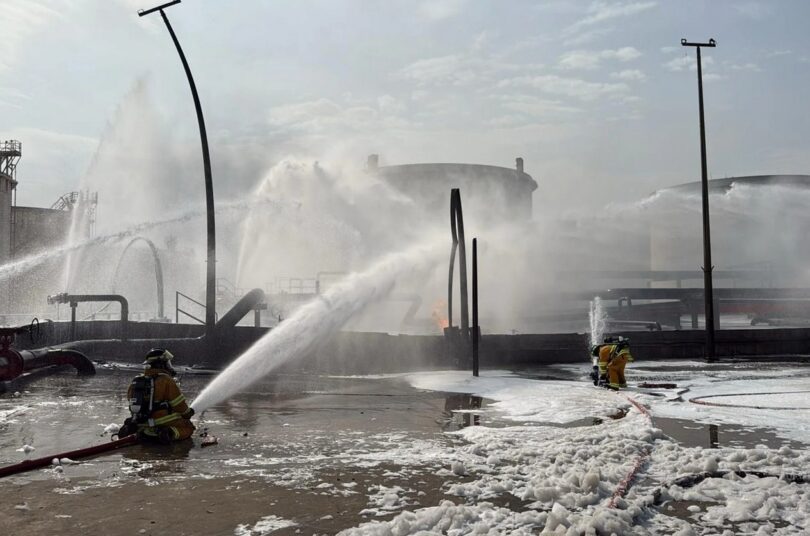
On 9 March 2026, an explosion struck the Mahazza neighbourhood in Sitra, Bahrain. The blast left approximately 32 civilians injured, with reported damage of residential buildings near key infrastructure.
Additionally, the area affected is in close proximity to critical energy facilities, including a refinery.
However, since Bahrain and US are allies, both attributed the blast to an Iranian drone strike. But regardless, this soon came under question.
A detailed analysis conducted by researchers from the Middlebury Institute, reviewed by Reuters, reached a significant conclusion that the explosion was likely caused by a Patriot interceptor missile launched from a U.S.-operated battery.
Trajectory analysis traced the missile launch to a U.S. Patriot system in Riffa, Bahrain.
The Satellite imagery and video verification supported the missile’s origin and flight path as well. The damage pattern was consistent with a mid-air detonation, not a direct drone impact.
Official Position vs Analytical Evidence
Bahrain has confirmed that indeed a Patriot missile was involved and further added that the missile successfully intercepted an Iranian drone mid-air. Authorities denied that either missile or drone directly hit the ground.
In response to speculations, the US has not explicitly confirmed or denied operational responsibility. Hence there are growing gaps in the narratives.
Based on available data, analysts suggest several possibilities:
Scenario 1: Successful Intercept with Collateral Damage
Patriot missile intercepts an Iranian drone followed by explosion in mid-air. The debris or blast wave damage residential area.
Scenario 2: Interceptor Malfunction
Missile fails to track or detonate properly due to which the warhead explodes over a populated area.
Scenario 3: Misidentification or No Drone
Missile launched at a suspected target but no confirmation of drone presence. Interceptor itself causes the explosion
All scenarios point to a common conclusion:
The interceptor not necessarily the threat caused the civilian damage.
Broader Context: Iran’s Regional Strike Campaign
The Bahrain incident occurred during a wider Iranian retaliation campaign:
Iran launched missiles and drones across Gulf states. Bahrain alone reported intercepting dozens of incoming threats.
The key targets by Iran were US military installations, Energy infrastructure and Strategic ports and refineries.
This created a high-pressure environment where:
The Patriot System: Capability vs Risk
The MIM-104 Patriot system is one of the most advanced air defence platforms in the world, designed to intercept ballistic missiles, aircrafts, and drones. It uses radar-guided targeting for either proximity explosions or direct “hit-to-kill” interception.
Key Challenge Highlighted by the Incident
The Bahrain case has exposed a growing issue which includes using high-cost, high-power interceptors against low-cost drones in populated areas.
This has created high financial cost with increased risk of collateral damage and also operational inefficiencies.
Civilian Risk in Defensive Warfare
Even defensive systems can:
Cause unintended harm
Shift danger from incoming threats to interception zones
This complicates the traditional narrative of “defensive weapons = safe outcomes.”
Urban Air Defence Dilemma
In densely populated regions like Bahrain interceptions often occur over cities, falling debris or blast effects are unavoidable. Similar patterns have been observed in UAE, Saudi Arabia and other Gulf states during the same conflict.
The lack of clear evidence about the drone raises doubts about official reporting and concerns over accountability. This could affect international perception of military operations.
Final remarks
The Bahrain Patriot incident reveals several critical realities of the 2026 Iran war:
- Defence Systems Are Not Risk-Free
- Asymmetric Warfare Is Effective
- Urban Warfare Extends Beyond Battlefields
The March 9 Bahrain explosion stands as a defining example of the complex risks of modern air defence warfare.
While initially framed as an Iranian drone strike, evidence increasingly points to a U.S.-operated Patriot interceptor as the likely cause of the blast. Whether due to a successful intercept, malfunction, or misidentification, the outcome underscores a harsh reality:
In contemporary conflict, even defensive actions can produce destructive consequences.
As the 2026 Iran war continues, the Bahrain incident indicates the urgent need to reassess how advanced military systems are deployed particularly in densely populated, strategically critical regions.