
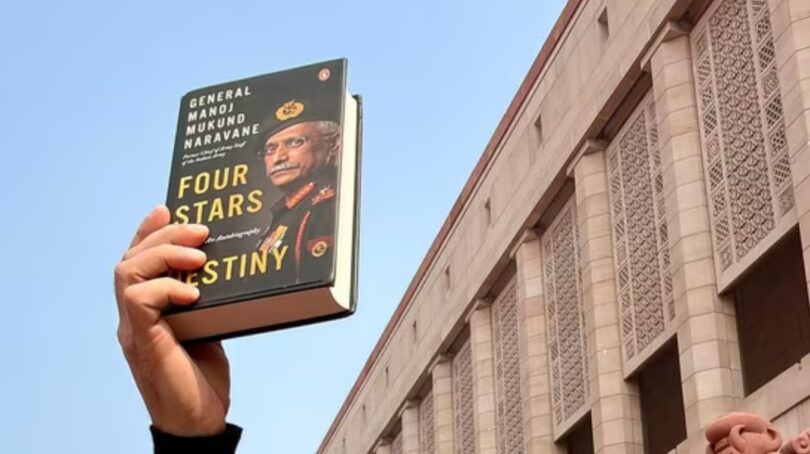
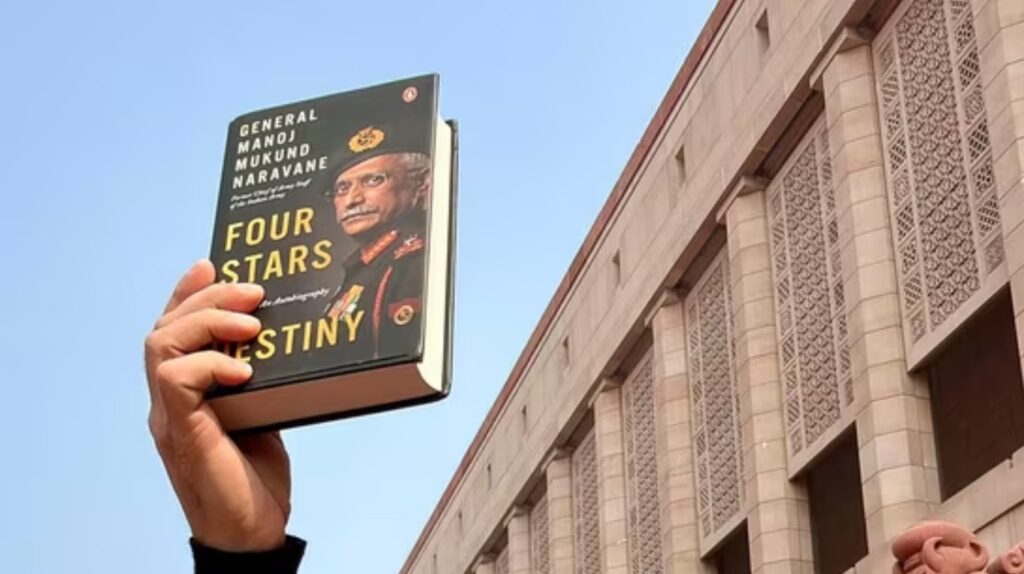
Appearance in Parliament of the book ‘Four Stars of Destiny’, authored by former Indian Army Chief General MM Naravane has caused much hiatus and rage in the political hierarchy since the book wasn’t cleared for publication, even though the excerpts of the book were released in the media in 2023. At that time, the media also said that the book would be published.
It is not known when the Indian government placed a ban on the publication of the book – after how many days or weeks, given the perpetual focus on elections and vote banks. Was the ban order delayed – a convenient bureaucratic goof up? But together with releasing the book excerpts, the publisher offered the book for sale on Amazon. Any publisher offering the book on Amazon, would have at least 100 printed copies ready; more in the instant case given its importance.
After the issue rocked the Parliament, both the publisher and the author issued statements that the book has not been published. A subsequent statement by the publisher said that the book shown in Parliament is different from the published one, without elaborating where he got a copy of the book shown in Parliament and what the difference is between the so-called unpublished book and the published one – who is fooling who (https://www.thestrategicperspective.org/mapping-mischief/)? Obviously, there is only the published book, which is not officially released.
The government finds the book embarrassing on multiple counts, as under:
- First, a political redline was given to the Army Chief that fire will not be opened on the PLA.
- Second, facing advancing PLA troops and tanks, when Gen Naravane sought orders from Defence Minister Rajnath Singh; he responded by saying, “Jo ucchit samjho woh karo” (do as you deem fit). This pusillanimous response was an abdication of responsibility when an explicit political order was given NOT to open fire on the PLA. The obvious aim was to put the total blame on the Army if anything went wrong.
- Third, when General Naravane conveyed enemy tanks and troops coming within 500 metres of own troops, Rajnath, External Affairs Minister (EAM) S Jaishankar, NSA Ajit Doval and CDS General Bipin Rawat didn’t respond how he should deal with the criticality.
- Fourth, the book brings out the mass imposition of the Agnipath scheme (short-term recruitment of soldiers) came as a bombshell to the Armed Forces, who were not consulted earlier. This scheme has been thrust on the 1.4 million Armed Forces, but not on the 2.16 million police, Central Armed Police Forces (CAPF) and the and the special police.
- Fifth, Foreword of the book was written by veteran General VK Singh on November 23, 2023, who then was Minister of State (MoS) for Civil Aviation (now Governor of Mizoram). General VK Singh, who was the Indian Army Chief from April 1, 2010 to May 31, 2012, obviously saw nothing wrong in the book.
Veteran Major General Yash Mor, who runs an academy, writes that between 2020 and 2024, the Ministry of Defence (MoD) cleared 35 books for publication and General Naravane’s book is the only one pending. According to him, writing more is essential because analysis and debate are crucial for both civil society and the Armed Forces. By writing, discussing, and debating, we learn valuable lessons and take corrective actions. The Official Secrets Act of 1923 might need a revisit as it obstructs thorough analysis of significant operations and military lessons? He added a short clip taken from his live YouTube session few days ago (https://www.facebook.com/reel/1429778905466810).
At the same time, the book says that PLA troops advancing on Rechin La fired a shot at Indian positions. Therefore, there was no reason not to fire back a volley of 8-10 rounds because: the PLA had already opened fire; PLA was already across the China claimed Line of Actual Control (LAC) in other areas; whenever Indian troops stood up to China, be it at Nathu La or Sumdorong Chu, the PLA retreated. There were other goof ups by India, which readers should read here (https://www.thecitizen.in/opinion/goof-ups-in-ladakh-1250129).
A video clip on the Galwan Valley Clash points out that the PLA is encumbered by China’s single-child family rule and Indian troops are better battle-hardened at those heights. This is correct, because subsequent reports have also been indicating PLA suffering large number of medical casualties, which is why China has recruited Tibetans in the PLA (and possibly Nepalese also because of poverty and unemployment?) After all, Indians and Nepalese are participating in the war in Ukraine on individual basis, unlike western mercenary outfits who have been in Ukraine since 2014.
The Galwan Valley Real Truth: The butterfly effect pic.twitter.com/vzJFbfvEEr
— MapReader (@MapOsnit) February 2, 2026
Significantly, the above video clip points out that the Indian troops were unarmed. This is the result of defence against China placed under the foreign ministry despite China repeatedly breaking every agreement in the past. When the question arose whether our troops were armed, Rajnath, who had visited our injured soldiers in the Military Hospital at Leh, did not respond. But Jaishankar told the media that they were armed – a half-truth? If they were armed at all, were they carrying empty magazines?
India’s political hierarchy has been traditionally scared of the Dragon. When the setting up of 65 Patrolling Points (PPs) in Ladakh was approved decades back, these PPs were short of the Indian perception of the LAC. In 2013, when a PLA patrol occupied the Y-Junction location inside Indian territory in Depsang, a veteran General said in a TV discussion that an Indian patrol should be positioned behind the PLA patrol. A politician of the then ruling party immediately snapped back, “General Sahib, aap toh ladai karwa dogey (General, you will draw us into a war). Apparently, more than a war, or the bogey of a nuclear war, the political fear is a missile strike on their seats in the nation’s Capital.
The PPs were not permanently occupied, as should have been since they were short of own perception of the LAC. The Indo-Tibetan Border Police (ITBP) in the show window had a separate channel of command and control all the way up to the Ministry of Home Affairs (MHA) – not under command of the Army, as should be the case. This state continues to-date. Rajnath Singh, who was earlier the Union Home Minister hasn’t opened his mouth on the issue.
During the Chinese invasion of 1962, VK Krishna Menon, a native of Kerala, was India’s Defence Minister. A close confidant of Prime Minister Jawaharlal Nehru, he served as India's first High Commissioner to the UK and engineered the first high-level corruption scam (the Jeep Scandal); ignoring protocols in 1948, he signed a INR 8 million contract for purchasing army jeeps with a foreign firm. As the defence minister, when he visited Army’s Central Command in mid-1962 and was given a presentation on how the Chinese invasion would unfold, he rubbished it. Later, he visited the National Defence College (NDC) at New Delhi, where he was again briefed on the likely Chinese offensive. Menon lost his shirt and said if this is the thinking of NDC, he will have it shut down. Menon resigned on October 31, 1962, following the massive Chinese invasion.
Lieutenant General BM Kaul, with no battle experience whatsoever, was given command of the Army’s newly raised IV Corps during the Chinese invasion. He was awarded the Param Vishisht Seva Medal while commanding 4 Infantry Division at Ambala earlier; for successful construction of 1,450 quarters for troops in Ambala Cantonment. Faced with the PLA advance, he ordered withdrawal of IV Corps, when some locations could have continued to hold on and resupplied by air. India didn’t use the Air Force – courtesy the nincompoop defence minister and the bureaucrats in his ministry. After ordering withdrawal, Kaul flew back to New Delhi for medical treatment.
Brigadier John Dalvi, former commander of 7 Infantry Brigade, is critical of Lieutenant General BM Kaul, attributing the debacle partly to him in his book ‘Himalayan Blunder. Excerpt from the book read: "He (Kaul) managed to keep himself away from hardship and learning the nuances of a military commander as a junior officer and later in service, managed to grab important Army senior command appointments due to his “pull”. His involvement with Jawaharlal Nehru later turned out to be a major reason for the shameful loss and massacre of Indian troops at the hands of the Chinese".
India had no ambassador in Beijing during the 1962 war, as the last ambassador G Parthasarathi was withdrawn in July 1961 following declining relations with China. PK Banerjee was the Chargé d'affaires in Beijing from July 1961 until early 1964. RK Nehru, a former Ambassador to China and a special representative, met Chinese officials in July 1962. Banerjee obviously had no inkling of what the Chinese were planning.
China is adept at cultivating bureaucrats serving in Beijing. Indian diplomat TN Kaul serving in Beijing during the sensitive negotiations for the 1954 Sino-Indian agreement, developed a romantic relationship with a Chinese woman, and Nehru gave him a direct order to return to India immediately without waiting for the conclusion of the negotiations. But Kaul delayed his departure for four months, treating the period as a "holiday" while continuing to live in Beijing. Despite this serious breach, Kaul later served as the Foreign Secretary of India.
BN Mullik was India’s intelligence Chief in 1962. Commissioned in the Imperial Indian Police, he served as Director of the Intelligence Bureau (IB) from July 1950 to October 1964. As key advisor to Nehru on internal security and foreign policy issues, he failed (by default or design) to warn Nehru on the impending Chinese invasion. Nehru died on May 27, 1964 – a disillusioned man.
A question is often asked why the current dispensation, which blames Nehru and the Congress for anything and everything, hasn’t declassified the Henderson Brooke Report on the 1962 debacle. The reasons are not too difficult to gauge. Not only did Krishna Menon and the diplomats/bureaucrats let down Nehru, so did the policeman Mullik on whom Nehru was totally dependent for intelligence.
The bureaucrats, on whom the politicians continue to depend upon, hold them to ransom. Their slogan is that governments come and governments go but their choke hold on politicians will remain forever. The police man the intelligence services and are privy to all the skeletons in the cupboard. They are also a source of income and help execute political machinations. The Director General of National Security Guard (NSG) is always from IPS. That is why the MHA is currently considering statutory intervention in response to a supreme court ruling to progressively reduce the deputation of Indian Police Service (IPS) officers up to the rank of Inspector General in the CAPF; according to an affidavit filed on February 9, 2026. At present, 20% DIG and 50% IG level posts in the CAPF are reserved for IPS officers. One can expect MHA’s statutory intervention to succeed.
A comment on social media reads: the govt will always buttress the IPS and tooth and nail to buttress the IPS and protect the interests of IPS officers, but will fight all the way to the Supreme Court against the Armed Forces personnel to deny them their dues.
Finally, the government is mulling lifting the ban on General Naravane’s book after 20 years. Also, Epstein Files may have been released but there is little chance of the Henderson Brookes Report getting released.
The author is an Indian Army veteran. Views expressed are personal.