



On 8 April 2025, post Rana’s plea to halt his extradition to India was dismissed by the Supreme Court of the United States, the National Investigation Agency officers from India took Rana into custody. (https://www.thestrategicperspective.org/articles/petition-denied-us-supreme-court-clears-2008-mumbai-attacks/)
The NIA team with Rana arrived at the Palam Air base in New Delhi on 10 April 2025 and was sentenced to an 18-day NIA custody by a special NIA court in Delhi.
On 9 July 2025, NIA filed a supplementary charge sheet in the 26/11 Mumbai terror attack case, where Tahawwur is named as a key suspect.
Special Judge Chander Jit Singh of Patiala House Court extended the judicial custody of Rana, who was produced in the court through video conference. The court is expected to determine the next hearing on basis of the recent NIA produced charge sheet.
Tahawwur Rana has been granted the permission to make a one-time phone call to his family. This call will be monitored by Tihar jail authorities and will take place according to jail regulations. The court also asked for a detailed health report on Rana.
The court is yet to determine whether Rana should be allowed regular phone calls with his family in the future.
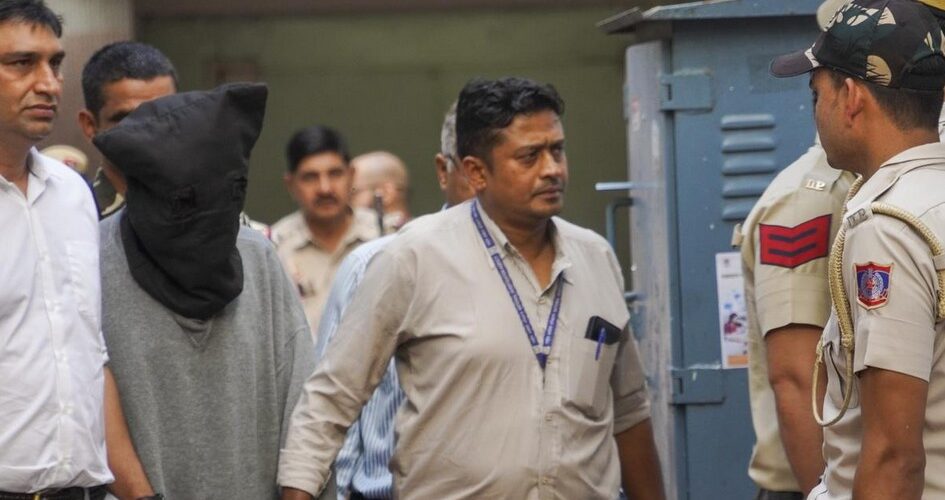
The National Investigation Agency (NIA) did not object to the one-time call but had concerns initially that the suspect could be compromising the ongoing investigation.
Tahawwur Rana currently faces trial in the case 17 years after the terror attacks that killed more than 166 people in Mumbai in 2008. He is charged as a key conspirator along with his friend David Headley, a Pakistani-American Islamic terrorist and Lashkar-e-Taiba (LeT) member, responsible for orchestrating and carrying reconnaissance operations for the Mumbai attacks at the orders of LeT chief Hafiz Saeed.
According to the NIA, it is ascertained that Rana shared a key role in the organization of the attacks, while aiding Headley in procuring an Indian visa and creating a false identity to travel to India. On basis of the data collected on the individuals, Rana has been charged with criminal conspiracy, waging war against the Government of India, murder and forgery and provisions under the Unlawful Activities (Prevention) Act.
Headed by Solicitor General Tushar Mehta, along with Additional Solicitor General S. V. Raju, senior advocate Dayan Krishnan and advocate Narender Mann, a team of lawyers are conducting the trial.
The Ministry of Home Affairs (MHA) has notified that decision was made exercising the powers conferred under the National Investigation Agency Act, 2008 and the Bharatiya Nagarik Suraksha Sanhita (BNSS), 2023.
The current team of lawyers will also handle matters related to the case RC-04/2009/NIA/DLI (case registered with the NIA in Delhi involving the trial of Rana and David Coleman Headley in connection with the 26/11 Mumbai terror attacks) on behalf of the NIA before the NIA Special Courts at Delhi, High Court of Delhi and Supreme Court of India for three years or till the completion of trial of the said case, whichever is earlier, the notification said.
He has been interrogated by the NIA investigators for around eight to ten hours daily.
The evidentiary proof accumulated by the Federal Bureau of Investigation (FBI), includes several intercepted conversations and emails between him, David Coleman Headley and Lashkar-e-Taiba (LeT) handlers in Pakistan. This additionally has provided the core information which has subjected Rana to conspiracy charges filed by the NIA.
The FBI recorded a conversation between Headley and Rana when they took a long car ride on September 7, 2009. During their meeting the individuals were heard discussing the Mumbai attacks, Rana’s regards for LeT, his meeting with Abdur Rehman Hashim Syed alias Pasha (a former major in Pakistan army and a 26/11 handler) in Dubai, giving Nishaan-e-Haider (Pakistan’s highest military honour to nine attackers) and the possible plan of attacking the National Defence College (NDC) in India.
Additionally, in email conversations on August 11 and 17, 2009 between Headley and Sajid Mir (a high ranking LeT operative), the FBI noted the Rana’s admission and deep regard for Mir, for have planned the attacks in Mumbai. The FBI was successful in retrieving travel details of Rana to Dubai where he met Pasha prior to the 26/11 terror attacks.
Memory cards with pictures of possible target locations were recovered belonging to Rana, who had acted as an information conduit for the co-conspirators in Pakistan. Some of the memory cards included fraudulent immigration documents prepared by him for Headley for acquiring a five-year business visa for India. Financial documents were also recovered from the memory cards which prove Rana’s engagement in transferring money to Headley on four occasions during Headley’s visits to India. All the details of payment of expenses in relation with the Immigrant Law Centre office of Rana in Mumbai (front cover for Headley’s surveillance activity in Mumbai), was also recovered.
On 11 November 2009, charges were filed under sections 121 A of the Indian Penal Code (IPC), Section 18 of the Unlawful Activities (Prevention) Act and Section 6(2) SAARC Convention (Suppression of Terrorism) Act against David Headley.
Upon the NIA investigation, the involvement of senior leaders of terror outfits such as LeT and Harkat-ul Jihadi Islami (HuJI) – Hafiz Muhammad Saeed alias Tayyaji, Zaki-ur-Rehman Lakhvi, Sajjid Majid alias Wasi, Illyas Kashmiri and Abdur Rehman Hashim Syed alias Major Abdurrehman alias Pasha – had been uncovered. A collaborated effort between the Pakistan based terror outfits and Pakistan’s ISI was established. It has been ascertained that an ISI handler by the name of Major Iqbal alias Major Ali and Major Sameer Ali alias Major Samir were actively involved in the orchestration and planning of the Mumbai attack.
Upon NIA’s recent interrogation, Tahawwur Hussain Rana has confessed to having frequent communication with other key conspirators of 26/11 attacks, including Abdul Rehman Pasha, Sajid Mir and Major Iqbal. When asked about forwarding emails to Major Iqbal, Rana has been ambiguous in his response.
He discussed his meeting with Rajaram Rege, a contact of Headley. Rege has recently been arrested by Kolkata Police in another case. Headley had passed Rege’s details to both Rana and Major Iqbal. Rana has denied the knowledge of the exact landing sites used during the attacks. He has acknowledged to knowing Bashir Shaikh, who received Headley at the Mumbai airport. Shaikh, resident of Santacruz, is currently absconding and assumed to be in Canada.
Rana was also implicated in an international terrorism investigation in relation to a planned attack on the offices of Jyllands-Posten, a Danish newspaper. The plot was devised in joint effort with David Coleman Headley. It targeted the newspaper’s employees in retaliation for its 2005 publication of cartoons depicting the Prophet Muhammad.
Although U.S. intelligence agencies had long suspected connections between home-grown Pakistani terrorist outfits and the Pakistani military, the Rana-Headley events pointed a more direct engagement of military personnel in global terrorism led by Pakistan.







What struck me most was the NIA’s timing: filing a supplementary chargesheet against Tahawwur Hussain Rana nearly 14 years after the original charges. This new filing follows his extradition from the U.S. earlier this year—an achievement only made possible after lengthy appeals up to the U.S. Supreme Court were dismissed.
The updated chargesheet isn’t just symbolic. It includes critical procedural materials like arrest memos and seizure records, in addition to new evidence revealing that Rana helped orchestrate multiple reconnaissance trips by co-accused David Headley across key Mumbai targets. Notably, the establishment of a sham “Immigrant Law Centre” in Mumbai emerges as a chilling detail—it functioned as a covert base to facilitate meticulous surveillance for the 26/11 attackers.
This move transforms the investigation from dormant to dynamic again. It’s a clear message: India continues to follow through in its pursuit of justice, no matter how long the wait.
Equally telling is the judicial custodian extension, with Rana’s custody now secured until August 13—when the court will also review the chargesheet.
[…] NIA files supplementary charge sheet against Pakistani Canadian terrorist Tahawwur Rana responsible for 26/11 attacks: https://www.thestrategicperspective.org/nia-files-supplementary-charge-sheet-against-pakistani-canad… […]