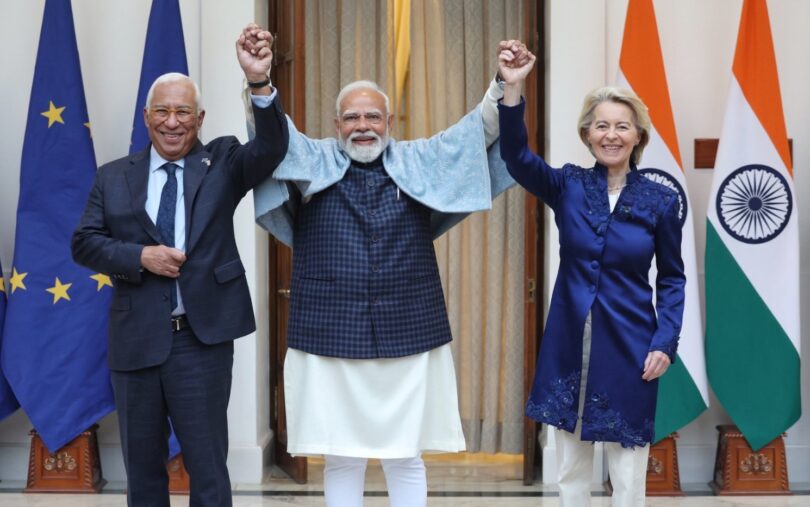

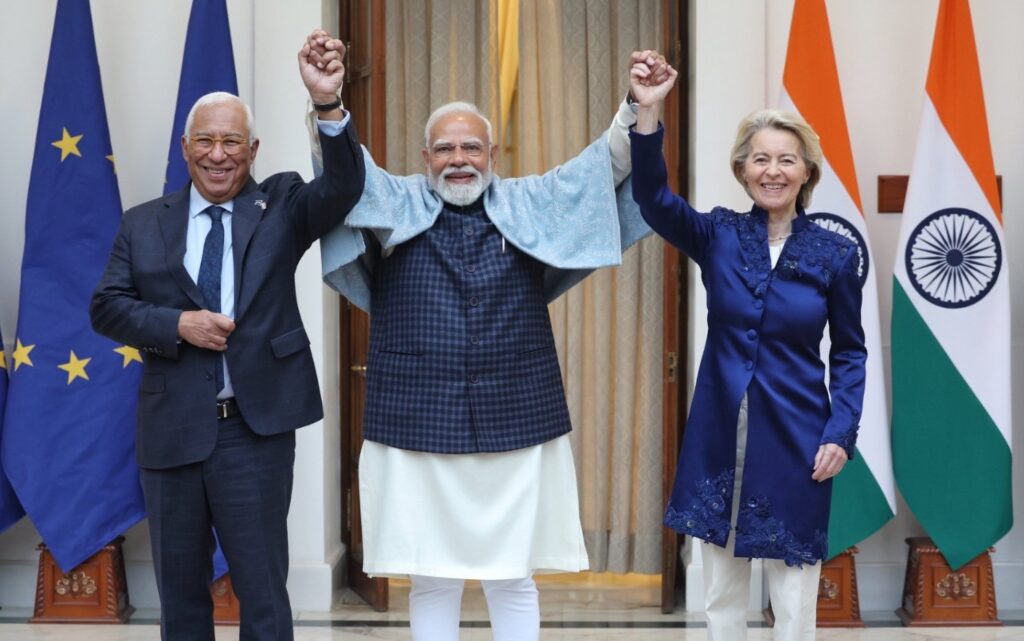
India and the European Union (EU) have reached a historic breakthrough with the conclusion of nearly two decades of negotiations on a comprehensive Free Trade Agreement (FTA), which have come to be widely dubbed by officials as the “mother of all deals”. This significant pact, announced at the 16th India-EU Summit in New Delhi, is expected to recast and evolve the economic ties, investment flows, and geopolitical alignment between the two global partners.
This landmark agreement—encompassing goods, services, investment, and cooperation is positioned to redefine economic ties between two major blocs and is expected to be officially signed post the legal vetting and parliamentary approvals in both India and the EU. The pact is expected to take effect in 2027 following the final legal drafting, formal signing, and ratification.
The European Commission President Ursula von der Leyen stated that “a successful India makes the world more stable, prosperous and secure. And we all benefit.” Her remarks highlighted India’s dynamic and burgeoning economic role which will be crucial to Europe’s interests as well.
At the World Economic Forum in Davos in January 2026, von der Leyen referred to the pact as potentially “a historic trade agreement” that would create a market of nearly 2 billion people accounting for almost a quarter of global GDP, giving Europe a “first-mover advantage” with one of the world’s fastest-growing economies.
Her visit to India as a chief guest at India’s 77th Republic Day celebrations alongside European Council President António Costa further accentuated the progressing strategic and economic cooperation between India and the EU, suggesting that a landmark deal was imminent.
Additionally, the Indian Commerce and Industry Minister Piyush Goyal has hailed the agreement as “the mother of all deals” ever signed by India, emphasizing its scale and strategic importance.
Indian Commerce Secretary Rajesh Agrawal validated the conclusion of official-level negotiations in regards to the pact, describing it as “balanced and forward-looking, facilitating improved economic integration and higher trade volumes between India and the EU”.
India’s External Affairs Minister (EAM) Subrahmanyam Jaishankar played a vital diplomatic role in regard to this crucial agreement leading up to the final phase of the deal. He hosted and engaged with top EU leaders including European Council President António Costa and European Commission President Ursula von der Leyen. Furthermore, Jaishankar held meetings with EU foreign policy chief Kaja Kallas and led high-level delegations in finalizing negotiations and aligning both sides on the contours of the future partnership.
What the Agreement entails:
- Tariff Reductions and Market Access
One of this deal’s features is India’s commitment to considerably cutting import tariffs on European goods, specifically in sectors where barriers have historically been high. India has complied to lowering customs duties on some EU-made cars from as high as 110% to 40% initially, with further reductions planned down to 10% over time.
The agreement is also expected to provide preferential or duty-free access for Indian exports to the EU, particularly for textiles, chemicals, gems and jewellery, leather goods and electrical machinery, benefiting labour-intensive sectors that have faced higher European import duties of around 10%.
- Services, Investment and Standards
Beyond goods, the pact includes services, investment and regulatory cooperation. It is expected to bolster Indian access to EU markets in sectors such as telecommunications, finance, maritime services and also provide investment protections for both Indian and European businesses.
Frameworks to aid geographical indications, intellectual property standards, and cooperation on digital trade have also been included.
- Broader Strategic Agenda
The leaders from both blocs are expected to adopt a joint strategic agenda covering cooperation on security, defence, climate change, technology and connectivity.
This includes plans for a Security and Defence Partnership that would deepen interoperability and collaboration between Indian and EU forces, and proposals for a Security of Information Agreement (SOIA) to boost defence industrial cooperation.
Context and Background: 2-decade Negotiation
The idea for an India–EU free trade pact first culminated in 2007, but was stalled amid disagreements on market access, standards and tariffs. Talks commenced again in 2022 with renewed political will on both sides, transpiring in the current breakthrough.
The EU is already India’s largest trading partner in goods, with bilateral commerce amounting to about USD 135 billion in 2023-24, while both groups have consistently stressed on the need to deepen economic integration against a backdrop of global supply chain uncertainties.
Economic, Strategic and Geopolitical perspectives
Economic Advantages
Boost to Trade and Market Access: The pact may foster an expanded market access for Indian exporters as well as easier access for European companies into India’s growing consumer base.
Investment Flows: With reduced constrictions and clearer rules, European foreign direct investment (FDI) into India is expected to rise, especially in manufacturing, automotive technology, and services.
Sectoral Advantages: Indian labour-intensive industries such as textiles and leather are expected to benefit from lower tariffs in the EU, while European manufacturers gain better access to a huge and fast-growing economy.
Strategic and Geopolitical Shifts
Diversification of Partnerships: For the EU, stronger ties with India provides an alternative to over-reliance on trade with China and the United States. This move can be interpreted as part of the bloc’s broader strategy of strategic autonomy in global markets.
Global Influence: The deal positions India as a central player in global economic governance and strengthens EU support for multilateral trade frameworks.
Political Coordination: The inclusion of defence and security cooperation also suggests the progressing alignment on global challenges beyond economics.
The Steps and Implementation Timeline for the Deal
On 27 January 2026: India and the EU officially announced the conclusion of negotiations at the summit in New Delhi.
Next 5–6 Months: Legal scrubbing of the treaty text will be completed.
2026 – 2027: The deal will be signed and ratified. It requires EU Parliament approval and, in India, the Union Cabinet’s approval before it can enter into force — anticipated in early 2027.
Concluding remarks: Reinforced India–EU Relations
The India–EU FTA — the so-called “mother of all deals” — signifies a major economic and strategic shift in both partners’ foreign policy trajectories.
It is expected that by integrating markets and aligning regulatory frameworks, the pact stands to benefit producers, consumers and investors on both sides and sets a precedent for India–EU cooperation in areas such as technology, defence, and sustainable development in future. The India–EU Free Trade Agreement combines deep economic engagement with strategic collaboration, signals a reconfiguration of global trade relationships, and reinforces the importance of multilateral partnerships in a complex international landscape.
More on Indian diplomacy:
India–UK economic partnership: The signing of the Comprehensive Economic and Trade Agreement (CETA): https://www.thestrategicperspective.org/india-uk-economic-partnership-the-signing-of-ceta/
India’s trade with Russia and BRICS ties draw Trump’s tariff “penalty”: https://www.thestrategicperspective.org/indias-trade-with-russia-and-brics-ties-draw-trumps-tariff-penalty/
India’s Strategic Engagement with the Taliban: Realignment and Implications for Pakistan: https://www.thestrategicperspective.org/indias-strategic-engagement-with-the-taliban-realignment-and-implications-for-pakistan/
The Asian Century: https://www.thestrategicperspective.org/the-asian-century/
India and the G2 Factor: https://www.thestrategicperspective.org/india-and-the-g2-factor/
Iran to Host Pakistan–Afghanistan De-Escalation Talks: https://www.thestrategicperspective.org/iran-to-host-pakistan-afghanistan-de-escalation-talks/