
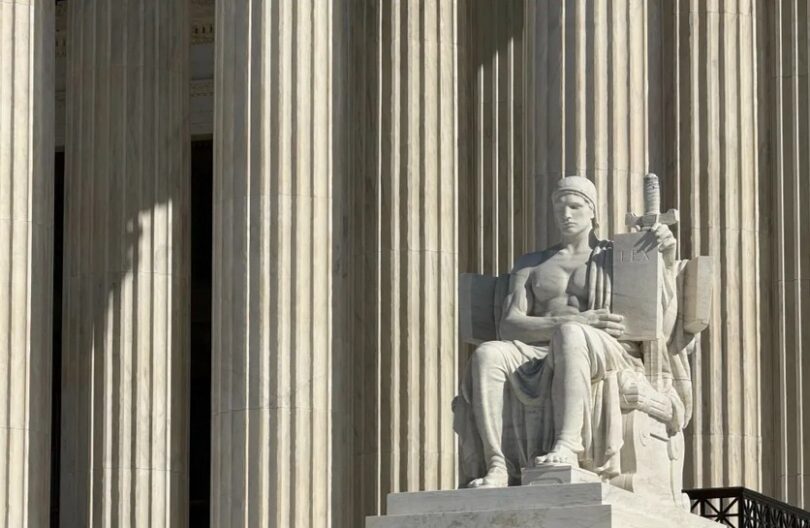

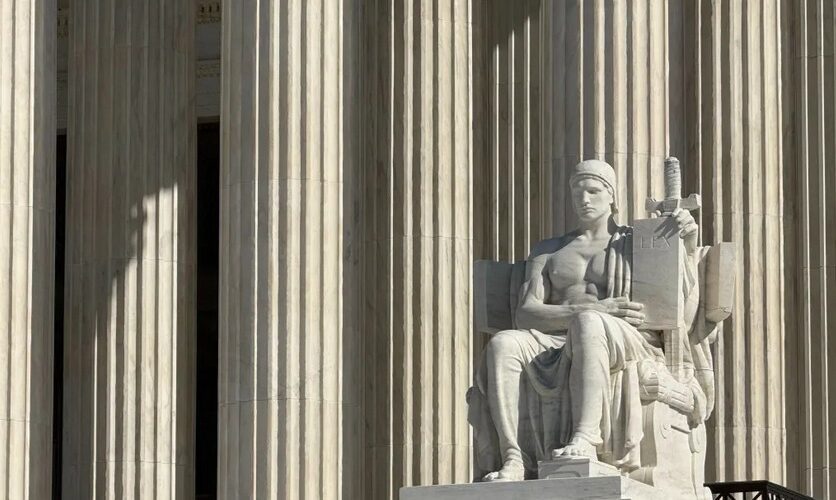
The ruling of the US Supreme Court on 20 February 2026 to strike down Trump’s tariffs announced on “Liberation Day” 2 April 2025 imposed by Executive Order 14257 was the leading news across the world, overshadowing even the US military build-up in the Mediterranean as part of an expected then attack on Iran (which later materialized). Viewed by many as a big surprise decision and a major setback to the US internal and external policy, the reality is it was not a factor, on which these policies were solely dependent on. Aside from the immediate replacement by another tariff policy, the administration, in conjunction with the FED, has created the environment, which would likely push the economy forward and sustain the required interventions abroad (as required by the National Defense Strategy).
The tariff decision origination
In order to implement a universal tariff, on April 2025 the Trump administration declared a national emergency over the US trade deficit and used the International Emergency Economic Powers Act of 1977. The IEEPA authorizes the president to declare the existence of an "unusual and extraordinary threat ... to the national security, foreign policy, or economy of the United States" that originates "in whole or substantial part outside the United States." It further authorizes the president, after such a declaration, to block transactions and freeze assets to deal with the threat and requires the president to report to Congress every 6 months on the circumstances, threats and actions taken.
The actions under IEEPA, however, are not indefinite. The Act falls under the provisions of the National Emergencies Act (NEA), which means that an emergency declared under the act must be renewed annually to remain in effect.
The tariff decision did not go as smoothly as initially perceived. It led to a market crash where the S&P500 index dropped 12% and the administration issued a tariff suspension, after which a strategy of individual negotiations with key markets (countries) followed in the following months.
The institutional pushback
The first rebuttal came from a ruling by the US Court of International Trade on 28 May 2025, which stated that Trump had overstepped his authority to impose tariffs under IEEPA. An appeal was filed, but the Federal Circuit Court of Appeals upheld the decision on 29 August 2025. Consequently, the Supreme Court affirmed the decision last Friday.
In the ruling, Chief Justice John Roberts wrote “IEEPA contains no reference to tariffs or duties. The Government points to no statute in which Congress used the word 'regulate' to authorize taxation. And until now no President has read IEEPA to confer such power,”, "We claim no special competence in matters of economics or foreign affairs. We claim only, as we must, the limited role assigned to us by Article III of the Constitution. Fulfilling that role, we hold that IEEPA does not authorize the President to impose tariffs.”
The fallout
The initial decision by Trump was solely based on the assumption that the national deficit was a national emergency. The court decisions, however, stated that the power to impose taxation lies solely in the Congress and since tariffs are taxes, the President cannot singlehandedly create an emergency to bypass the Congress process.
The first question that comes after this ruling is – what happens with the tariffs, which, according to the Supreme Court, were collected illegally? There are no exact figures, but the speculation is that a figure in the realm of USD 175 billion would be a subject to a messy and possibly lengthy litigation process.
There are two main questions associated to it – how much is to be distributed and who gets it.
The tariffs are a tax, which is levied on the importer, but in order to offset it, they must include it in the final cost, hence it is borne by the final consumer, i.e. the American people. As such, would the claimants be the final recipients, i.e. the customers, or the importers of the goods? Or in the case of more complex supply chains, would that be the companies in the foreign nations or the foreign nations themselves?
Additional problem is deciding what gets distributed. There two main aspects – the money that was already collected and the money that was lost as a result of the decreased demand stemming from the implementation of the tariffs. While the former can be traced by the revenues to the IRS, the later is an opportunity cost, which is hard to prove. That, however, is not impossible – most of the intellectual property cases associated to pirate use of products use the same principle of establishing lost potential revenue.
As it turns out, a decision, which was unlikely to sustain the institutional pushback, has created a huge market for the legal and lobbying companies.
The road ahead
The Supreme Court decision was clearly not a surprise for the administration. Aside from the speech, which lambasted it and the justices behind it, Trump announced the next step – a blanket 10% tariff (later increased to the maximum of 15%) under Section 122 of the Trade Act of 1974. The section allows the president to impose tariffs of up to 15% for up to 150 days in response to "large and serious" balance-of-payments deficits. It requires only presidential determination that such a deficit exists, but any measures imposed expire after 150 days unless Congress votes to extend them. Actions under it must be applied uniformly and cannot target individual countries.
As it takes effect on 24 February 2026, the Trump administration has to secure a possible Congress voting majority until 24 June 2026 to continue with the policy. Considering the fact that the Supreme Court voted 6:3, which included also judges appointed by Trump himself, there are clearly indications that the support that he might want to have is possibly not there. Aside from the Supreme Court, the waning support might be a fact in the Congress too, which is why they look for alternatives and have not pursued Congressional approval since the tariff announcement last April.
Invoking the 122 Act was in essence bridge financing for the budget until a stable solution is found. The speed of implementation indicates that this was one of the likely scenarios developed by the administration and that there are possibly other cards up his sleeve.
Inflation and the FED relationship
Tariffs have a mixed effect on inflation. In the short term they are inflationary, as they directly increase the prices of the goods and services. In the mid to long term, however, because of the decreased demand, they have deflationary effects. So far we have seen only the first part of their influence on the US markets. Trump knows that perfectly well, which is why he needed a FED policy, which would be stimulating the economy.
In essence, that would mean keeping the interest rates lower. Jerome Powell was adamant to decrease the rates out of fear of the economy overheating, especially in the presence of the AI investment boom and the seemingly uncontrollable rise in investments in the sector leading to often ridiculous sounding valuations requiring hundreds of years to repay investments (PE ratios between 300 and 900 not uncommon). In his defense, massive amounts of data point out to great similarities to the Dot-com bubble, which reached its peak in March 2000 and over the next 2.5 years lost 78% of its value.
Trump, however, needs a booming market. The clear differences in the approaches with Powell has led him to look for alternatives when his term expires in May 2026. He nominated Kevin Warsh to be the next FED chair with the explanation that he’s hawkish. In economic terms, this means a policy meant to control inflation which is done by higher interest rates and tighter money supply.
Whether Kevin Warsh is a hawkish economist, i.e. somebody favoring high interest rates and tight monetary policy, or is presented as such, are two different things. Additionally, how he’d react as a FED chair in the existing conditions, is a third. He was a member of the FED Board of Governors from 2006 to 2011 and in the aftermath of the 2008 Financial Crisis was the FED’s primary liaison to Wall Street, as well as the FED’s representative to G20. Clearly, a very prominent figure at very turbulent times.
His support for the the first Quantitative Easing (QE) in 2009 was likely due to his intent to prevent a systemic crash even if this is the exact opposite of a hawkish policy. The global banking system was facing extensive and highly probable risks and needed drastic measures. It is likely that pragmatism was the major motivator behind his vote.
The second round of QE in 2010, however, faced different circumstances, where the situation was not as dire. Yet, he still voted in favor, perhaps out of loyalty, as a decision of a divided FED could send the wrong signals to the market and effectively erase the positive effects of it. After a while he publicly criticized the FED for taking this decision in a time when it was not necessary and which would lead to artificially inflating asset prices without addressing existing structural problems.
In recent interviews he’s expressed the view that the AI boom would lead to changes in productivity, which would eventually have disinflationary effects. As such, his approach might be that a more lax FED policy with rates to neutral 2% levels (currently at 3.50% - 3.75%) would not be a problem and would serve to push the economy without overheating it, considering where it is heading.
The White House approach
On 8 Jan 2026 Trump announced that he had instructed “his representatives” to purchase USD 200 billion of mortgage backed securities (MBS). By representative he probably meant Fannie Mae and Freddie Mac, the government sponsored enterprises created to provide liquidity and stability for the housing market via purchasing mortgages and securitizing them as MBS. Fannie Mae and Freddie Mac have been in conservatorship of the Federal Housing Finance Agency (FHFA) since 2008 and its director is appointed directly by the President, essentially giving him a direct link to the MBS market.
The MBS purchases affect the interest rates of the housing market – greater prices mean lower interest rates and that would affect most loans with real estate as a collateral. While this was described as a way to make housing more affordable, its real goals were to achieve the same results as QE – lowering the interest rates, but without using the Treasury or the FED, and injecting more liquidity in the economy, which would lead to booming stock and housing markets. This way they would still have their desired leadership of the FED without contradicting his principles for keeping a clean balance sheet.
While the Supreme Court decision was not what the Trump administration wanted, it was hardly unexpected. The speed with which a new measure was announced, the relationship with Kevin Warsh and the decision to purchase USD 200 billion via Fannie Mae and Freddie Mac, indicate that they are staying on course to enforce the objectives under its National Defense Strategy. And for that, they’d need both lower fiscal deficit and a growing economy. Whether that materializes is yet to be seen.
References:
https://uslaw.link/citation/us-law/public/95/223
https://www.cbsnews.com/news/supreme-court-tariffs-decision-trump/
https://www.law.cornell.edu/uscode/text/19/chapter-12
https://www.law.cornell.edu/uscode/text/19/2132
https://www.cfr.org/articles/how-trumps-tariffs-could-survive-the-supreme-court-ruling
https://www.nytimes.com/2026/02/20/business/ai-productivity-fed-rate-cuts-warsh.html
More on the topic:
US National Defense Strategy and Iran: https://www.thestrategicperspective.org/us-national-defense-strategy-and-iran/