
Executive Summary
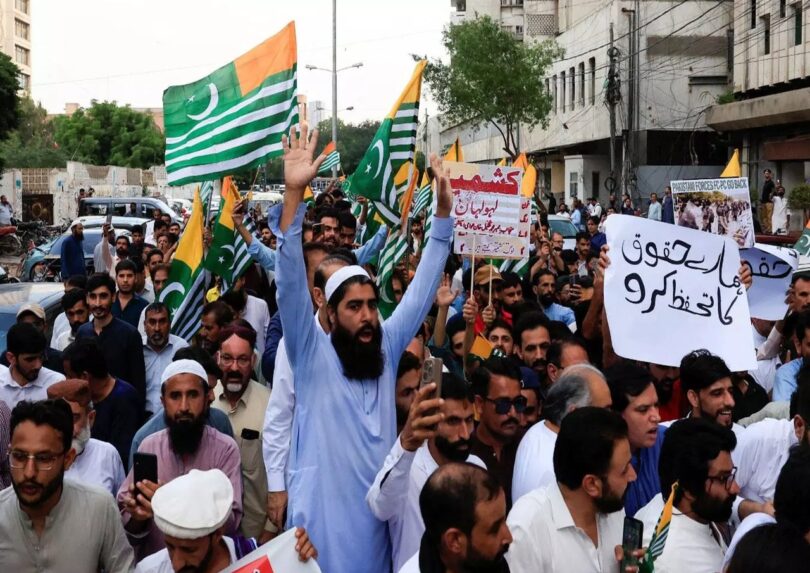
The ongoing mass mobilization in Pakistan-occupied Jammu and Kashmir (PoJK) is indicative of the direct structural shift which has erupted from the culmination of decades of systemic exploitation, political disenfranchisement, and human rights violations by Pakistan. The current development which began in 2023 gained a dramatic momentum, escalating sharply between 2025-2026. The unrest in the region has become reflective of the the fundamental contradiction between Pakistan's claim of "Azad" (free) POJK and the reality of direct colonial-style control from Islamabad.
Background: The Creation of PoJK
The 1947 Partition and Karachi Agreement
Post partition of India in 1947, the princely state of Jammu and Kashmir was divided between India and Pakistan along the Line of Control (LoC). Pakistan-administered Kashmir comprises two territories: Azad Jammu and Kashmir (AJK) and Gilgit-Baltistan (GB).
The 1949 Karachi Agreement was reported to have been signed clandestinely between Pakistan and compliant PoJK representatives. This laid the framework for Pakistani control. In 1993, the agreement became known through a 1993 PoK High Court judgment. It was denounced by that court as "a direct violation of UN Security Council resolutions."
The agreement effectively ceded control of the Northern Areas (now Gilgit-Baltistan) to Pakistan without any plebiscite or democratic consultation.
The Karachi Agreement was reported to have been signed on 28 April 1949 by Mushtaq Ahmed Gurmani, Pakistan’s “Minister without Portfolio” (in charge of the Ministry of Kashmir Affairs), Sardar Mohammed Ibrahim Khan, (President of Azad Kashmir) and Chaudhry Ghulam Abbas (Head of All Jammu and Kashmir Muslim Conference).
Furthermore, apart from being kept as a secret up to the 90’s, the agreement never made the news or a mention in 1949 or in the memoirs of Sardar Ibrahim or any other sources.
In 2008, it was published as the Appendix XVII of The Constitution of Azad Jammu & Kashmir by Justice Syed Manzoor.
Rule by Proxy
The 1974 interim constitution of PoJK centralized primary legislative and executive authority within the Kashmir Council. This was a body chaired by the Prime Minister of Pakistan. This governance structure was largely characterized as a "rule by proxy" due to its ambiguous scope as a result of the locally elected assembly.
Even though the 13th Amendment of 2018 deprived the Kashmir Council of these powers, executive and legislative autonomy was not devolved to the local assembly. The federal government of Pakistan rather, assumed direct authority over 32 key administrative subjects within the territory. Additionally, the local assembly remains dependent on Islamabad's formal approval to enact legislation on the remaining 22 subjects. Centralized federal control is even more defined in Gilgit-Baltistan. Under the Gilgit-Baltistan Order of 2018, the legislative assembly's jurisdiction over 61 previously designated subjects was repealed. Accordingly, statutory and executive authority over the region was effectively consolidated under the direct purview of the Pakistani Prime Minister.
The 2023-2026 Protest Movement: Origins and Escalation
Foundational Fiscal distress
The recent wave of protests can be traced back to May 2024, when JAAC-led protests forced the government to commit to subsidies on flour and electricity. Nevertheless, the deeper roots extend to December 2023, when the 2023-2024 Gilgit-Baltistan protests (also known as the "Wheat protests") flared up in response to stark hike in wheat prices.
The price of subsidized wheat had been raised by the GB government from Rs 20/kg to Rs 36/kg, which had previously increased from Rs 12/kg to Rs 20/kg in June 2023. On 22 December 2023, protests began in Skardu, with the movement spreading to Diamer, Nagar, Hunza, Astore, Ghanche, Ghizer, Shigar, and Kharmang.
Najaf Ali, Awami Action Committee Baltistan (AAC), chairman for Baltistan, stated: "We completely reject the government's decision to increase the wheat prices. Gilgit-Baltistan is a disputed region and the onus is on the government to provide subsidies on 28 things (wheat, salt, sugar, petrol) due to its territorial dispute."
The Joint Awami Action Committee (JAAC) emerged in 2023 as a grassroots response to systemic grievances surrounding escalating electricity tariffs and critical wheat flour shortages. Under the leadership of activist Shaukat Nawaz Mir, the movement institutionalized its platform through the publication of a comprehensive, 38-point Charter of Demands formulated between September and October 2025.
On 29 August 2025, JAAC called for a state-wide shutdown across PoJK starting 29 September 2025. Sardar Umar Nazir Kashmiri, a well known JAAC Core Committee member, declared: "We are activating every union council, tehsil and ward. From Rawalakot to the smallest village, our volunteers are mobilising communities. This is not just a protest—it is a movement for accountability."
In August 2025, a detailed and comprehensive reform agenda called the 38-Point Charter of Demands was enunciated by protest groups in Azad Jammu & Kashmir (AJK). It highlighted the deep-rooted grievances pertaining to governance, economic inequality, political disenfranchisement, and human rights concerns. The subsequent government crackdown in June 2026 has exacerbated the tensions and drawn criticism towards the institutional structures and state response mechanisms. One of the central political demand of the charter was the abolition of the 12 Legislative Assembly seats which were reserved for Kashmiri refugees residing elsewhere in Pakistan. The JAAC indicated that to permit non-residents to exert influence in regional affairs would lead to a poor local representation.
Core Demands Framework
The charter prioritizes systemic restructuring of governance, which included the removal of elite privileges and VIP culture, reduction in government expenditures and enforcement of accountability mechanisms, equitable resource distribution and tax reform, reconsideration of the 12 reserved assembly seats for non-resident refugees, expansion of civil liberties, including press freedom and expression, bolstering local governance structures and addressing enforced disappearances and unlawful detentions
- Economic and Social Measures
The movement calls for immediate relief and long-term socio-economic reforms. These included the subsidies on essential commodities (flour, electricity), elimination of load-shedding, access to affordable healthcare and free education, youth employment and merit-based recruitment systems as well as land reform and compensation for displaced population.
- Infrastructure and Development Priorities
The goals indicated in these demands included expansion of road networks and public transport, universal access to clean water, Digital transformation and IT education, development of tourism and reform on electricity billing systems.
- Social Justice and Institutional Accountability
The charter focuses on inclusive and rights-based governance which include women’s empowerment and child protection enforcement, labour rights and pension reforms, anti-discrimination policies, judicial efficiency and transparency in development projects.
Escalation and State Response
On 5 June 2026, the AJK government proscribed and banned the JAAC under anti-terrorism legislation deeming them as a threat to state security.
On 8 June 2026, the AJK Supreme Court ruled that the 12 reserved refugee seats are constitutionally protected, hence would require formal amendment process involving both the assembly and Pakistan’s approval.
By late May 2026, all negotiations had collapsed, leading to protests and enforcement measures.
Structural Representation Controversy
It is vital to mention that the composition of the AJK Legislative Assembly highlights systemic imbalances.
While the total number of seats is 53 (Directly elected seats: 33, Reserved seats: 12 for refugees outside AJK, 8 for women and technocrats), there are disparities in Representation. According to reports, 464,000 refugees are represented by 12 seats, while 434,000 from Jammu receive 6 seats and 30,000 from the Kashmir Valley are allocated 6 seats respectively. This disproportionate allocation has undermined the regional representation while emphasizing on higher influence and control from out-of-PoJK. According to Article 33, any amendment requires a two-thirds legislative majority and approval from Pakistan. This prevents the local autonomy in any institutional reform.
Human Rights Situation
A July 16 2026 report by the Jammu Kashmir Human Rights Observatory (JKHRO) documents widespread violations during the crackdown period (June 5–July 14, 2026). According to the report, excessive use of brute force was employed against protesters with several cases of arbitrary detentions and enforced disappearances. Communication was curbed in the area with reported internet/mobile shutdowns. The citizens were denied access to essential services with raids and intimidation tactics deployed by law enforcement agencies.
The report has highlighted the Casualties and Impact as well as the discrepancies in official reported figures:
According to JKHRO, the death toll in the area was over 50 (JKHRO) vs. 28 (official reported figures). Over 60,000 individuals were reported to have engaged in the protests.
Affected population: Approximately 3 million
Documented Incidents:
Negotiations between JAAC and the regional government broke down in early June 2026. JAAC called for a region-wide protest and general strike on 9 June.
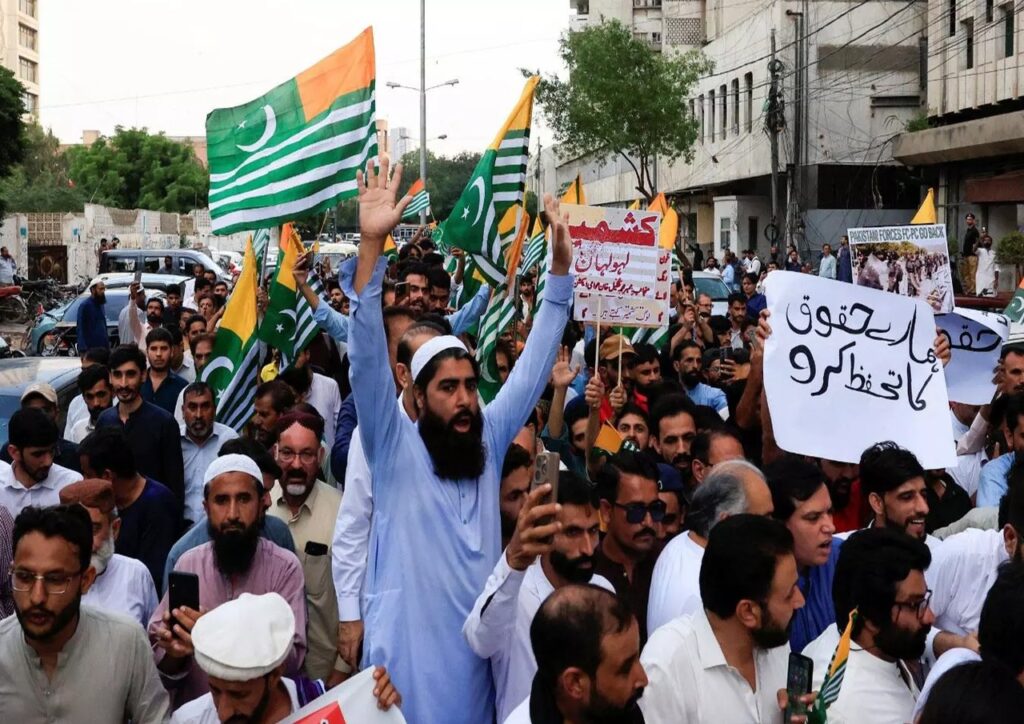
The tensions escalated due to police and law enforcement brutality in their effort to disperse a large gathering in Rawalakot before the planned strike. According to Reuters 11 people were killed and more than 70 injured during the clashes. Protest organisers have pointed fingers to the security forces for opening fire on civilians, while the authorities maintained that personnel reacted in response to the attack from the protesters. There are several reports about arrests, raids and sedition cases against 4 prominent JAAC leaders including Shaukat Nawaz Mir. The regional government also announced a bounty with reward of 10 million Pakistani rupees for information leading to their arrest. The Rawalakot incident sparked a heated response from the Kashmiri diaspora in UK. On 9 June, demonstrators gathered outside a Pakistani diplomatic mission in the United Kingdom, demanding an investigation into the brute force deployed by Pakistan.
On 11 July, Kashmiri communities from Washington DC, Maryland, and Virginia held a demonstration near the White House, calling on the US government and international actors to intervene, restore communications, and demand accountability for protest‑related deaths.
On 14 July, reports of second major round of violence surfaced. The incident erupted a day prior to a planned JAAC march towards Rawalakot. 9 people are killed in separate clashes across Poonch Division. According to officials 6 protesters and 1 police officer were killed in Tararkhal, and one protester and one security official was killed in Rawalakot.
On 15 July, additional solidarity protests were conducted outside the Pakistan High Commission (London) and Pakistan Consulate (Bradford), highlighting the communications blackout and alleged human rights violations.
International Response
The UN High Commissioner for Human Rights Volker Türk called for calm, restraint, and prompt, thorough, impartial investigations into deaths of civilians and security personnel, and urged the authorities and protest leaders to resume dialogue on longstanding political and economic grievances.
Due to the deteriorating security apparatus in PoJK, the Election Commission decides to abandon simultaneous voting. Military personnel are deployed to support security arrangements.
With several leaders detained, facing criminal cases, or barred from participation, JAAC called for a boycott, arguing that elections without resolving the refugee‑seats issue or addressing the crackdown would legitimize an electoral structure that dilutes local representation.
27–28 July Violence and Allegations
Although polling on 27 July was confined to Mirpur, thousands gather in Rawalakot (Poonch) and began a march towards Muzaffarabad, coinciding with the first polling day and following another breakdown in negotiations.
Reports of fresh violence emerge, immediately after the first phase of voting. JAAC alleges security forces used lethal force against unarmed protesters in Rawalakot, Mirpur, and adjoining areas, claiming 25 killed on 27 July and five on 28 July while other accounts estimate 19–30 deaths.
JAAC representatives and some witnesses further alleged that the security personnel transferred the bodies from hospitals and public spaces and restricted access to medical facilities to conceal casualties. These remain unverified due to the internet shutdown, restricted access, and limited independent media presence.
On 28 July, Amnesty International called for a prompt, independent and transparent investigation into alleged lethal force in Rawalakot and demands restoration of internet and mobile services, warning the blackout impedes verification and access.
The 27–28 July incident triggered another wave of diaspora mobilization in Britain, with protests outside the Pakistan Consulate in Bradford condemning the alleged firing and demanding justice. Diaspora networks in the US and UK amplify images, casualty claims, and JAAC appeals, pressing elected representatives, media, and human rights organizations to scrutinize Pakistan’s handling of the protests.
Rawalakot remains under curfew‑like restrictions for over 39 days.
Strategic Assessment
The AJK protests indicate governance deficits, contested constitutional arrangements, and rising state-society friction. Islamabad’s crackdown risks instability rather than seeking a solution to resolve the matter.
Pakistan’s long-standing projection of the UK-based Mirpuri diaspora as “Kashmiris” for its anti-India messaging was undercut by Defence Minister Khwaja Asif himself, who dismissed Rawalkot/Mirpur residents as not “true” Kashmiris after they began criticizing conditions at home.
New Delhi attributes the unrest to Pakistani governance failure. Spokesperson Randhir Jaiswal has called the protests (July 14) a product of “decades-long systemic exploitation” and “excessive police brutality”.
MEA’s Fact Check unit dismissed the July 27 AJK elections as a “cosmetic electoral exercise” (July 28). These are attributed Indian government positions.
Amnesty’s September 2025 investigation is the key independent source which stated that a Lawful Intercept Management System (Germany’s Utimaco, UAE’s Datafusion) gives ISI/military warrantless access to subscriber data and communications, capable of monitoring 4 million+ people at once. A separate Web Monitoring System (2023 upgrade, China’s Geedge Networks plus US/French hardware) enables content-blocking and throttling. Local officials cite “security situation”; Amnesty calls this pretextual. The multinational supply chain complicates any single-actor accountability narrative.
Ahmadis and Shia face compounding pressure from anti-Ahmadiyya laws and sectarian violence with state-enforcement dimensions.
JAAC leader Sardar Aman Khan’s line has also stated “PoK is not Azad, it is disputed”. A day later, JKHRO report a day later, marked local actors for reframing their own status. If JKHRO’s allegations hold, Pakistan’s monopoly on the Kashmir rights argument at the UN weakens, and the vote reads as a referendum on a rejected arrangement.
More on POJK:
From Gaza to Kashmir: Jihadist convergence of Hamas and Pakistan based Terror groups: https://www.thestrategicperspective.org/from-gaza-to-kashmir-jihadist-convergence-of-hamas-and-pakistan-based-terror-groups/
Musa, LeT and ISI in the aftermath of Pahalagm attack: https://www.thestrategicperspective.org/musa-let-and-isi-in-the-aftermath-of-pahalgam-attack/
General Munir’s Reckoning: https://www.thestrategicperspective.org/general-munirs-reckoning/