
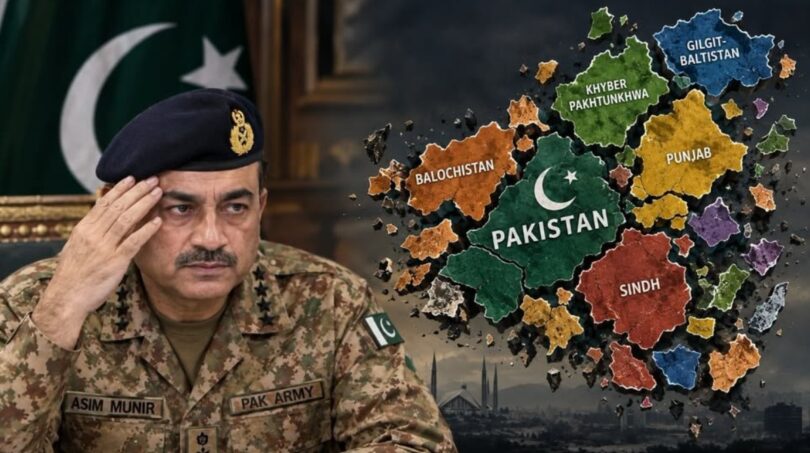

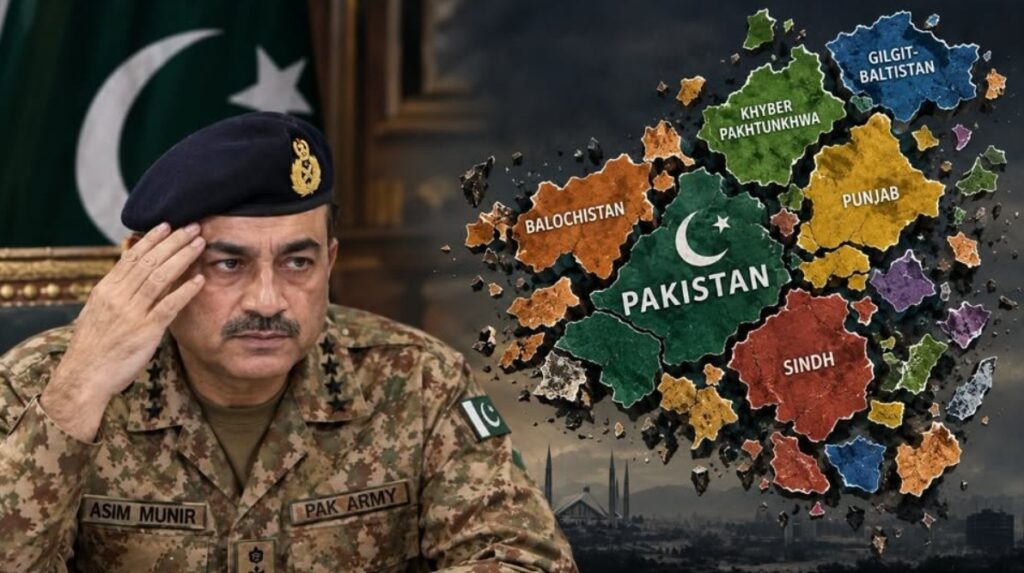
According to reports, Pakistan's government and military establishment has been deliberating on the restructuring of its four provinces (Punjab, Sindh, Khyber Pakhtunkhwa and Balochistan) by splitting them into multiple smaller units. The provinces have not been altered since 1947. It is assumed that real intent behind this proposed plan is to enervate the regional powers and reinforce the army's control under Field Marshal Asim Munir. Contrarily, the reasoning is justified as reinforcement of effective governance in all the provinces as they are too large to govern.
Despite the supposed proposed plan, its is yet to be established if there is an official map, draft bill or constitutional text been published. At the moment, there is no indication of the above.
The numbers of possible units, that the provinces may be divided into come from different people and present different things.
- The "160" is not a count of provinces. Planning Minister Ahsan Iqbal stated that it as an alternative which could be to either create new provinces, or give about 160 districts real governing powers. The "12 to 15" figure reported by The Economist and reported by other outlets, remains unverifiable.
- Additionally, Munir has not publicly backed the idea. An official statement remains yet to be published. It has been established at the time, the Economist’s reporting comes from the views of people close to Munir, and the fact that Interior Minister Mohsin Naqvi, seen as close to him, has reportedly started the debate.
- The law gives Sindh a veto. Also, province's borders cannot change unless its own assembly approves by a two-thirds majority. Sindh's assembly has unanimously rejected any split on 3 September. The open question is whether the government goes through that door or tries to steam roll the decision.
- The insurgency premise. Pakistan has sustained insurgencies in Balochistan, Khyber Pakhtunkhwa and in Sindh, and none in Punjab. These provinces in revolt would certainly dampen the possible plan.
What is actually being proposed
The claim going around is that Munir wants to replace the four provinces with 12, 15 or even 160 units, run by elected chiefs, assemblies or "nominees of the government". Each piece traces back to a different source.
Claim | Who said it | What it really is |
A dozen or more provinces, "about 12 to 15"; rulers could be elected chiefs, provincial or district assemblies, or nominees of "the government", essentially the Field Marshal | The Economist, as summarised by The Week (9 Oct) | Claims not verified. |
15 provinces, or 160 district governments | Planning Minister Ahsan Iqbal, early September, per Express Tribune and Arab News | On the record from a cabinet minister. Geo reports it as "12 to 15 new provinces". |
12 provinces of about 20 million people each, up to 38 units of about 6.3 million | Think tank of former caretaker PM Anwar-ul-Haq Kakar and Gohar Ijaz, per Arab News (Aug 2025) | A published model, not a government plan. |
Balochistan into two, Punjab into three, Karachi and Gwadar under federal control, Khyber Pakhtunkhwa into Pakhtun and Hazara areas | An unnamed "top government functionary", per Dawn (15 Aug) | One option "under serious consideration"; anonymous sourcing. |
Munir calls administrative division "inevitable" | Federal minister Mustafa Kamal (MQM-P) | Kamal's paraphrase of a conversation he says happened three years ago. Unverified. |
The Dynamics of Pakistan's Administrative Reform Debate (2025–2026)
To comprehend the recent debate over restructuring Pakistan’s provinces, it is vital to trace the institutional consolidation of military power and the timeline of the political discourse.
The military rule in Pakistan has persisted for 33 of its 78-year history. Recent legislative changes have further institutionalized this influence:
May 2025: General Asim Munir was appointed Field Marshal following a four-day conflict with India triggered by the Pahalgam attack.
The 26th Amendment: This amendment extended the terms of all military service chiefs to five years.
November 2025 (The 27th Amendment): Signed by President Asif Ali Zardari, this amendment drastically changed the defense architecture. It passed the National Assembly on November 12, 2025, with an overwhelming 234–4 majority after an opposition walkout (Aaj News; some sections of the report cite 231 votes).
It abolished the post of Chairman Joint Chiefs of Staff Committee and established the position of Chief of Defence Forces (CDF), assumed by the Army Chief. The CDF was granted lifetime legal immunity, rank, and privileges (Gulf News), alongside reported control over the nuclear arsenal. According to an Institute for Defence Studies and Analyses (IDSA) brief, the CDF can only be removed by a two-thirds parliamentary majority. The amendment also established a Federal Constitutional Court, with judges appointed directly by the government.
Can it legally happen?
The rule. Article 239(4) of the Pakistani constitution states that a bill that changes a province's borders is not subjected to be presented to the President unless the province's own assembly passes it by a two-thirds majority of its total members. Furthermore, the bill needs two-thirds in both the National Assembly and the Senate.
The government can reach two-thirds in Parliament but it is rather difficult with regards to the provincial assemblies, which the federal coalition does not control.
Who holds a veto, and where they stand
Actor | Position |
Sindh Assembly (PPP-led) | Unanimous resolution of 3 September rejecting any split or federal administration of any part of Sindh, citing Article 239(4) |
Sindh Chief Minister Murad Ali Shah (PPP) | "No one has the power to divide Sindh" (Geo, Nov 2025) |
Bilawal Bhutto Zardari (PPP) | Wants the issue debated in Parliament; has said provincial allocations "can increase but cannot be reduced" (Express Tribune; The News) |
KP Chief Minister Sohail Afridi (PTI) | "I stand with the people of Sindh against this division" |
PTI chairman Gohar Ali Khan | Wants a commission and consensus first |
National Party, Achakzai and other opposition leaders | Will not accept new provinces; want an All Parties Conference |
MQM-P | Supports new provinces and a separate Karachi; threatens street protest |
Supreme Court Bar Association | Endorses the proposal |
Ways around the veto.
- Call them "administrative units", not provinces. Khawaja Asif popularized the term. Whether a sub-provincial unit with its own assembly escapes Article 239(4) would end up in court.
- Put Karachi and Gwadar under federal control. One option mentioned in Dawn's source. Sindh's resolution anticipates it explicitly. Husain Haqqani compares it to creating a Maharashtra without Mumbai.
- Fund local governments directly from Islamabad, bypassing the provinces. One analyst calls this recentralization that would weaken the formula for sharing revenue (the NFC Award).
- Start with Islamabad. Naqvi has called himself the "biggest proponent" of an Islamabad province, and Iqbal's committee has drafted a 27-member elected assembly for the capital territory, still awaiting the prime minister's approval. This touches no province's borders and may be the least contested first step.
- An extra-constitutional route. Altaf Hussain has claimed the establishment could impose martial law and pass the change afterwards; Ayesha Siddiqa said a referendum is unlikely without martial law. These are predictions, not reported plans.
Under the 7th NFC Award (2009), the provinces get 57.5% of the shared tax pool and the center 42.5%. During talks on the 27th Amendment, drafts reportedly included removing a protection for the provincial share, as a result the PPP refused. Separately, a decision to freeze provincial development allocations for three years is expected to free more than Rs900 billion for the center.
If anything is challenged, it would expectedly be directed to the new Federal Constitutional Court, whose judges are appointed by the government.
The case for reform, and the case for suspicion
- Punjab has about 128 million people, over half the country. Balochistan has about 15 million, around 6%.
- Iqbal argues that provinces devolved no powers to local bodies after 2010. Article 140A already requires provinces to establish local governments, and the Supreme Court in 2022 required real devolution. Economist Khaqan Najeeb says only 4.7% of GDP is spent locally (Arab News).
- The Kakar-linked think tank cited poverty of 30% in Punjab, 45% in Sindh, 48% in Khyber Pakhtunkhwa and 70% in Balochistan.
- Resolutions for South Punjab and Bahawalpur provinces passed in 2012 under a PPP-led government and never came into effect. The MQM has long wanted a separate Karachi.
- Naqvi drew parallels with India, citing India’s transition from 14 provinces to 29. Iqbal cites India with 28 and Afghanistan with 34. These are loose comparisons, given that India's units are states with elected governments, an independent election commission and independent courts.
- Former finance minister of Pakistan, Miftah Ismail says smaller provinces are no substitute for empowered local governments. Abid Qaiyum Suleri stated that if replaced, decisions would remain centralized despite the number of provinces.
- PPP's Raza Rabbani highlighted that failures would come from violated constitutional rules, eroded provincial autonomy and "civil-military bureaucratic control", not from the provinces' size.
- Each new province needs a secretariat, assembly and bureaucracy. The KP government says the 2018 tribal-district merger remains unresolved on NFC financing eight years later.
- Zahid Hussain stated that even though Naqvi's critique of governance is accurate, it disregards the security establishment's long dominance, and that Pakistan can only rely on force in Khyber Pakhtunkhwa, Balochistan and Pakistan-occupied Jammu and
- Husain Haqqani believe the true intention is to is undo existing provinces to transfer resources to the center. Fazlur Rehman warned against "imposition of new provinces without debate".
The insurgency picture
There are two sustained insurgencies, in Balochistan and Khyber Pakhtunkhwa. Sindh has a smaller militant problem, mostly in Karachi. Punjab has almost none.
The table below is determined on basis of Monthly figures from PICSS (the Pakistan Institute for Conflict and Security Studies):
Region | Attacks, July 2026 | Attacks, August 2026 | Deaths, July | Deaths, August |
Balochistan | 83 | 89 | 372 | 194 |
Khyber Pakhtunkhwa, mainland | 36 | 54 | 154 | 104 |
Khyber Pakhtunkhwa, merged districts | 23 | 52 | 79 | 67 |
Sindh | 2 | 2 | 1 security-force death | 1 |
Punjab | 0 | 2 | 0 | 3 |
National | 144 | 199 | 606 | 369 |
July 2026 was the deadliest month according to the data. Different trackers count attacks differently, the numbers need to be treated as indicative. PICSS's own August report gives 369 deaths in one place and 378 in another.
Balochistan. The Baloch Liberation Army (BLA) is the main insurgent group. PIPS recorded at least 254 attacks and 1,026 casualties in 2025, up 26% on 2024. The BLA's coordinated attacks on 30 to 31 January 2026 killed nearly 50 by one account, with the military reporting 17 security personnel and 31 civilians dead. Separate claims are reported: the BLA stated it killed 84 security personnel, which could not be verified. Islamabad as anticipated blamed India, which India has firmly rejected. The Pakistani state's coercive approach has hit an impasse.
Khyber Pakhtunkhwa. The Pakistani Taliban (TTP) and allied groups are active. Pakistan struck alleged TTP and ISIS-K camps in Afghanistan on 21 February 2026 and conflict followed, with sharply disputed casualty claims. The province is governed by the PTI, which opposes the army-backed federal order.
Sindh. PICSS counted 34 militant attacks in Sindh in 2025, 24 of them in Karachi. The Sindhudesh Revolutionary Army (SRA) claims small attacks and PICSS rates its capability as limited.
Punjab. PICSS found two attacks and three deaths in August and none in July. Punjab matters for another reason: it is the PML-N's base and it is also the region where the army became most unified.
Other unrest. deadly clashes in Pakistan-administered Jammu and Kashmir on 9 June 2026, and the PTI's protest movement for jailed leader Imran Khan.
What Munir’s provincial plan could mean for Pakistan
The implications depend less on the number of provinces but more so on three things: who appoints the heads of the new units, how the funds are directed to them, and whether the plan is pushed through provinces already in revolt.
Additional Breakdown
- The Question of direct or indirect military rule?
It is evident that Munir now has constitutional immunity with command of all services and a longer term. It is also evident that the 27th Amendment "inches" Pakistan closer to direct military rule. Yet there are no official reports of a plan for formal martial law, and Prime Minister Shehbaz Sharif has reportedly described the system as a "hybrid regime" (WION). Pakistan's army has often preferred military influence masked with a façade of a civilian front. Under that plan, dozen or more units headed by nominees would give the center a way to reach below the provincial level, where elected governments find it hard to resist. How the model functions would greatly depend on the appointment rule, which is unpublished. The "nominee" model is the Economist's description of a possible outcome, not a reported draft.
- Dividing the opposition's strongholds.
The plan is assumed to be aimed at Punjab and Sindh, the bases of the PML-N and the PPP (the Economist per The Week, Shekhar Gupta, IDSA's Ashish Shukla). Splitting is cheaper than dismantling a party. The PPP's grip on Karachi is the specific stake: the MQM-P wants a separate Karachi, and Sindh's assembly rejected federal control of any part of Sindh. The risk is that the PPP and PML-N are the coalition that passed the 27th Amendment. Alienating them tests how far their dependence on the army goes.
- The money/funds
The center’s finances are stretched. ThePrint reported that Pakistan’s defence spending rose almost 20% this year, and provincial development funds are frozen for three years to free Rs900 billion for the center. New provinces will add new claimants on the shared tax pool, which weakens the existing provinces' bargaining position. The cost to the center is that more provinces mean more recurring expenses and more demands from weaker units.
- Balochistan
According to Dawn's source, there is a suggestion for two provinces, but no lines are published. Parties in Quetta have called the plan a bid for the province's resources. A split along ethnic lines could formalize Baloch-Pashtun separation and shrink the territory a Baloch-majority provincial government controls, which would feed the insurgents' claim that Islamabad exploits the province. IDSA says Balochistan's share of the Saindak project fell to 2%. Federal control of Gwadar, the port at the center of the China-Pakistan Economic Corridor (CPEC) would exacerbate that grievance. Any change imposed during active military operations is likely to be read as a counterinsurgency measure, not an administrative one. That is judgment, not data.
- Khyber Pakhtunkhwa
A Pakhtun-Hazara split would break up a PTI-governed province that is on the front line of the Afghan conflict. The 2018 tribal-district merger shows how hard structural change is here: financing is still unresolved. The security risk is practical. Counterterrorism, police and civil administration would all be reorganized while the TTP is attacking in Bannu, Kohat and the merged districts.
- Sindh
This is where the plan is highly likely to stall or be anticipated to be fought politically. Afridi's pledge to stand with Sindh, Ayesha Siddiqa's warning of civil conflict and the assembly's unanimous vote show leaders ready to escalate. Sindhi nationalist militancy is reportedly small, but a plan seen as taking Karachi from Sindh could most definitely widen its recruiting pool. That is a risk to weigh, not a prediction.
- Friction inside the government.
The Sharif government is ambivalent. Khawaja Asif's tone which has quite dubiously changed between August and September, and the Raiwind meeting produced no statement. If the PML-N concludes the plan threatens Punjab, its calculation about the military changes.
- The courts and legitimacy.
The Federal Constitutional Court, with government-appointed judges, would likely decide any dispute. A ruling for the plan can be clearly read as the court endorsing a power grab. A ruling against the military establishment would test the court's independence. The Pakistan Bar Council says the plan must stay strictly within the constitutional framework, while the Supreme Court Bar Association has endorsed it.
Conclusion
Pakistan’s proposed provincial restructuring can be comprehended beyond the mere administrative question. It would most certainly restructure and alter the relationship between regional political power, federal authority and the military establishment.
Creating smaller provinces might improve representation and public-service delivery, but it would fragment established political constituencies, increase fiscal dependence on Islamabad and make collective provincial bargaining more difficult.
These potential effects explain why the initiative has attracted scrutiny in the context of Field Marshal Asim Munir’s influence.
It can be expected that the territorial restructuring will produce decentralization and concentrate practical authority in the federal establishment.
More on Pakistan policies:
Pakistan, Houthis and the Mecca Pact: https://www.thestrategicperspective.org/pakistan-houthis-and-the-mecca-pact/
Integrating Pakistan Occupied Kashmir: https://www.thestrategicperspective.org/integrating-pakistan-occupied-kashmir/
The “Azad” Kashmir Myth: PoJK’s Protest Movement and Pakistan’s Rights Record: https://www.thestrategicperspective.org/the-azad-kashmir-myth/
Sentenced to Silence? Mahrang Baloch’s Life Imprisonment Raises Uncomfortable Questions for Pakistan: https://www.thestrategicperspective.org/sentenced-to-silence-mahrang-balochs-life-imprisonment-raises-uncomfortable-questions-for-pakistan/
Saudi Arabia Blocks Pakistan’s $5.5 Billion African Arms Push in Major Strategic Shift: https://www.thestrategicperspective.org/saudi-arabia-blocks-pakistans-5-5-billion-african-arms-push-in-major-strategic-shift/