

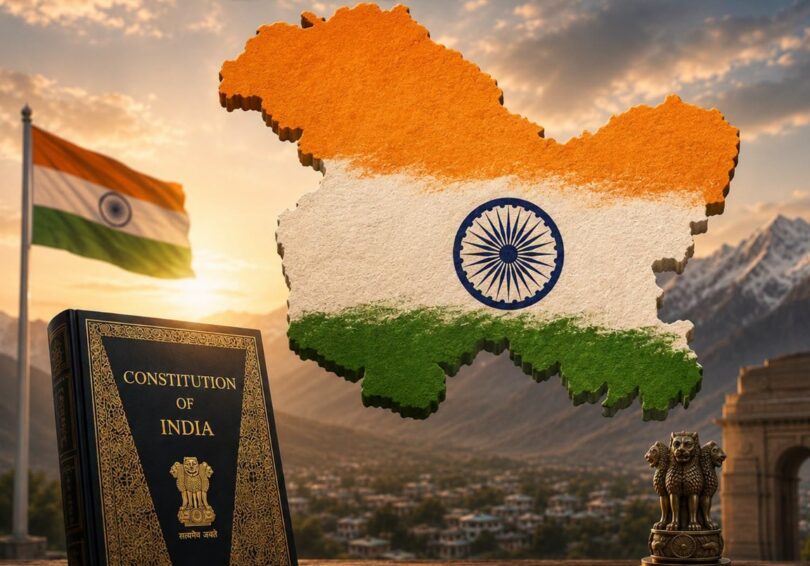

On 5 August 2019, the abrogation of Article 370 became the most consequential constitutional amendment in India’s post-Independence history. The abrogation of Article 370 catalysed a structural realignment in Jammu and Kashmir, immensely reshaping its security framework, accelerating its political integration, and redirecting its socio-economic development.
Even though terrorism had not been eradicated in all entirety, as reflected by the events of 22 April 2025 Pahalgam attack, the larger evidence still points to a substantial decline in routine militancy, street violence, shutdown politics, and local recruitment, alongside a more decisive counter-terror posture by the Indian state.
Comparatively, it has become notably evident that Jammu & Kashmir and Pakistan-administered territories have developed drastically differently since then - while J&K have grown economically and socially, POJK has remained a hotbed of instability and economic decay. On the Indian side, Srinagar has hosted the G20 Tourism Working Group, elections have returned to the area, tourism has boosted, and normal public life has reasserted itself. Contrary to Islamabad's assertions, empirical evidence contradicts Pakistan’s narrative that the abrogation of Article 370 would lead to destabilization of the region and prompt irreversible civil unrest.
Article 370, not be regarded simply as mere a legal clause was constitutional expression of an extremely unusual political settlement which emerged from the partition of India and the accession crisis of 1947. Hence its abrogation on 5 August 2019 was significant beyond the immediate legal mechanics. The abrogation restructured the constitutional relationship between Jammu & Kashmir and the Indian Union. It terminated the special status framework and initiated a new governance model based on direct integration, uniform legal application, and a reinforced central security authority.
Even though there has been a considerable development, the critics continue to wonder if Kashmir became peaceful in an absolute sense. It may be noted that despite the potential threats from cross border terrorism or the residual terror potentials or sleeper cells, the region’s overall trajectory has been improved. Overall, official statements and media reporting indicate to lower terrorist incidents, reduced civilian casualties, fewer shutdowns, diminished stone-pelting, and stronger democratic participation since 2019. Those changes do not eliminate the political controversies surrounding the abrogation, but they do support the claim that the post-2019 order has produced a more stable and governable region.
Historical Background
After Independence in August 1947, the princely state was invaded by Pakistan-backed tribal raiders in October 1947. Maharaja Hari Singh was forced to sign the Instrument of Accession on 26 October 1947. The accession transferred authority over defence, external affairs, and communications to India, while leaving other powers with the state. It is imperative to mention that Article 370 translated this arrangement into constitutional form as a temporary, transitional provision.
Proponents characterized the provision as an indispensable constitutional safeguard for regional autonomy and indigenous identity, whereas detractors have argued that it constituted an impediment to full national integration, legal harmonization, and socioeconomic development. Prior to its abrogation on 5 August 2019, Article 370 had transformed as one of the most contentious focal points within the framework of Indian constitutional jurisprudence.
The 2019 Constitutional Turning Point
On 5 August 2019, the Union government promulgated the Constitutional Order 272. As a result, this superseded the in-place Jammu & Kashmir constitutional governing framework, and the Indian Constitution now applied in extenso to the region. Subsequently Article 370 was rendered inoperative.
The Jammu and Kashmir Reorganisation Act was passed, it bifurcated the former state into two Union Territories: Jammu & Kashmir, and Ladakh. The reorganization came into effect on 31 October 2019.
Central laws, which previously could not be enacted to the region, now also extended more uniformly, and institutions responsible for administration, policing, and development were able to operate under a less fragmented legal framework. The Supreme Court’s unanimous 2023 decision upholding the abrogation further consolidated the legality of the new constitutional order.
Security Before 2019
The security environment before August 2019 indicates that the region had experienced multiple forms of violence which included armed insurgency, cross-border terrorism, targeted killings, mass protests, stone-pelting campaigns, separatist shutdowns, and recurring cycles of civil unrest.
The insurgency in Jammu and Kashmir can be traced to 1989 amidst the political discontent, separatist mobilization, and the support from Pakistani state or its home-grown militant groups. The local insurgency rapidly transformed into a sustained campaign involving terror outfits such as Hizbul Mujahideen, Lashkar-e-Taiba (LeT), Jaish-e-Mohammed (JeM), Harkat-ul-Mujahideen, and other Pakistan-backed groups.
The 1990s and early 2000s indicated a sharp spike in violence and terrorism. Terrorists targeted security personnel, government officials, political workers, minority communities, and civilians accused of cooperating with the state. Simultaneously, operations intensified as security forces sought to dismantle militant networks.
The conflict also contributed to massive demographic upheavals - exodus of large sections of the Kashmiri Pandit community from the Valley following threats, targeted killings, and widespread insecurity.
By the early 2000s, Kashmir had transformed into a militarized conflict zone, with fatalities among civilians, militants, and security personnel reaching levels unprecedented in independent India.
Between 2004 and 2014, it appeared that the number of active militants fell substantially, and the frequency of large-scale attacks seemed less prevalent. Kashmir appeared to be moving away from full-scale insurgency. However, even though terrorism-related fatalities decreased, alienation among sections of the population remained unresolved. This manifested through mass street mobilization.
Post 2008 Kashmir saw mass protests as a mode of political expression and confrontation.
The 2008 Amarnath Land Agitation
The decision to transfer land to the Shri Amarnath Shrine Board led to widespread protests across the Valley and countermobilization in Jammu. This led to months of demonstrations, strikes, curfews, and confrontations which disrupted life.
The 2010 Summer Unrest
In 2010 following the Machil encounter controversy, there were protests and a massive outcry.
The Valley shook with months of demonstrations, clashes, and curfews. Separatist leaders issued protest calendars and shutdown schedules that effectively governed daily life. Educational institutions, businesses, and transport services frequently remained closed.
The Burhan Wani Effect and the Revival of Militancy
After the killing of Hizbul Mujahideen commander Burhan Wani on 8 July 2016, the tensions escalated. Wani had cultivated a significant social media presence. Photographs and videos portrayed the terrorists or armed militants as a symbol of resistance among sections of Kashmiri youth. After the encounter, his death triggered unrest in Kashmir. Demonstrations spread rapidly across South Kashmir and later across the Valley. Curfews were consistently imposed; communication networks were restricted and prolonged hartals disrupted economic activity.
Stone-Pelting as a Security Challenge
Post-2010 era also witnessed the rise of organized stone-pelting.
Security forces were often met with large mobs who would pelt stones, obstruct operations, and occasionally facilitate the terrorist in escaping. While stone-pelting may not be regarded as a form of terrorism in the conventional sense, it certainly can be viewed in scope of a part of a broader ecosystem aiding militant/terror activity.
The Resurgence of Local Militancy
Between 2015 and 2019, security agencies recorded a notable increase in local recruitment into militant organizations.
In the late 2010s, there was a large proportion of militants who were recruited locally from within the Kashmiri community. In the past, most of the recruits were typically chosen from Pakistan and Afghanistan. According to reports, South Kashmir districts such as Pulwama, Shopian, Kulgam and Anantnag emerged as major recruitment hubs.
Major Terrorist Incidents Before 2019
Despite the overall decline from the violence levels of the 1990s, terrorist groups retained the capability to conduct strategically significant attacks. Amongst these attacks, there were some significant ones such as:
- The 2001 attack on the Jammu and Kashmir Legislative Assembly.
- The 2002 Kaluchak massacre targeting military families.
- The 2005 Srinagar attacks targeting civilian and political institutions.
- The 2016 Uri attack in which 19 Indian soldiers were killed.
- The 2017 Amarnath Yatra attack targeting Hindu pilgrims.
- The 2018 Sunjuwan military station attack.
- The February 2019 Pulwama attack led to the deaths of 40 Central Reserve Police Force personnel and triggered the most serious India-Pakistan military confrontation since the 1999 Kargil conflict.
These incidents highlighted that Pakistan-based terrorist organizations retained both operational intent and capability.
The security environment in Jammu and Kashmir before the abrogation of Article 370 cannot be understood solely through casualty statistics or terrorist incident counts. By 2019, the conflict had evolved into a multidimensional challenge encompassing armed insurgency, Pakistan-backed terrorism, local militant recruitment, digital radicalization, mass protests, stone-pelting campaigns, and prolonged separatist shutdowns.
The Valley was significantly less violent than during the height of the insurgency, yet it remained far from stable. The resurgence of local militancy after 2015, the massive unrest following Burhan Wani's death, the persistence of separatist mobilization, and high-profile attacks such as Uri and Pulwama reinforced a perception within New Delhi that the existing political and security framework had failed to deliver durable peace.
Consequently, the abrogation of Article 370 emerged not in response to a single security event, but against the backdrop of three decades of evolving violence—one that had shifted from large-scale insurgency to a more complex blend of terrorism, civil unrest, political mobilization, and societal radicalization.
Article 370 as a Governance Constraint
Article 370 did create administrative and legal constraints which limited the Union’s ability to apply national laws invariably across the territory. A wide range of laws and institutional frameworks did not fully apply in Jammu & Kashmir before 2019, including parts of the IPC, the Prevention of Corruption Act, the RTI Act, the RTE Act, and other central legislation. Constrained operational reach and fragmented legal frameworks prevented the harmonization of land and investment governance. This institutional fragmentation sustained elite capture, administrative discretion, and lopsided development, fostering a political economy where legal exceptionalism and insecurity became mutually reinforcing.
In this way, the state operating with weaker legal tools, fragmented jurisdiction, and a climate of political exceptionalism, became conducive for overground worker networks, terror financing, collaborators. The pre-2019 environment therefore cannot be understood simply as “violence in the Valley”, but has to be viewed also as a broader system in which law, politics, and militancy interacted.
Post-2019 Security Decline
In December 2021, the Ministry of Home Affairs stated that terrorist incidents in Jammu & Kashmir had fallen from 417 in 2018 to 203 by 30 November 2021, while also noting broader improvements in the security situation.
By early 2024, Union Home Minister Amit Shah cited a 66 percent decline in terrorist incidents, an 81 percent decline in civilian killings, and a 48 percent decline in security-force deaths since the abrogation of Article 370. He also highlighted the decline of organized stone-pelting in 2023 and the elimination of organized shutdowns that had once crippled the normalcy in the region.
Counter-Terrorism Operations
While examining the developments since abrogation of article 370, it can be ascertained that there is a sharp decline in terms of protests, violence and militancy, however the complete termination of terrorism still remains an ongoing challenge. The Pahalgam attack of 22 April 2025 indicated that terrorism remains a live threat despite the improvised developments since 2019. However, the aftermath of the Pahalgam attack also reflected a counter-terror model that was faster, efficient, and more conclusive than many earlier responses in the region.
India’s response unfolded through Operation Sindoor on 7 May 2025, a tri-service strike campaign that hit terror infrastructure across Pakistan and Pakistan-occupied Jammu & Kashmir. This was followed by Operation Mahadev on 22 May 2025, a joint Army-CRPF-J&K Police operation in Dachigam that eliminated the perpetrators. The combination of cross-border precision strikes and ground-based elimination of attackers signalled a more integrated and assertive security doctrine.
The significance of these operations is not only tactical but structural. They show that the Indian state’s counter-terror capability in J&K has evolved from reactive containment toward intelligence-led pursuit and decisive follow-through. In comparative terms, this is a substantial departure from earlier eras when major attacks were often followed by long, inconclusive mobilizations or limited retaliation.
Two realities emerge from the Pahalgam attack: first, the terrorism has not been completely eliminated and second, that the post-2019 state is now able to respond with greater coordination and effectiveness. A region can have a declining violence curve and still experience high-impact attacks. The crucial question is whether the state is more capable of detecting, containing, and punishing such attacks than before. On available evidence, Jammu & Kashmir today is better able to do so than it was in the pre-2019 period.
Importance of Abrogation of Article 370 in Governance
The extension of central laws and the removal of the old constitutional asymmetry have given an allowance for institutions such as anti-corruption agencies, welfare legislation, and administrative regulations to operate more cohesively. That legal integration was part of the government’s stated rationale for the move and has remained as a focal point to the post-2019 development agenda.
After decades of political unrest, democratic participation has returned to the region. The 2024 Assembly elections, held after the Supreme Court’s December 2023 judgment, was monumental in normalcy being restored. The large turnout for voting also indicated that a significant share of the population was willing to re-engage with democratic institutions despite lingering disagreements about autonomy and statehood. With a steady security apparatus, elections have been conducted smoothly, and more likely to hold importance especially since the public order is not dominated by militancy, mass shutdowns, or fear of reprisal. Thus, the political normalization of J&K is inseparable from the security normalization that followed 2019.
Economic Transformation
The post-abrogation period has seen an influx of tourism, greater investor interest, and a broader reactivation of ordinary economic life. While these developments do not erase structural challenges, they do suggest that the region is more attractive to economic activity than it was when recurring violence defined the business climate. Amit Shah pointed to higher investment flows, higher GSDP, and the transformation of public life from shutdowns and bomb blasts toward schools, colleges, industries, and infrastructure. The broader economic logic is straightforward - stability reduces transaction costs. When roads remain open, internet access is available, markets are functioning, and security conditions are predictable, tourism and entrepreneurship become possible in ways they were not during the prolonged conflict years.
The contrast between Jammu & Kashmir and Pakistan-administered territories has also sharpened considerably since 2019. Srinagar hosted the G20 Tourism Working Group in May 2023, an event that showcased international confidence in the Valley’s security and administrative capacity. In contrast, PoJK has continued to face instability, economic protest, communication restrictions, and governance crises.
Conclusion
The abrogation of Article 370 should be understood as a structural intervention rather than a single-cause explanation. It should be viewed as a process which altered the legal and political environment in which militancy operated. That environment had earlier been marked by legal asymmetry, administrative fragmentation, and an insurgent protest culture.
Article 370 bolstered the uncertainty and contributed to a legal and political structure that allowed instability to thrive and hard to resolve.
Since its abrogation on 5 August 2019, the region entered a different phase. Terrorism declined, organized violence weakened, the state became more capable of counter-terror action, elections returned, tourism grew, and the public order environment improved substantially.
More J&K related topics:
White-collared terrorists and their Pakistan-loving Kashmiri predecessors: https://www.thestrategicperspective.org/white-collar-terrorists-and-their-pakistan-loving-kashmiri-predecessors/
Munir’s Anti-India prattle and blame games: https://www.thestrategicperspective.org/munirs-anti-india-prattle-and-blame-games/
Remembering the Pulwama attack (2019) and India’s strategic reprisal against Pakistan: https://www.thestrategicperspective.org/remembering-the-pulwama-attack-and-indias-strategic-reprisal/
Pahalgam Terror Attack: https://www.thestrategicperspective.org/pahalgam-terror-attack/
Political leaders spark tension, 20,000 additional CRPF deployed, many separatists apprehended and concerted deradicalisation needed in J&K: https://www.thestrategicperspective.org/political-leaders-spark-tension-20000-additional-crpf-deployed/








A detailed and insightful piece.Must read article offering a nuanced and comprehensive presepective
A comprehensive analysis packed with valuable insights