
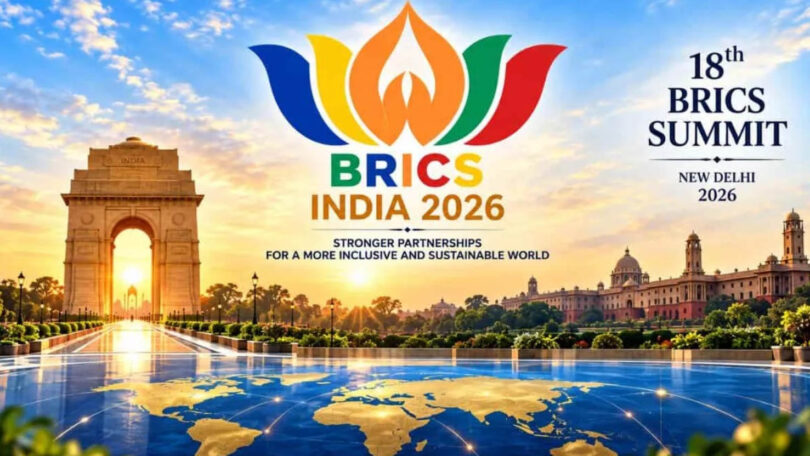
Preparations are in full swing in New Delhi to host the 18th BRICS Summit on September 12-13, 2026, under the theme 'Building for Resilience, Innovation, Cooperation and Sustainability'. The BRICS economic bloc has officially overtaken the G7 in terms of Purchasing Power Parity (PPP) -adjusted GDP. According to the IMF, the combined economic output of the expanded BRICS bloc has reached USD 88 trillion, surpassing the G7's USD 62 trillion. This G7-BRICS gap has dramatically widened beyond 2020 due to: G7 economies are growing at roughly 1.1% annually compared to over 4% of BRICS nations. The BRICS bloc has expanded to include economic and energy heavyweights like Egypt, Ethiopia, Iran, the UAE, and Indonesia. BRICS now commands roughly 40% of global GDP and half the world's population; integration of major oil producers into the bloc has shifted global trade dynamics, allowing member countries to increase domestic trade efficiency and bypass traditional Western channels.
Alongside the 18th BRICS Summit, more than 500 institutional investors, finance ministers and business leaders, managing a combined USD 1 trillion in capital, are poised to attend what is being termed as the first 'iBRICS Summit" organised by the Sovereign Wealth Fund Institute; it will connect sovereign investors with infrastructure, energy and digital projects across the 21 BRICS member states and partner nations. Separate meetings will look at projects in infrastructure, technology, critical minerals and energy transition. A proposed 'Sovereign Capital Compact' is also proposed to be signed. Chairing the summit, India is expected to push for cooperation in technology, digital payment systems, critical minerals, clean energy and elevating the Global South, as America's Donald Trump administration watches the Russia-India-China confluence and proceedings of the Summit in general, particularly non-dollar settlements and payment systems among BRICS economies.
BRICS affects de-dollarization by promoting bilateral trade in local currencies, building alternative payment systems, and using development finance through institutions like the New Development Bank. However, the bloc’s impact is gradual rather than revolutionary due to wide gaps in currency convertibility, market depth, and member trust. The BRICS Council Analysis explains that the bloc's approach to de-dollarization is not a sudden rebellion to destroy the dollar, but a process of practical gradualism. Several major hurdles keep this shift slow due to: strict rules on moving money in and out of countries; convertibility of most BRICS currencies; absence of large pool of cash in alternative financial systems; conflicting views of members to build an economic counterweight to the West; trade gaps between member states; rapid addition of new countries (like Iran, Egypt, and the UAE) introduces widely different foreign policy priorities; heavy political and tariff threats from Western economies; strong external economic pushback has caused leaders to scale back bold plans for a shared BRICS currency.
The Trump Administration views the leaders of Russia, India, and China at the 18th BRICS Summit in New Delhi with a mixture of deep economic scepticism, aggressive tariff threats, and geopolitical concern: the US is highly critical of any moves by BRICS leaders to trade in local currencies or build alternatives to the US dollar; Trump warned BRICS nations they will face 100% tariffs if they attempt to replace the US dollar in global trade; power of the dollar to impose sanctions and control global payments; Washington views China as the main driving force behind effort to dismantle the Western-led financial system; the US views Russia's involvement with deep hostility due to global conflicts – the administration is threatening both India and China with severe penalties if they continue to heavily purchase Russian oil; despite heavy tariff warnings, the Trump Administration and US analysts argue that the BRICS bloc lacks true unity - deeply divided by their own conflicting national interests they can't launch a unified bloc to challenge Western financial system anytime soon.
India is not opposed to the broad idea of using other currencies, but it is explicitly against any aggressive, anti-Western "de-dollarization". External Affairs Minister S Jaishankar has clarified that dismantling the dollar is not part of India's financial agenda; India wants to protect itself from global shocks, lower transaction costs, and bypass sanctions when buying crucial resources (like Russian oil). India maintains a massive, critical trade and strategic partnership with the US and does not want to support a movement that could hand too much financial power to China. India's 80-85% reade is in USD and 15-20% in alternate currencies. The US remains India’s top export destination, and over 60% of India's massive USD 700+ billion foreign exchange reserves are in USD-denominated assets. India supports a BRICS alternate payment system but strictly as a technical upgrade to lower costs, not to destroy SWIFT. But India is completely opposed to any shared BRICS currency.
A bilateral summit between Modi and Chinese President Xi Jinping on the sidelines of the BRICS Summit appears on the cards. Post the 25th round of Special Representative (SR) talks on the boundary question held in Beijing both sides are to focus on how best to operationalise the consensus reached. Under the new arrangements, two additional meeting points were agreed for General Level Mechanism or Senior Highest Military Commander meetings. Two additional channels for border military hotlines in the Eastern and Middle Sectors were also established; to enhance communication and coordination between the two militaries. On trans‑border rivers, India and China agreed to hold the next meeting in September 2026. China has urged India to place the boundary question in an "appropriate position" within the relationship rather than letting it dominate everything; pushing for a long-term strategic perspective, promoting the idea of the "Dragon-Elephant Dance" and economic normalization.
Apparently, the earlier proposal for an Early Harvest of boundary delimitation and border management has been shelved while the “Package Deal” (full boundary settlement) is back on the table. However, with China holding all the aces why would it give up its claim to 90,000 sq km of Arunachal Pradesh, whole of Ladakh and claims in the Middle Sector, in exchange to giving Aksai Chin (roughly 38,072.83 sq km) to India where PLA maintains 50,000-60,000 troops during high-alert phases, through which passes the China National Highway 219 (G219), and the second major expressway China is constructing through Aksai Chin (G695 National Expressway) is to touch Galwan and Hot Springs in Eastern Ladakh by 2035? According to one analyst, Chinese investment in India and the bilateral trade is likely to grow exponentially with the 18th BRICS Summit and the first iBRICS Summit; China may end up doubling its annual bilateral trade benefit from USD 100 billion to USD 200 billion.
Russian President Vladimir Putin is visiting India for the BRICS Summit, having attended the annual India-Russia summit at New Delhi in December 2025. His visit comes at a time when NATO-EU (using Kiev as their proxy) is going full steam to target Moscow strategically, while Donald Trump continues to play the charade of trying for a ceasefire. In July 2026, Russian crude accounted for a record 50.83% of India’s total oil imports, or about 2.47 million barrels per day, according to trade data cited by Reuters. Kremlin spokesman Dmitry Peskov said in a press briefing declined to give the figure of oil India is importing from Russia “for understandable reasons” but said, “Every month we have a new record.” India has long argued that its energy choices are a matter of national interest and that it does not recognise unilateral sanctions outside the UN system.
In February 2026, Washington removed the additional 25% Russia-oil tariff after saying India had committed to stop directly or indirectly importing Russian oil, and lowered its reciprocal tariff on Indian goods to 18%; with a warning that if India resumes direct or indirect purchases of Russian oil, US officials can recommend bringing back the additional 25% tariff. Being the world's third-largest oil consumer, Russian imports are crucial for India. India's imports from Russia have become concentrated in energy: crude oil alone accounted for USD 35.76 billion of imports in FY2025-26 through November, according to IBEF data. Fertilisers were another major category at USD 2.11 billion.
India's crude oil imports from Venezuela hit a multi-year peak of 358,000 to 383,000 barrels per day (bpd). This 64% month-on-month surge has pushed Venezuela ahead of Saudi Arabia as India's 3rd largest supplier. This in turn benefits the US companies who control the sale of Venezuelan oil. Venezuela and Brazil have replaced the US and Nigeria in the list of India's top five crude oil suppliers. Combined, the US and Venezuela accounted for roughly 11% of India's total crude import mix. However, the US remains a massive exporter of LPG to India, capturing over 53% of India's LPG import market).
As to India's refined oil exports to Europe, India supplied approximately 60% (three-fifths) of all Europe-bound diesel and gasoil; roughly 120,000 barrels per day out of the 200,000 barrels per day that transited the strategic Bab-el-Mandeb shipping chokepoint toward Europe. Refined fuel exports to Europe spiked to USD 6.92 billion. The Trump administration can reimpose sanctions tariffs/sanctions on India, but will need to consider the following: China-Russia don't recognize US sanctions on Iranian oil; India-Russia relations in terms of energy, fertilizers, defence remain important – replacing crude oil import from Russia is extremely difficult for India; the energy conundrum interlinks the US-Venezuela-Russia-India-Europe; Iran not bowing to US pressure has caused inflation in the US; Trump's ratings are dropping as midterm elections approach; the degree India will accept America's economic terrorism (pressure of sanctions/tariffs) keeping its energy security, economic interests and strategic balance in mind.
Due to the expansion of the BRICS bloc to include new major regional powers, the sideline talks at the New Delhi summit are heavily oriented toward regional security and trade de-risking, like:
- Modi and Putin will hold a bilateral to discuss cooperation in energy fertilizers and defence,
- Bilateral talks between Modi and Iranian President Masoud Pezeshkian can be expected to focus on securing trade routes amidst West Asian volatility, specifically addressing recent security threats in the Strait of Hormuz and accelerating the operational capacity of the Chabahar Port.
- Building on discussions hosted in Cairo, India and Egypt are scheduling high-level bilateral discussions to harmonise trade priorities for the Global South and navigate maritime trade issues through the Suez Canal.
- India is utilizing the Sherpa channels to mediate divergent viewpoints within the expanded group. Sideline meetings will primarily focus on successfully integrating the newest members rather than pushing for further expansion in 2026.
Will a RIC Heads of State Summit follow the BRICS Summit? Holding one, including a portion not in camera, would be a direct signal to Washington. This should be possible with India having agreed to China's demand for keeping the boundary question separate from progressing India-China bilateral relations. However, will India be amenable to the RIC Heads of State Summit in New Delhi remains ambiguous as this would test India's political resolve.
Finally, the ultimate test of the 18th BRICS Summit will be how much consensus can be achieved by the BRICS bloc; including in the reforms of global financial institutions, greater representation for emerging economies, development finance, trade and the use of national currencies. Measures to energize the New Development Bank enabling it to challenge the World Bank and IMF, given that it is still till dependent on dollar-based assets? With the five founding members of BRICS also members of the G20, and BRICS nations demand greater influence for developing countries in financial institutions, how can BRICS influence the G20 to drop its 'America First' policy, forcing it to negotiate with emerging powers and the Global South?
The author is an Indian Army veteran. Views expressed are personal.