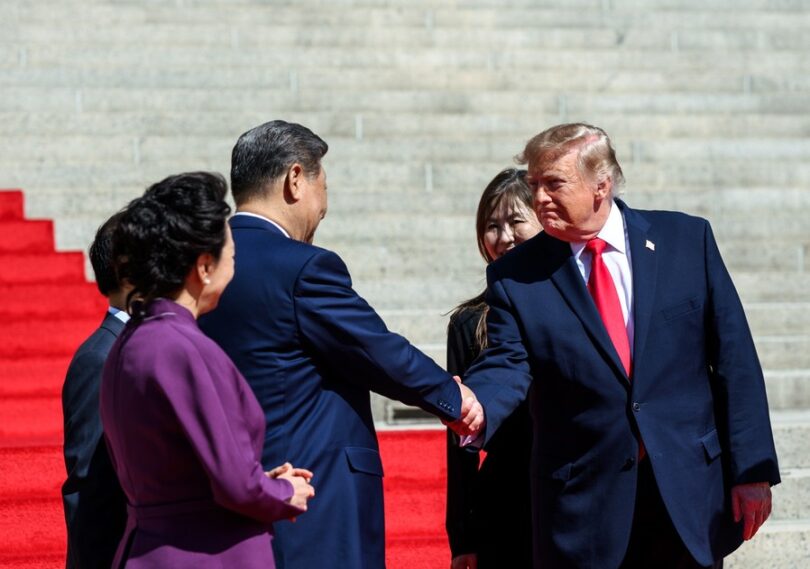
The POTUS Donald Trump receiving visiting Chinese President Xi Jinping on September 23, 2026, at the tarmac of Joint Base Andrews airport in a long winter coat and gloves was quite a sight, especially with speculation his protruding posterior was because of extra diapers. Was this exceptional reception out of respect to Xi or just Trump's tantrums before the midterm elections?
In their meeting at Busan (South Korea) in October 2025, Xi had said both countries should be partners and friends even though it is normal for them to have friction sometimes. Trump indicated readiness to build a solid foundation for China-US relations. In May 2026, when Trump visited Beijing, both sides declared their commitment to build a constructive relationship of strategic stability.
The red carpet laid out for Xi in September 2026 reinforced Trump's concept of G2 (the China-US duo), first mentioned by Trump in Busan, the greatest diplomatic victory for China in being accorded peer status by the US. In 2025, when China responded to American tariffs by restricting RRE exports, it showed that economic interdependence cuts both ways, demonstrating its capacity to impose retaliatory costs on the US. Trump understands hostility with China doesn't benefit America. He has indicated that he will meet Xi again in November 2026 at the APEC Economic Leaders’ Meeting in Shenzhen (China), and in December 2026 at the G20 Summit in Miami.
Despite the pomp and diplomatic pageantry during Xi's visit to the US, the Xi-Trump summit in September 2026, only achieved a tactical reset and established formal channels to prevent deep geopolitical rivalry. Both sides agreed to extend the trade truce by two months beyond the November 2026 expiration date. But the summit did little to bridge the shrinking middle ground of shared structural interests.
Xi expressed the need for controlling advanced AI. Trump didn't agree but both leaders agreed to continue the ongoing dialogue framework to evaluate the risks and benefits of advanced AI, with the next meeting set for November 2026. Post Trump's visit to Beijing in May 2026, both sides had traded accusations over how the other side is conducting the AI race.
On the Middle East, both sides reiterated that Iran must not possess nuclear weapons and that the Strait of Hormuz must remain open. Trump is conscious that China is militarily helping Iran but why would China not when the US-led NATO and EU are militarily helping Ukraine; hoping to strategically defeat Russia?
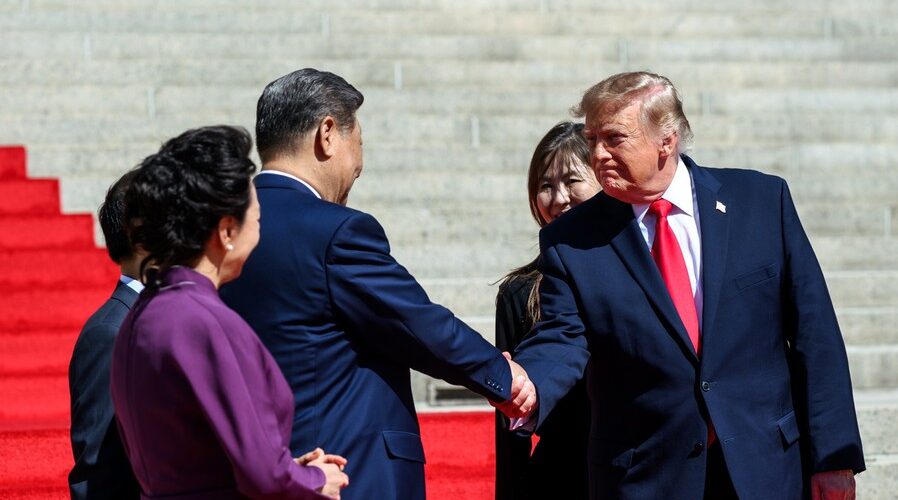
Under the 'Taiwan Relations Act', the US continues to feign it does not support Taiwan's independence. Trump downplayed arms sales to Taiwan as routine although after the May 2026 summit in Beijing, Washington paused a record USD 14 billion arms package for Taiwan. But Xi explicitly pressured Trump to stop this charade. Noticeably, when Xi was being introduced to Trump's secretaries, he skipped shaking hands with Pete Hegseth, Secretary for War. Trump criticised China for coercing neighbours, particularly the Philippines, but Xi made no commitment as it views America's regional framework a containment trap.
The US side demanded China fulfil shortages in purchasing USD 17 billion in other agricultural goods and flagged deficiencies in agreed REE deliveries. China kept the larger disputes over tariffs, industrial subsidies and tech restrictions off the table. China continues to enforce sweeping export controls on Advanced AI chips and computing infrastructure, whereas the US seeks to overcome foreign dependency.
In sum, multiple sticking points remain unresolved in the US-China relationship, such as tariffs, restrictions on semiconductors and Chinese export controls, especially on rare earths. China is also pressing the U.S. to stop arms sales to Taiwan, described by Beijing as the biggest flashpoint in the relationship.
What is the fallout of Trump's G2 concept? In a 20-minute phone call with Japanese Prime Minister Sanae Takaichi on September 26, 2026, Trump debriefed details of his summit with Xi; to ease Japan's concerns and reiterate the US-China alliance. This was followed by Trump calling up Prime Minister Narendra Modi on September 30, 2026. Modi raised the issue of the New Russia Sanctions bill, which threatens to impose 100% tariffs on India.
Despite seeking better relations with Xi, Trump's demonstrated policy is likely to remain unchanged: warmongering, including the wars in Ukraine and the Middle East will continue; Trump's policy on South Asia, China and Japan will remain the same; India's rise will be curtailed – as US officials have been indicating: US will refrain from direct war with China but will continue to seek indirect war with China, using India, Japan or another country as proxy/proxies.
At the same time, Col Alan MacGregor predicts that Trump's final strike on Iran is coming, which could break the Middle East – a massive air and missile attack lasting for several days and a ground invasion limited to some islands; because Trump is a gambler who has been bankrupt six times in his lifetime. Trump perhaps wants to copy-cat the US bombing Iraq for 45 days before invading it although the setting is entirely different – Iraq could not hit back; Iran very well can. However, if that happens, some analysts surmise that China will invade Taiwan.
In India, the hyper-active US ambassador Sergio Gor (known as Mini-Trump) is ecstatic over India importing America's Javelin ATGM despite the equally effective indigenous Nag ATGM and the Spike ATGM co-produced with Israel (https://www.thestrategicperspective.org/the-nag-spike-javelin-triangle/). His efforts have also resulted in the Delhi Court releasing US national and international mercenary Mathew Aaron VanDyke (along with six Ukrainians) from Tihar Jail, permitting him to travel to the US for one month despite the National Investigation Agency (NIA) maintaining that its investigation under the Unlawful Activities Prevention Act (UAPA) was continuing and that further evidence could potentially lead to supplementary charges.
The US ambassador to China David Perdue has said the Trump offered US weapons to Xi, though the US State Department has denied it. But Sergio Gor is thrilled about US F-35s in India for the first time – participating in Exercise 'Tarang Shakti'. Perhaps he hopes to persuade India to import the F-35 fighter jets, even as China has surreptitiously acquired parts of the F-35, Chinese radar and alternative sensor networks can detect US F-35 fighter jets, and China has modelled a missile-mounted single-photon lidar that can detect an F-35 from a distance of 61.12 km even by night.
Gor would be thrilled that India has been hedging the Russian 5th-generation Su-57E fighter jets offer with full technology transfer (https://www.thestrategicperspective.org/hedging-the-su-57/) fearing American sanctions, is still dilly-dallying on the issue, and instead is going for below the 5th-generation additional 114 French Rafale jets double the price of the Su-57E and without full technology transfer.
In the current geopolitical dynamics, Jeffrey Sachs says that the two great civilizations of India and China must cooperate better with each other, including in BRICS, without the border dispute dominating current policies, political and economic interests.
Prof. Jeffrey Sachs message to India🇮🇳 and China🇨🇳: DON’T let a border dispute created by Britain🇬🇧 prevent cooperation between TWO GREAT CIVILISATIONS!
— Afshin Rattansi (@afshinrattansi) September 27, 2026
‘All the world’s problems go back to the British. The problem between India and China goes back to 1914, to a line drawn on a… https://t.co/zFAPtyIHHW
Sachs is hinting at an Asian G2 (India and China) but what he says depends on India's political hierarchy: how much can it move away from the spectre of fear of the Trump administration; personal and political interests keeping the foreign policy largely in Washington's lap – despite claiming 'strategic autonomy"; inability to acknowledge how American activities in Pakistan, Nepal, Myanmar and Bangladesh adversely affect India; fear of losing political power; fear factor of China and the illusion of how the US will help India in the event of conflict; illusion of peer-parity with China; inability to handle the immediate neighbourhood despite a much publicized 'Neighbours First' policy; continued lack of a national security strategy that enables diplomatic semantics and strategic ambiguity to rule the roost.
The author is an Indian Army veteran. Views expressed are personal.