
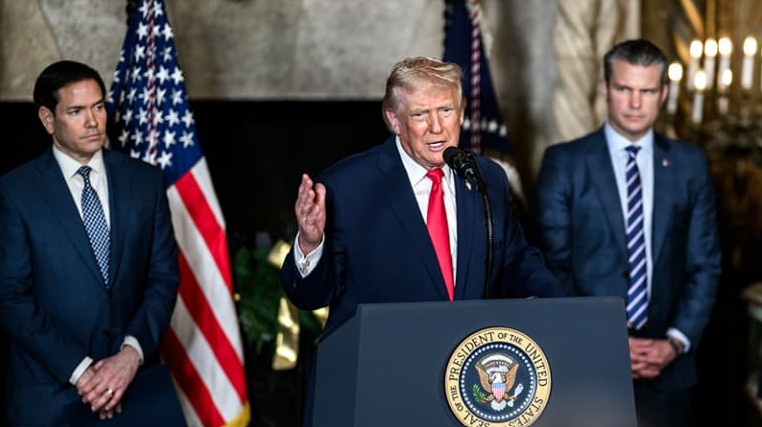
Donald Trump's pre-election promise of ending the war in Ukraine within a month of assuming the second presidency was akin to promising he would release the Epstein Files in full. After all voters were no fools and rapes are like everyday shootings in schools that cause little concern. The aim of the of US-led West to strategically defeat Russia will remain unchanged. Hence, NATO and the EU continue to arm and support Volodymyr Zelensky, including for deep strikes inside Russia. A major portion of American money pumped into Kiev, flows back to the US anyway. When the US warned Moscow of a possible terrorist attack at the Tsaritsyno Museum Reserve in Moscow, it can be safely assumed it was planned by the West, or a diversion. Similarly, the US-Israel aim to subjugate Iran and establish Greater Israel remains unchanged. With Trump's rogue leadership, the world should be ready for unlimited wars in Ukraine, Middle East, Indo-Pacific and elsewhere (https://www.thestrategicperspective.org/unlimited-wars/).
Financial benefits stemming from global conflicts on Donald Trump's personal portfolio, the US economy, and global fuel markets are big. According to a report released on October 26, 2026, by Democrats on the congressional Joint Economic Committee, Donald Trump's personal oil and gas stock portfolio has increased significantly in value; Trump's energy holdings grew from an estimated USD 12.6 million to USD 46 million at the end of 2025, reaching between USD 22.5 million and USD 81.6 million by October 2026. The committee found that more than 94% of his oil and gas stock purchases in 2026 occurred after geopolitical conflicts escalated. Media and congressional reports note Trump's sons, Donald Trump Jr. and Eric Trump, have financial connections to defence and drone tech businesses positioned to gain from increased defence expenditures.
Allegations linking Trump's son-in-law Jared Kushner’s financial dealings to ongoing global conflicts centre on his dual role as a private businessman and an active US foreign policy envoy; slush funds creating conflicts of interest in the Middle East and Ukraine wars. These include the following, because of which the US House Judiciary Committee Democrats have formally demanded Kushner's recusal from all Middle East and Ukraine war negotiations:
- Kushner’s private equity firm, Affinity Partners, is the largest shareholder in Phoenix Financial, which invests heavily in Israeli defence contractors supplying military equipment for the Gaza conflict.
- Matthew Cole’s book 'Princes and Thieves' claims that the UAE and Saudi Arabia deposited more than USD 2 billion into secret accounts managed by Kushner, portions of which was routed through Israel's central bank and intended for unrecorded diplomatic operations regarding the Israeli-Palestinian conflict, raising concerns about compromised US foreign policy.
- Talks to end the Ukraine conflict included a multibillion-dollar deal involving the sale of oil assets from one of Russia’s largest energy companies - prospective buyers included a group of investors with ties to Kushner and fellow Trump administration negotiator Steve Witkoff, according to New York Times.
- Hundreds of millions of dollars from an Azerbaijani bank went into a Dubai account accessed by Kushner and Kushner transferred significant amounts to individuals active in Middle Eastern and African conflicts, including a warlord and a mercenary, according to Vanity fair.
Democrat lawmakers cite intelligence warnings that Russian and other foreign spy agencies hacked Kushner’s personal devices, arguing that foreign powers could possess compromising financial information on Kushner, creating a severe national security leverage point as the US navigates global wars. According to independent analysts and fact-checks, actual US revenue collected from Venezuelan oil sits closer to USD 13 billion. Meanwhile, the direct cost of the military campaign in the Middle East has already exceeded USD 47 billion, meaning the actions have overall cost US taxpayers billions. Concurrently, major US defence contractors (like Lockheed Martin and RTX) have experienced heavily increased order books and surging stock values due to the supply of military equipment globally.
The ongoing wars in Ukraine and the Middle East (specifically the US-Israel war on Iran) heavily impact the American public through rising domestic fuel costs, severe political polarization ahead of the midterm elections, plus deep anxiety over military deployments; shifting domestic economic and societal consequences from distant geopolitical concerns to immediate hardships for everyday citizens. The national average for gasoline has climbed above USD 4 per gallon, placing financial strain on household budgets. The baseline cost of consumer goods has risen despite technology-driven sectors experiencing growth. 54% of Americans express that the conflict in the Middle East has not been worth fighting. The wars have amplified domestic ideological rifts. Public discourse remains intensely divided over America's role as the global policeman, driving a growing sentiment that billions of dollars in foreign military aid would be better spent addressing pressing infrastructure and economic needs at home.
Notably, between 2025 and 2026 combined, Donald Trump's net worth grew by an estimated USD 2.7 billion, bringing his total net worth to roughly USD 7 billion. With such personal gains, including from energy stocks, combined with the defence sector's influence, why would Trump want to end wars beyond indulging in rhetorical ceasefire negotiations? He is applauding easing the energy crisis in the Ukraine war but is unconcerned about the situation in the Middle East, including Saudi Arabia. Jeffery Sachs points out that 10 richest American individuals (not companies or clans) presently own USD 2.3 trillion wealth. They own the White House, instal the Vice President, determine the US policy, will own cryptocurrencies that will become America's main currency, and own all the big platforms for communication, they own the media, privacy, e-mails and the like. Such concentration of power has already destroyed America's democracy.
The US has indicated that an attack on Iran could occur any time after November 4, and that this will be a full-scale war. In the past 24 hours, at least 10 US military transport planes have landed in Israel, Saudi Arabia, Jordan, and Qatar. US diplomatic personnel have been ordered to leave several missions in the Middle East, Trump is deploying roughly 9,000 additional troops and a massive naval buildup, including a third aircraft carrier strike group, to the Middle East, pushing the total US naval presence past 20,000 personnel alongside over 50,000 US land-based troops in surrounding nations like Kuwait, Qatar, Bahrain, Jordan, the UAE, and Saudi Arabia; including USS Theodore Roosevelt carrier strike group, the USS Makin Island amphibious group, and additional warships joining carrier strike groups already in the region.
Iran's supreme leader Mojtaba Khamenei has threatened immediate reply to an attack without any geographic limits; he ordered the military to update its lists of potential targets to bring all types of material and immaterial assets of the US and Israel within the armed forces reach. Iran's foreign minister Abbas Araghchi told media that the Iranian delegation in Qatar had suggested to mediators accelerating the implementation of its earlier 7-day proposal of reopening the Straits of Hormuz for two days. Iran's proposal included lifting the imposed sanctions following the June 2026 Islamabad memorandum and reducing US forces in the region that later collapsed. Araghchi further said, "we demand the restoration of oil waivers and release of all waiver funds, including those held in Qatar. Mediators have also shared proposals about Iran's nuclear program. Araghchi acknowledged the recent letter from US Vice President JD Vance to Iran's national security chief, saying, "The American side's attempt to open the door to broader dialogue and understanding is considered a positive step.
Additionally, Iran has escalated regional tensions by broadcasting a video titled "Zero Hour,". It encompasses a list of eight nations — Israel, Jordan, and six Gulf states—rather than focusing strictly on eight specific cities. Following a directive from Iran’s Supreme Leader Mojtaba Khamenei amid ongoing conflict, state media warned that a renewed U.S. or Israeli bombardment would trigger a military response with "no geographical limitations." The updated Iranian "target bank" explicitly threatens critical civilian and economic infrastructure including international airports, maritime ports, power plants, desalination facilities, and tech hubs, alongside American military installations in the region. This warning serves as a direct counter to recent statements from U.S. President Donald Trump, with Tehran explicitly cautioning neighboring countries against allowing their airspace or territory to be used for hostile actions against Iran.
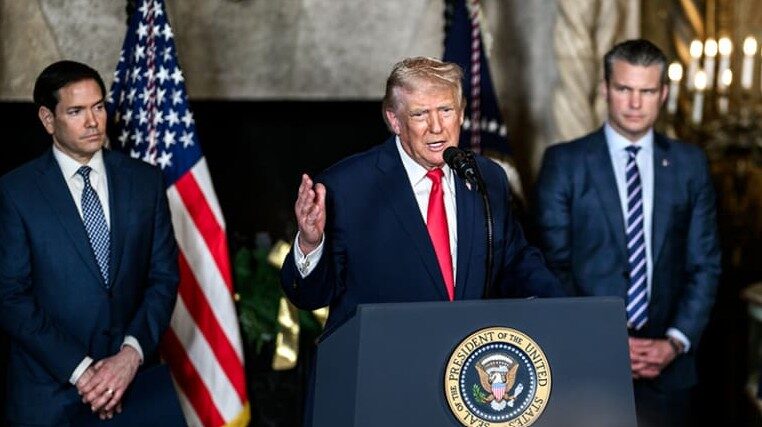
But the latest is US Secretary of State Marco Rubio saying in a press conference in Atlanta, where he was hosting the two-day G20 Foreign Ministers Meet, that Trump has not made up his mind about fresh strikes on Iran amid stalled talks Rubio said, "We can achieve military objectives if we seek to." US media reports that Gulf countries have been asked by the US to prepare for renewed strikes in Iran after the midterm polls on November 3.
Israel is reportedly fully prepared for airstrikes on Iran, while the US is preparing for a situation where military bases may need to remain operational for 90 days without external supplies or electricity. The intensity of the conflict could be so high that US troops are undergoing training to dig mass graves, similar to what they did during the Korean War. Iran has shrouded its entire defence system in secrecy. It has demonstrated its capability of intercepting and bringing down enemy drones and jets in the Hormuz Strait and Iranian airspace. But in a situation of protracted war, Iran could cut all internet lines beneath the Strait of Hormuz. This would be reminiscent of World War I where telegraph lines were cut off during the war. A Middle East without electricity or internet could reduce the US war capabilities by 50%. In such a situation, stock market crash, global economic disruption resulting in major recession appears inevitable.
Allison Minor, Senior Fellow in the Middle East Program at the CSIS and Nate Swanson, Director of the Iran Strategy Project at the Atlantic Council write that Arab monarchies must help the US and Iran save face; the war in Iran is a strategic failure, with US-Israel showing they can achieve few military objectives like sinking Iran's naval vessels. But after eight months of fighting and pressure, they have proved they can't forcibly realize their main ambitions, including regime change, destroying Iran’s nuclear program, or reopen the Strait of Hormuz. Iran has demonstrated it can survive intense bombings but cannot break the US economic blockade. They recommend a cease-fire brokered and managed by the Gulf Arab states, beginning with Gulf countries providing economic relief to Iran in exchange for Iran lifting its restrictions on the Strait of Hormuz, in turn allowing the US to lift its own blockade. The Gulf states would also need to commit to taking steps to deter Washington from resuming strikes on Iran in the future. But neither the United States nor Iran would need to make direct concessions to the other, and each would avoid the most painful compromises (https://www.foreignaffairs.com/united-states/only-gulf-can-end-iran-war)
There is more, which can be read at the above link. Gulf Arab States are no doubt central to the Middle East, but the write up ignores the following:
- The war was started by US-Israel despite even the US Director National Intelligence initial assessment that Iran is not pursuing a nuclear weapons program.
- The Straits of Hormuz was a free waterway before US-Israel attacked Iran, while merchant vessels have been paying for their passage through the Panama and Suez canals over the past decades.
- Donald Trump's obsession to control global energy and oils supplies led to his inefficient Secretary of War Pete Hegseth hallucination that Iran was a walkover – nearly two dozen generals, admirals, and top military leaders have been fired, sidelined, or forced into early retirement since Hegseth is in this process.
- Gulf Arab States rely on the US for military support, but their experience in the current conflict shows the US is grossly unreliable, specifically Saudi Arabia against Houthi attacks.
- The decision to end the war is NOT of the Gulf Arab States but of the US and Israel.
- The Trump Administration continues to believe it can achieve its military objectives, as voiced by Rubio in Atlanta.
The geopolitics of the Muslim world have shifted dramatically with the emergence of two major, interlocking defence frameworks: the Mecca Defence Alliance and the Badr Defence Pact. The Mecca Defence Alliance (also termed "Islamic NATO") is a hard-power military pact signed by Saudi Arabia, Pakistan, and Türkiye on August 7, 2026. The alliance has a permanent secretariat in Riyadh. It pools Saudi financial clout, Turkish advanced drone and electronic military industry, and Pakistan's massive conventional army and nuclear deterrent. Syria's foreign minister announced at the Manama Dialogue that Damascus is actively evaluating joining this pact. Egypt has been in high-level talks to join, though it faces technical roadblocks regarding its existing treaties with Greece and Cyprus. Bangladesh, Kuwait and Qatar are identified as primary candidates or currently in expansion discussions to build out a broader defensive umbrella.
The Badr Defence Pact was signed by Türkiye, Pakistan, Qatar and Indonesia at Doha, Qatar on October 21, 2026. Its name means "full moon," symbolizing how the different strengths of its members merge into a complete circle. it is an economic and technological alliance aimed at creating a self-sustaining Islamic Military-Industrial Complex, complementing the Mecca Alliance by supplying it with hardware: Türkiye provides advanced aerospace engineering and weapons design; Pakistan provides a skilled defence manufacturing workforce; Qatar provides the deep-pocketed financial investments and funding; Indonesia provides a massive new market and Southeast Asian geographic depth. The overall goal is to completely stop the members' reliance on the US, Europe, Russia, or China for hardware. They plan to co-produce fighter jets (like Türkiye's KAAN stealth fighter), naval warships, and advanced drone technology. The pact is accessible to non-aligned Muslim nations in Southeast Asia, Central Asia, and North Africa who want advanced defence technology without being dragged into Middle East wars.
The Saudi-Pakistan Defence Arrangement (SPDA) was sponsored by the Trump Administration with the hope that Saudi Arabia would lead the Arab World into officially recognizing Israel, which has not happened. With the renewed protracted US-Isreal war on Iran, is the Trump Administration pushing the Muslim World into a corner? Looking at the global dynamics, Europe preparing for direct war with Russia in the 2029-2030 period, and the impending revival of US-Iran war on Iran in the immediate, a veteran Indian Army Vice Chief of Army Staff questions whether the Shia-Sunni Muslims will combine to face the West and what would be the global consequences if that happens?
For the Trump Administration this is impossible because the US has played on the Shai-Sunni rift ever since. But then despite the holocaust victimising between 5.7 million and 6 million Jews, the Germans and Jews are hardly averse to each other, especially after the US purposely inducted Nazi officials into NATO immediately post World War 2,
The author is an Indian Army veteran. Views expressed are personal.
More on related topics:
Pakistan, Houthis and the Mecca Pact: https://www.thestrategicperspective.org/pakistan-houthis-and-the-mecca-pact/
Turkey Explores Joining Saudi–Pakistan Defence Pact: https://www.thestrategicperspective.org/turkey-explored-joining-saudi-pakistan-defence-pact/
Saudi–Pakistani Defence Pact: Operationalizing Hedging and Deterrence in 2026: https://www.thestrategicperspective.org/saudi-pakistani-defence-pact-operationalizing-hedging-and-deterrence-in-2026/
Bangladesh Post-Hasina Defence Strategy: A Three-Track Shift: https://www.thestrategicperspective.org/bangladesh-post-hasina-defence-strategy/
Arab-Islamic NATO: https://www.thestrategicperspective.org/arab-islamic-nato/
Islamic Bomb and Islamic NATO: https://www.thestrategicperspective.org/islamic-bomb-and-islamic-nato/