
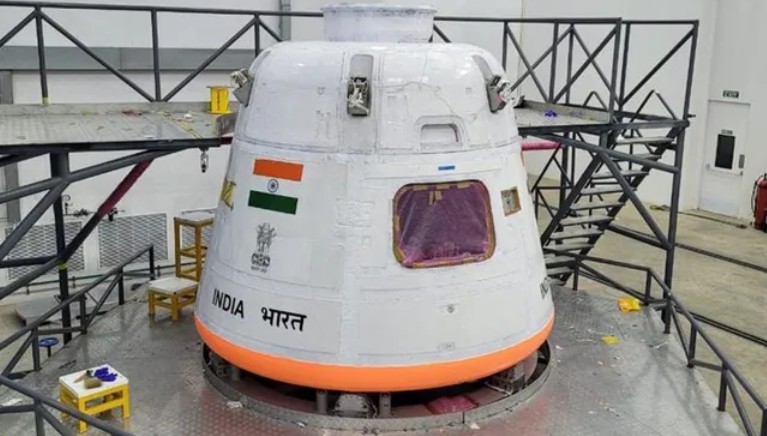
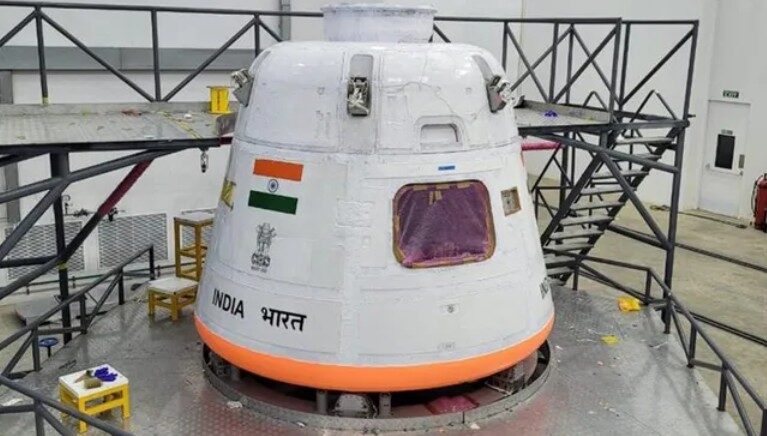
The Indian Space Research Organisation (ISRO) has planned major upcoming deep-space, lunar, and crewed missions that include: Gaganyaan uncrewed and crewed flights (2026–2027) - India's human spaceflight program features upcoming uncrewed orbital test flights carrying a robot named Vyommitra, leading up to the crewed Gaganyaan flight planned for 2027; Chandrayaan-4 (2027) – a complex lunar sample return mission aiming to land on the Moon and bring back material to Earth; Venus Orbiter Mission (March 2028) - India's first interplanetary mission to Venus to study its surface, atmosphere, and solar interactions using advanced aerobraking technology; Lunar Polar Exploration Mission or LUPEX (2028–2029) – a joint lunar mission with Japan's JAXA to explore the Moon's south pole with a lander and rover.
The global race for establishing permanent human presence on the Moon has been accelerated: China's Chang'e-4 spacecraft landed on the Moon on January 3, 2019; ISRO has a roadmap aimed at landing Indian astronauts on the Moon by 2040; NASA has planned for a USD 20 billion Moon Base by 2032; China-Russia announced an International Lunar Research Station (ILRS) open to all in 2021, with construction beginning by 2031.
At the 9th India-US Civil Space JWG meeting at ISRO Bengaluru headquarters on August 5-6, the US invited India to participate in NASA's Moon Base program. Three years after Chandrayaan-3 achieved a soft landing near Moon's South Pole, NASA appears keen to deepen cooperation with ISRO, building on the two countries' partnership under the Artemis Accords. The Artemis Accords, drafted jointly by NASA and the US Department of State launched in 2020, are a non-binding set of principles and political agreements designed to guide civil space exploration and governance.
Currently there are 73 signatories to Artemis Accords, including India, Japan, Canada, the UK, and numerous European states, which has following tenets: activities must be for peaceful purposes; share space policies and operational plans; develop open, hardware-sharing systems; pledge to aid astronauts or space personnel in distress; record space vehicles to prevent orbital crowding/; share scientific research with global community; preserve historic landing sites and artifacts; extraction of lunar/ asteroid resources complying with Outer Space Treaty; notify operations and create temporary safety zones to minimize physical interference; plan for safe disposal of defunct spacecraft to avoid polluting outer space. Russia and China declined to sign the Accord, criticizing the framework as a US-led initiative that circumvents traditional UN processes.
NASA describes the Moon Base as "humanity's first lunar outpost, a place where astronauts will live, work, and explore near the Moon's South Pole. NASA says the facility will be developed through a series of crewed and uncrewed missions that will establish the infrastructure needed to support an enduring human presence on the lunar surface. The aim is to stay on the Moon, learn to live off the land, develop new technologies and prepare for future human missions to Mars.
According to NASA, the lunar South Pole offers unparalleled scientific opportunities, including access to permanently shadowed craters believed to contain water ice. Water ice can be converted into drinking water, oxygen and rocket fuel, making it one of the most valuable resources for any future lunar settlement. NASA's entire Moon Base architecture is being designed around operations near the South Pole. For India, NASA's invitation carries special significance being the only nation that has successfully soft landed a spacecraft in the vicinity of the lunar South Pole. Chandrayaan-3's Vikram lander and Pragyan rover touched down in August 2023 and established India as a pioneer in one of the most challenging regions of the Moon.
Vikram and Pragyan remain enduring symbols of India's presence on the Moon as 'India's lunar Ambassadors' and have given India unique operational experience in the very region where NASA now plans to build its future outpost. India's long-term vision extends well beyond low Earth orbit. Under Space Vision 2047, the country has outlined ambitions that include advanced lunar exploration and eventual human operations related to the Moon.
However, the NASA-ISRO partnership faces significant challenges stemming from severe geopolitical friction, technological protectionism, resource ownership debates, and conflicting sovereign space priorities, like:
- The Moon is rapidly splitting between the US-Led Artemis Alliance anchored by NASA and the Artemis Accords (signed by India in 2023) and the Russia-China-led ILRS.
- India faces a tightrope joining the NASA Moon Base plan and alienating its strategic historical ties with Moscow.
- The 167 Outer Space Treaty strictly bans national appropriation/ ownership of celestial bodies, but establishing permanent Moon bases complicates this.
- With the lunar South Pole having limited peaks of eternal light (for solar energy) and cold traps (containing vital water ice), a NASA-ISRO base could end up in direct territorial/resource disputes with the Russia-China-led ILRS facilities.
- NASA and ISRO must negotiate complex intellectual property and technology transfer frameworks to ensure Indian engineers are not locked out of core systems.
- India-manufactured components must seamlessly connect with US-built habitats, power networks, and life-support systems.
- Risk of slowing down if India chooses to prioritize the BAS over contributing resources to the US-led timeline (2026-2032).
Concurrently, the European Space Agency (ESA) and ISRO intensified cooperation in human space flight, lunar exploration, and Venus missions, with discussions held at the International Space Summit in Paris, on September 9, 2026, building on existing agreements for Gaganyaan ground support and extends to India’s ambitious Bhartiya Antriksh Station (BAS) and the Venus Orbiter Mission scheduled for 2028.
During the delegation-level ISRO-ESA talks, headed by ISRO Chairperson V Narayanan and ESA DG Josef Aschbacher, Aschbacher emphasised that exploration remains a priority for both agencies and that several cooperation points are already under discussion. Daniel Neuenschwander, ESA’s Director for Human and Robotic Exploration, elaborated that the agencies are exploring collaboration in human space flight and lunar exploration.
ESA is keen to explore how both sides can mutually benefit from these capabilities, beginning with low Earth orbit and extending to lunar exploration. ISRO and ESA have already signed a Technical Implementation Plan (TIP) for Ground Tracking Support for Gaganyaan missions, enabling ESA to provide ground station support, ensuring continuity in data flow and communication with the Orbital Module for monitoring and orbital operations.
The Gaganyaan project aims to launch a 3-member crew to an orbit of 400-km for a three-day mission, before safely returning to Indian seas. Both agencies are also exploring cooperation in the Venus Orbiter Mission. India’s maiden Venus Orbiter Mission, with an approved outlay of INR 1,236 crore, is scheduled for launch in March 2028. The spacecraft will embark on a 112-day journey to Venus, departing Earth on March 29, 2028 and arriving on July 19, 2028. It will be launched aboard the Launch Vehicle Mark-3 (LVM-3). The mission will carry 19 payloads, including 16 Indian instruments, two collaborative payloads, and one international payload. This comprehensive suite reflects India’s growing scientific ambition and its willingness to integrate international collaboration into planetary exploration.
Sweden has already joined the mission with its Venusian Neutrals Analyser payload, while Norway has expanded cooperation with ISRO in space applications, Arctic observations, and infrastructure support. These partnerships highlight Europe’s increasing interest in India’s planetary programs. The Venus mission aims to study the planet’s dense atmosphere, volcanic surface, extreme weather systems, and super-rotating clouds. Scientists are particularly interested in understanding whether Venus once resembled Earth before a runaway greenhouse effect transformed it into a hostile world.
Addressing the recent convocation at IIT Roorkee, NSA Ajit Doval stated that the Indian economy will rise to USD 38 trillion in 20 years, while External Affairs Minister S Jaishankar has been saying over the past several months that India's foreign policy is that of "multi-engagement". The question therefore is when India is collaborating with NASA, ESA and Jaxa, what is the point of not joining the Russia-China-led ILRS? Would that not be "multi-engagement" or "multi-alignment" in the true sense? Do we consider inviting a Vice Minister-led delegation of Communist Party of China (CPC) to the BJP and RSS headquarters in New Delhi adequate engagement? It was amusing to Indian media calling photographs of Prime Minister Narendra Modi, Chinese President Xi Jinping and Russian President Vladimir Putin together at the 2026 BRICS Head of State Summit as "Russia-India-China (RIC) Meet". But while Modi held separate bilateral meetings with Xi and Putin on sidelines of the BRICS Summit, no RIC Heads of State Summit was held for fear of annoying the POTUS Donald Trump. Isn't it 'Time to call the bully's bluff', asks a former Indian ambassador to the US and the UK (https://www.theweek.in/opinion/columns/navtej-sarna/2026/09/26/india-us-relationship-why-its-time-to-call-the-bullys-bluff.html)?
Another veteran-analyst writes: "Wonder if it would be prudent to dump the HAL project and go for the Russian Stealth 57 with full technology transfer. At this cost of the 414 engines plus the INR 6,000 crore for local production, one can't be sure of not getting any more GE tantrums for the next decade or more since that would be the least time needed to get all these additional aircraft. Even thereafter, the US would still have the key technology with them only - they will hang us by our balls. It only reinforces the bitter truth that one can never trust the Americans. Drastic situations need drastic measures. The American poker game is a definitely losing proposition… so change tack." His frustration coincides with China's sixth-generation fighter jet entering a new stage of flight testing (https://militarywatchmagazine.com/article/china-sixth-generation-new-stage-flight-testing). The million-dollar question is does India's political hierarchy have the guts to call America's bluff or too scared of losing individual political power?
Finally, the Moon has become a warfighting domain of major militaries with the US, Russia and China having weaponized space, no permanent lunar base can survive without a continuous, multi-day supply line from Earth to transport water, equipment, fuel, and humans. But adversaries could use non-kinetic orbital weapons to blind navigational sensors, hijack automated cargo landers via cyberattacks, or sever critical satellite communications between the ground crew on the Moon and mission control on Earth. A lunar base cut off from its terrestrial supply chain becomes an instant humanitarian and logistical catastrophe. Infrastructure meant for peaceful lunar science and hardware meant for space warfare has inherent dangers. For example, lasers, autonomous rovers, satellites equipped with robotic grappling arms, are dual-use technologies that can be used against adversaries. Additionally, deployment and potential use of kinetic or counterspace weapons in orbit pose an existential threat to anything nearby.
The author is an Indian Army officer. Views expressed are personal.
More on Space exploration and ISRO:
ISRO Cacophony: https://www.thestrategicperspective.org/isro-cacaphony/
ISRO’s invaluable contribution to Op Sindoor in its year of the 101st satellite: https://www.thestrategicperspective.org/isros-invaluable-contribution-to-op-sindoor-in-its-year-of-the-101st-satellite/
Communication Security versus Insecurity: https://www.thestrategicperspective.org/communication-security-versus-insecurity/
Cyber Insecurity: https://www.thestrategicperspective.org/cyber-insecurity/
5th Edition of the India Space Congress-2026: https://www.thestrategicperspective.org/5th-edition-of-the-india-space-congress-2026/
Fiascos in Space: https://www.thestrategicperspective.org/fiascos-in-space/
India’s Air Power Ranking Ascent: Strategic Brief 2025: https://www.thestrategicperspective.org/indias-air-power-ranking-ascent-strategic-brief-2025/