
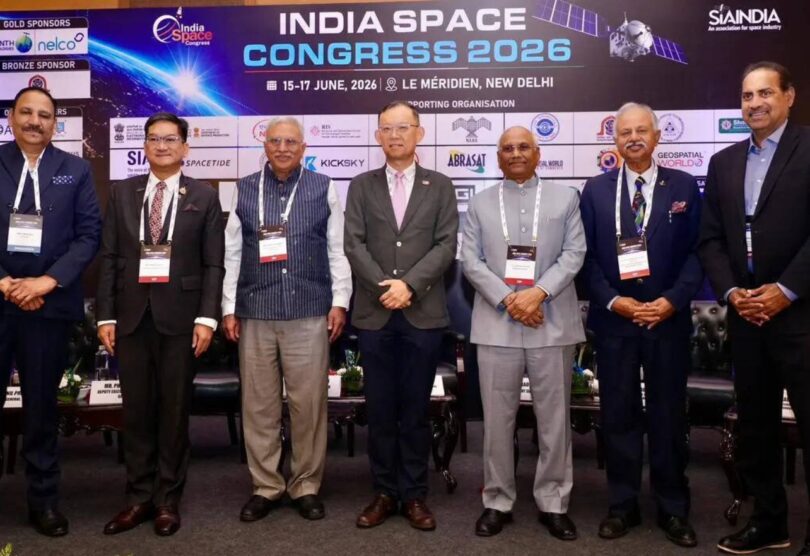

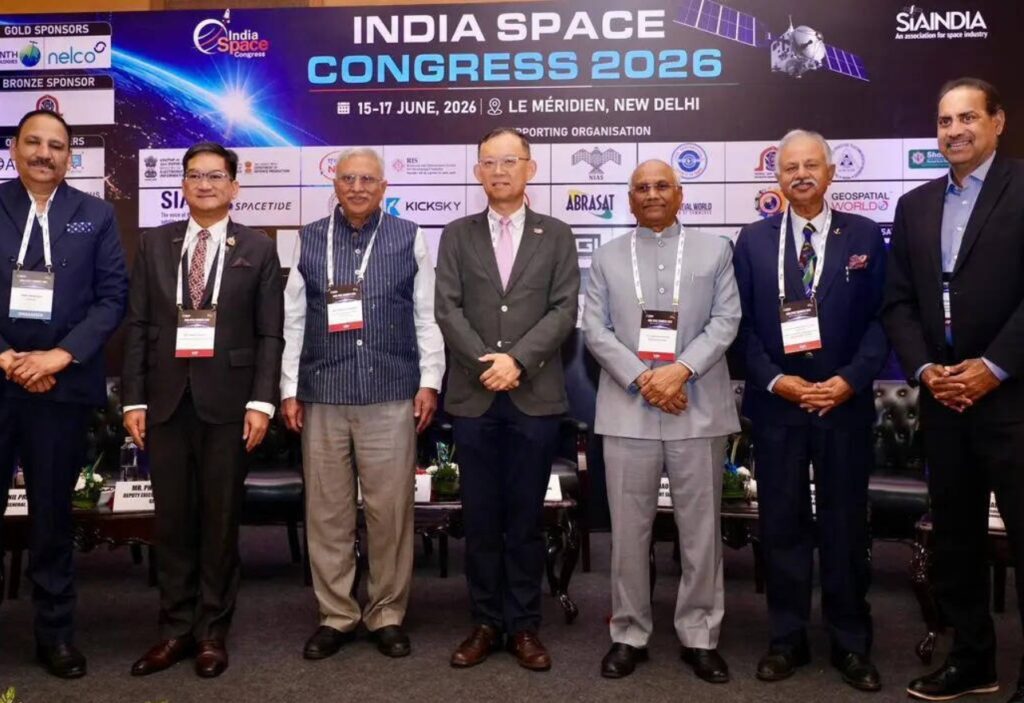
The 5th edition of the India Space Congress (ISC) was held in New Delhi from June 15–17, 2026. Themed "Reimagining Space. Reinventing Collaboration. Realising the Next Era of Space" and hosted by the Space Industry Association–India (SIA-India), the premier event brought together over 1,000 delegates and 250 speakers from 25 countries.
Discussions cantered broadly on India's ambition to build a $44 billion space economy by 2033, supported by rapid private innovation, over 300 private space startups, and the commercialization of the space sector.
The official Space Industry E-Catalogue Portal, was unveiled, advocating for historic Foreign Direct Investment (FDI) reforms projected to bring up to $25 billion into the Indian commercial space sector
The GeoNiti Ideathon, a national initiative aimed at nurturing future policy thinkers and bridging the gap between space technology and public policy was launched.
The inaugural India Space Congress Excellence Awards were presented, recognizing achievements in five categories including Space Startup of the Year and Emerging Women Space Pioneer.
Key technical and strategic panels explored emerging domains such as AI-driven space data analytics, in-space manufacturing, quantum technologies, and direct-to-device satellite connectivity.
Experts at the congress highlighted the role of spatial technologies in nation-building and disaster resilience, noting the deep integration between national authorities and the Indian Space Research Organisation (ISRO).
The session on "Space for Disaster Resilience" focused on utilizing satellite intelligence and spatial technologies for early warning systems, rapid damage assessment, and relief logistics. As climate change intensifies natural hazards, the emphasis has shifted from mere disaster management to community-level resilience and proactive, resilient recovery planning.
Core focus areas of space-based resilience included (a) Highlighting the use of space data for managing a variety of localized vulnerabilities, including floods, landslides, cyclones, lightning strikes, and glacial lake outburst floods. (b) Active collaboration between National Disaster Management Authority and the Indian Space Research Organisation to integrate geospatial and spatial technologies at both the preparedness and mitigation stages. (c) Agreeing that technologies like AI-enabled sensing and radar observations (historically supported by continuous missions like the Copernicus program's Sentinel satellites) are vital for all-weather damage assessment and ground-motion monitoring
Additionally, as discussions turned to the telecom revolution and satellite connectivity, experts emphasized the importance of lowering the cost of user devices to make direct-to-device satellite communications more accessible to the public. Direct-to-Device (D2D) connectivity which allows standard, unmodified smartphones and IoT devices to communicate directly with satellites in orbit, acting as cell towers in the sky. This bypasses traditional land-based towers to provide text, voice, and data in remote areas or during terrestrial network outages.
In terms of overall capabilities and space research, India consistently ranks among the top five spacefaring nations globally. Under ISRO, India is the premier global leader in launching foreign satellites, and ranks fourth worldwide in specialized operations like space docking and lunar exploration. ISRO is widely recognized as one of the top space agencies in the world due to its vast infrastructure, budget allocations, and high mission success rate. India currently globally ranks as Number 1 for launching foreign satellites, outperforming traditional heavyweights like Russia and the United States. This dominance is largely attributed to ISRO's cost-efficiency and dependability. India is one of only five nations with comprehensive, end-to-end capabilities in space research and development. This includes domestic launch sites, earth observation, satellite communication, and navigation systems. India made history as the fourth nation to achieve a soft landing on the Moon and the first country to land near the lunar south pole via the Chandrayaan-3 mission. Following the success of the SPADEX mission, India became the fourth nation in the world to master autonomous docking in space.
The SpaDeX (Space Docking Experiment) is ISRO's technology demonstrator mission that successfully achieved autonomous rendezvous and in-space docking using two small spacecraft, the "Chaser" (SDX01) and "Target" (SDX02). Launched on December 30, 2024, it made India the fourth country to master satellite docking, paving the way for future space stations and complex exploratory missions. Launched aboard the PSLV-C60 rocket from the Sriharikota spaceport, the mission successfully verified several critical in-space operations. The two 220-kg satellites autonomously navigated to align and physically join in Low Earth Orbit. Once connected, ISRO successfully maneuvered the combined docked spacecraft as a single unit. The spacecraft tested inter-satellite power transfer while locked together. The mission successfully undocked the satellites. Both satellites are now orbiting independently and carrying out independent payload and scientific operations.
The successful demonstration of these technologies is a massive leap for India's long-term aerospace ambitions. The acquired know-how is directly applied to future endeavours, such as the upcoming Chandrayaan-4 sample return mission and the development of the Bharatiya Antariksh Station (Bharatiya-Indian, Antariksh-space).
More on ISRO related topics:
ISRO’s invaluable contribution to Op Sindoor in its year of the 101st satellite: https://www.thestrategicperspective.org/isros-invaluable-contribution-to-op-sindoor-in-its-year-of-the-101st-satellite/
Fiascos in Space: https://www.thestrategicperspective.org/fiascos-in-space/
India’s Air Power Ranking Ascent: Strategic Brief 2025: https://www.thestrategicperspective.org/indias-air-power-ranking-ascent-strategic-brief-2025/
Munir’s Anti-India prattle and blame games: https://www.thestrategicperspective.org/munirs-anti-india-prattle-and-blame-games/
Aerial Surveillance: https://www.thestrategicperspective.org/aerial-surveillance/