

India has indeed come a long way since 1964, when the Directorate of Naval Design was created and major indigenous warship programs, such as the Nilgiri-class frigates in the 1970s and the initial planning for the aircraft carrier INS Vikrant were initiated, but systemic challenges—such as underdeveloped supply chains and a lack of competitive manufacturing scale—hampered the speed of achieving total self-reliance until recent years.
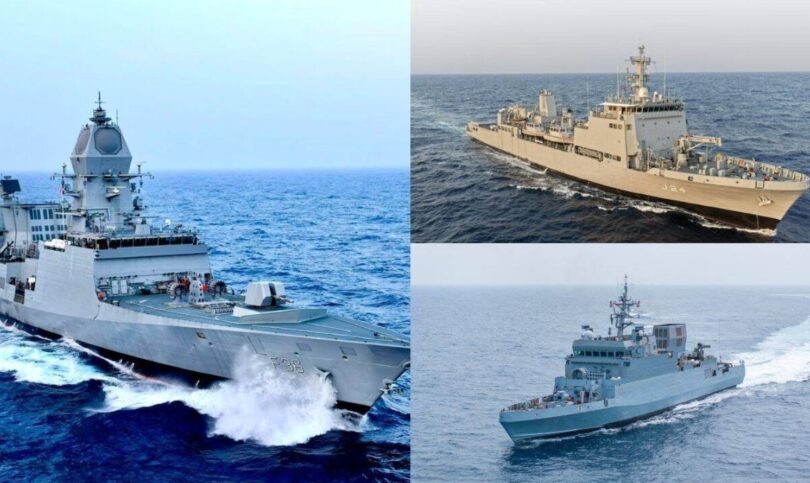
Prime Minister Narendra Modi commissioning INS Dunagiri, INS Sanshodhak and INS Agray, simultaneously on June 21, 2026, at Kolkata marked a defining milestone in India’s naval history because it is rare to commission three technologically distinct platforms on a single day.
Present at the commissioning ceremony were Shri R. N. Ravi, Governor of West Bengal, Shri Suvendu Adhikari, Chief Minister of West Bengal, Admiral Krishna Swaminathan, PVSM, AVSM, VSM, Chief of the Naval Staff, Commodore Rajat Manchanda (Retd), Executive Director, GRSE and senior officials of Indian Navy and GRSE. The commissioning of three major surface warships on a single day is a first-of-its-kind achievement for any shipyard in India and highlights GRSE’s robust shipbuilding infrastructure, advanced technological capability and efficient project execution. Rather than simply scaling up fleet numbers, the simultaneous induction completes a highly coordinated tactical triad spanning three distinct dimensions of naval warfare. The achievement further strengthens the shipyard’s operational preparedness across strategic surveillance, anti-submarine warfare and maritime defence capabilities.
Conducted at the Syama Prasad Mookerjee Port in Kolkata, this event highlights an unprecedented multi-domain force multiplication entirely driven by domestic manufacturing. It also reinforces the nation’s growing strength in indigenous warship design and construction under the vision of Aatmanirbhar Bharat (self-reliant India).
Aligned with the objectives of Maritime India Vision (MIV) 2030 and Maritime Amrit Kaal Vision (MAKV) 2047, GRSE is spearheading India's green maritime transformation through focused initiatives in shipbuilding and ship repair, modernisation of yard infrastructure, strategic global partnerships, promotion of sustainable maritime practices, and adoption of emerging technologies. By integrating Artificial Intelligence (AI), digitalization and innovation-led solutions across its operations, GRSE is driving efficiency, sustainability and technological excellence, while contributing to the vision of a resilient, self-reliant and globally competitive maritime sector.
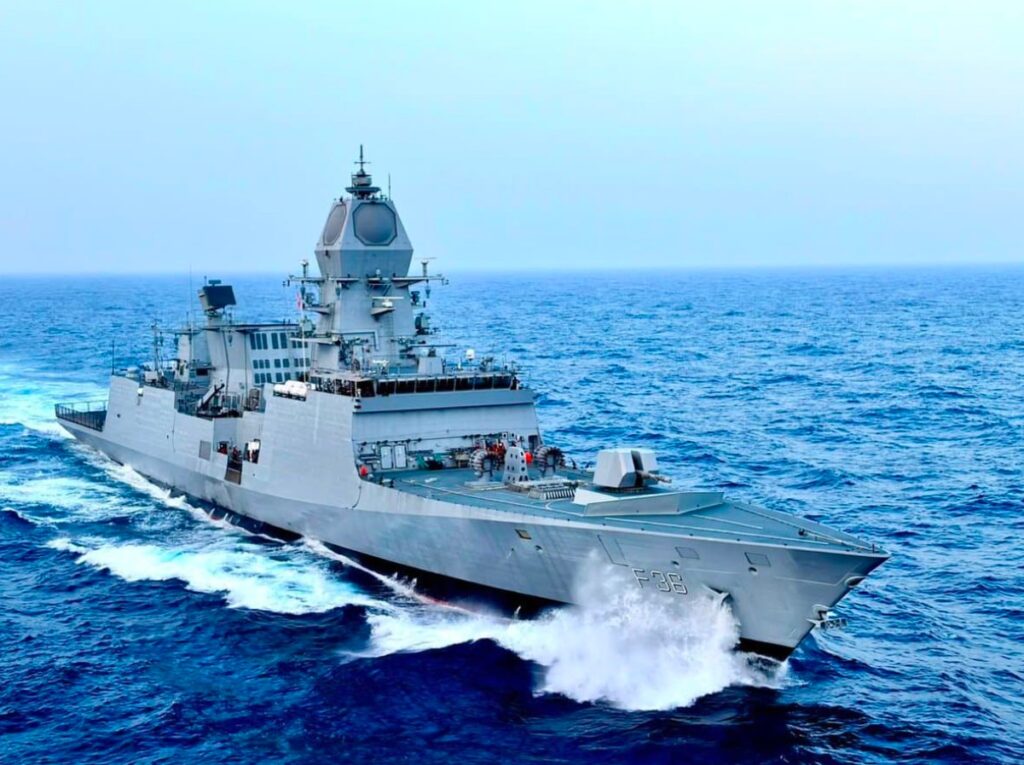
INS Dunagiri, the second Advanced Guided Missile Frigate built by GRSE under Project 17A, represents a significant advancement in indigenous warship design. Equipped with BrahMos anti-ship and land-attack cruise missiles along with advanced defence systems, the warship significantly enhances the Indian Navy’s strike and defensive capabilities.
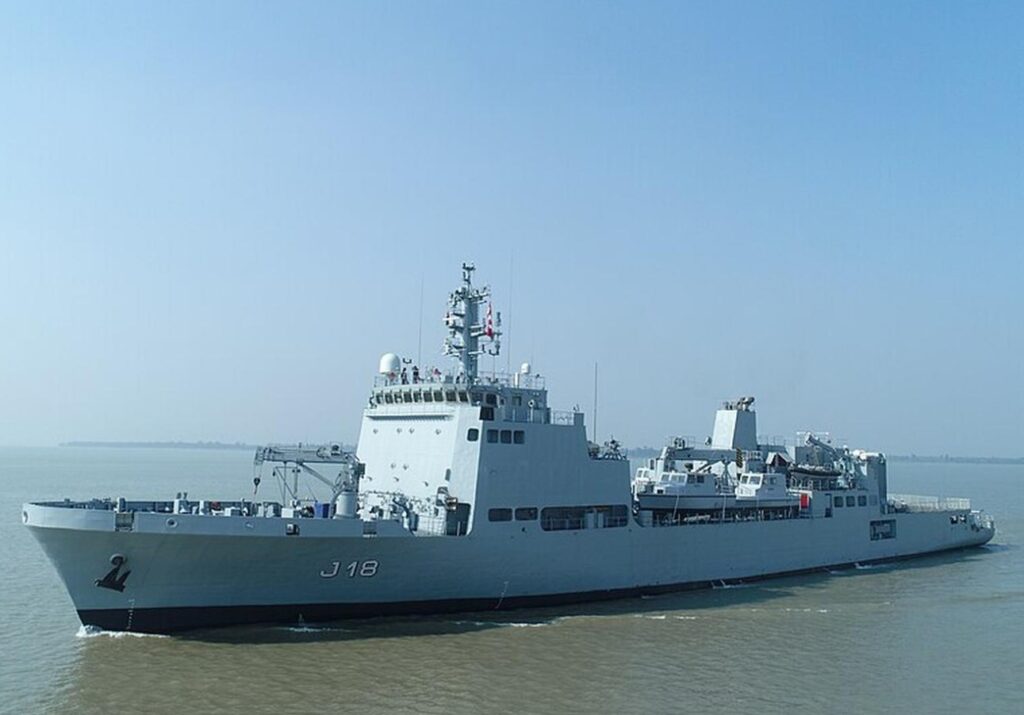
INS Sanshodhak, the last of the four Survey Vessels (Large) built by GRSE, will bolster the Indian Navy’s hydrographic and survey capabilities, supporting port and harbour approaches, navigation channels and maritime limits, while also aiding oceanographic data collection and Humanitarian Assistance and Disaster Relief (HADR) operations.
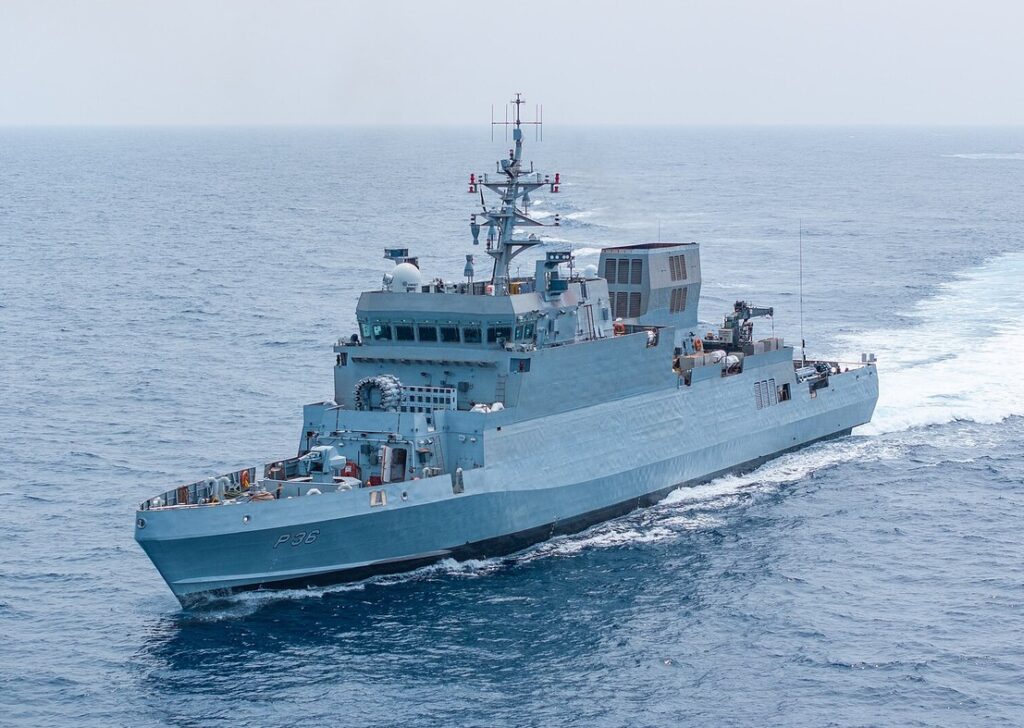
INS Agray, one of the eight Anti-Submarine Warfare Shallow Water Crafts (ASW-SWCs) under construction at GRSE, is designed for coastal anti-submarine operations and is equipped with advanced Combat Management Systems, lightweight torpedoes, anti-submarine warfare rockets and a 30 mm Naval Surface Gun with approximately 88% indigenous content.
With the delivery of INS Dunagiri, INS Sanshodhak and INS Agray, GRSE has achieved the milestone of building and delivering 118 warships, including 80 warships for the Indian Navy — the highest by any shipyard in the country.
Following infrastructural modernization, the yard can build up to 20 ships (8 large and 12 small) simultaneously. They are currently constructing advanced vessels like the P17A Class Advanced Frigates (e.g., INS Dunagiri) equipped with state-of-the-art missile systems. Beyond major combatants like frigates and corvettes, GRSE builds survey vessels, anti-submarine shallow watercraft, and fast patrol boats for the Navy and Coast Guard.
Reinforcing its technological leadership as well as highlighting its massive production capacity and financial scale GRSE is the only PSU shipyard to be recently elevated to a Navratna PSU by Government of India. Also notably, it received Defence Minister’s Award for Excellence in the Defence & Aerospace Sector for designing the most silent ship for Anti-Submarine Warfare (ASW) operations for the Indian Navy.
From building 05-ton boats to 24,600-ton Fleet Tankers, GRSE has demonstrated unmatched versatility and established itself as a pioneer warship builder of the nation. Since 1960, GRSE remains the only Indian shipyard to have delivered over 100 warships and is also the first Indian shipyard to have built a Fleet Replenishment Tanker. It is additionally the first shipyard in independent India to build a Seaward Defence Boat (SDB), the builder of the first-ever Patrol Vessel for the Indian Coast Guard, the first-ever Indigenous Survey Vessel and the first Indian shipyard to export a warship — CGS Barracuda — to Seychelles.
Beyond shipbuilding, GRSE has consistently championed indigenous innovation and engineering excellence, securing 100 Intellectual Property Rights (IPRs) from the Government of India and being recognised as the Best Performing Defence Shipyard of India for four consecutive years.
Prime Minister Modi stated, “I am delighted that on this occasion I have had the opportunity to come to this great land of Bengal. This is the land that gave a new direction to India’s ideas, that accelerated India’s renaissance, and that connected India to the world through the seas for centuries. Today, on this very soil, an important event linked to Aatmanirbhar Bharat, Surakshit Bharat, and Viksit Bharat is taking place. Today, INS Agray, INS Dunagiri, and INS Sanshodhak are giving new momentum to that journey. These three vessels are also symbols of three important national commitments. They have been built in India, their designs were developed in India. The talent of Indian industries has gone into their construction. The skill of Indian engineers has gone into them. The hard work of Indian workers has gone into them. And this is the greatest strength of the new India.”
On the occasion, the Naval Chief Admiral Krishna Swaminathan, stated, “GRSE has long been a trusted partner of the Indian Navy in ensuring maritime security. On this occasion, I would like to congratulate the GRSE team. I would also like to congratulate our industry partners and MSMEs who have helped us achieve this success. Last year, in Mumbai, the Prime Minister witnessed the first tri-commissioning in India. After 17 months, the second tri-commissioning in Kolkata shows that India's warship construction capacity, modernity, self-reliance and self-confidence are all gaining new momentum.”
GRSE is currently constructing multiple frontline platforms, including one Project 17A Advanced Frigate, four ASW-SWCs and four Next Generation Offshore Patrol Vessels (NGOPVs). In addition, the shipyard is building 30 other vessels, including 13 export platforms, and is in advanced stages of concluding a prestigious contract for the construction of the Next Generation Corvettes.
Through indigenous warship construction, export-ready maritime platforms, innovation drive with over 90% indigenous equipment fitted in frontline warships, GRSE continues to reinforce India’s emergence as a world-class maritime and shipbuilding powerhouse and adding majorly to India's transition from a "Buyer's Navy" to a "Builder's Navy".
Indian Navy has commissioned a total of nine major warships and vessels so far in 2026. With a total strength of roughly 250 to 297 active vessels depending on how auxiliary and coast guard support ships are classified and with 145 to 150 strictly principal combatants and submarines, the Indian Navy is considered a fully formidable blue-water navy.
It is not just numbers of warships in Indian Navy’s fleet. The political will to deploy them when necessary for national interest matters. The Indian Navy's deployment of frontline warships in the Persian Gulf and the Gulf of Oman—executed under Operation Sankalp and Operation Urja Suraksha has complicated the geopolitical calculus of Western powers and regional nations. By pursuing independent escorts rather than joining US-led maritime coalitions, New Delhi has asserted its strategic autonomy. The U.S. imposed strict blockades on Iranian ports, demanding compliance from international mariners. By maintaining a visible presence and negotiating safe passage for India-bound tankers directly with Iran, India has navigated around Western sanctions and unilateral enforcement. Analysts note that India's willingness to project hard power and conduct escort missions on its own terms, rather than acting under a Western-led umbrella, positions India as an independent security provider in the Indian Ocean and Gulf region
Col Anil Bhat, VSM (Retd), a strategic affairs analyst and former Defence Ministry and Indian Army spokesperson can be contacted at wordsword02@gmail.com
More on Indian Navy:
US-Iran Conflict Boosts India's Naval Role: https://www.thestrategicperspective.org/us-iran-conflict-boosts-indias-naval-role/
Indian Coast Guard’s first pollution control vessel with maiden appointment of women officers: https://www.thestrategicperspective.org/indian-coast-guards-full-pollution-control-vessel-with-maiden-appointment-of-female-officers/
Recounting Indian Navy's1971 valour: Questions before the nation: https://www.thestrategicperspective.org/recounting-indian-navys-1971-valour-questions-before-the-nation/
Maritime Information Sharing Workshop 2025 relates to what was implemented in Op Sindoor: https://www.thestrategicperspective.org/maritime-information-sharing-workshop-2025-relates-to-what-was-implemented-in-operation-sindoor/
India’s military tri-service exercise Trishul: https://www.thestrategicperspective.org/indias-military-tri-service-exercise-trishul/
Defending India’s vast maritime underwater domain: https://www.thestrategicperspective.org/defending-indias-vast-maritime-underwater-domain/
100th & 101st Indian built warships adding to India’s military self-reliance: https://www.thestrategicperspective.org/100th-and-101st-indian-built-warships-adding-to-indias-military-self-reliance/