
On November 8, 2026, Israeli President Isaac Herzog formally tasked opposition leader, Yashar party head and former IDF Chief of Staff, Gadi Eisenkot with forming Israel's next government. Benjamin Netanyahu will remain the caretaker prime minister until the coalition passes a vote of confidence. If Eisenkot establishes a government, Netanyahu will be pushed to the opposition benches, exposing him more to his ongoing criminal corruption trials without the protection of the executive office. Eisenkot has also extended a hand for Netanyahu's Likud party to join him as a junior partner explicitly under Eisenkot's leadership. Interestingly, Netanyahu has signalled openness in joining Eisenkot unity government (https://www.moneycontrol.com/world/netanyahu-signals-openness-to-joining-gadi-eisenkot-s-unity-government-calls-it-an-absolute-necessity-article-14075764.html/amp), which is more to save himself from being prosecuted.
Netanyahu has alleged that "foreign funding" and electoral fraud influenced the results, although his claims have been rejected by Israel's election committee. His downfall was primarily the product of intense domestic anger over security failures, combined with the US administration no longer willing to give his decisions unconditional backing. Domestic polls indicated that up to 68% of Jewish Israelis identified the October 7, 2023 attacks as the primary driver of their vote. A deeply traumatised public felt abandoned by the government's lack of preparedness, and persistent nationwide protests demanding accountability for security lapses and the failure to secure the release of hostages. Another reason was Netanyahu’s far-right coalition caused Arab citizens (20% of Israel's population) enabling Arab-led parties to emerge as potential political kingmakers. Also, criticism resurfaced during the campaign, including Netanyahu's ongoing trial for bribery and fraud, as well as reports that he had approved Qatari cash transfers during his previous premierships for funding Hamas's military wing. A drastic shift in US political support and strategic pressure from both major American parties also significantly weakened Netanyahu's position before the election.
There is speculation over how the change in government in Israel would influence defence cooperation, trade, energy security and diplomatic ties in future India-Israel relations, especially because of the personal rapport between Netanyahu and Prime Minister Narendra Modi. Modi called Isreal "Fatherland" and India "Motherland" while addressing the Knesset during his last visit to Tel Aviv.
But India-Israel relations are unlikely to get affected by the change of government in Israel, even though India supports the establishment of a sovereign and independent State of Palestine living side by side in peace and security with Israel. However, this is also viewed as India's "duplicitous" policy under the euphemism of "dialogue and diplomacy", viewing it as unworkable while continuously forging stronger relations with Israel.
India-Israel relations trace their ancient heritage back over 2,000 years through the historic presence of Jewish communities in India, such as the Bnei Menashe, Cochin Jews, and Baghdadi Jews. India recently sent 4,250 Bnei Menashe members from Northeast India to Israel (over 250 airlifted from Manipur to Tel Aviv) and is sending 50,000 skilled workers to Israel; already having sent 20,000+ to Israel to plug labour shortages,
India recognized Israel in 1950 although full diplomatic relations were established in 1992. The bilateral partnership was elevated to 'Strategic Partnership' when Modi visited Israel in 2017. The Battle of Haifa (1918 during World War I has a special significance when Indian Army's 15th Imperial Service Cavalry Brigade (comprising the Mysore, Jodhpur, and Hyderabad Lancers) executed a legendary cavalry charge to liberate the city of Haifa from Ottoman rule. September 23 is commemorated annually as 'Haifa Day'. India's Adani Group has acquired the Haifa Port for USD 1.18 billion, making it a core node for India’s supply chains and proposed trade corridors linking Asia to Europe.
Israel is one of India's top arms suppliers, having provided critical emergency armaments, ammunition, and tracking assistance during the 1971 Indo-Pak War and the 1999 Kargil Conflict. India deploys Israeli Phalcon AWACS (Airborne Warning and Control Systems), Heron drones, and advanced missile defence architectures. Both nations sustain a highly active Joint Working Group on Counter-Terrorism. Under the advanced India-Israel Initiative on Critical and Emerging Technologies (iCET), both sides collaborate intensely on artificial intelligence, semiconductor supply chains, quantum computing, space exploration, and robust cybersecurity infrastructure.
Major Israeli defence conglomerates, like Israel Aerospace Industries (IAI), Rafael Advanced Defence Systems, and Elbit Systems, have joint ventures with India's Adani Group, Tata Advanced Systems, Bharat Forge, and Tech Mahindra to co-produce specialized subsystems, tactical drones, and advanced weapon technology. The Barak-8 Missile System is a premier flagship joint development venture between India's Defence Research and Development Organization (DRDO) and Israel's IAI for creating next-generation surface-to-air missile defence systems. The I2U2 Group is a multilateral economic framework comprising India, Israel, the UAE, and the United States aiming to scale joint investments in water, energy, transportation, and space tech. In addition, a collaborative network of 43 approved agricultural Centres of Excellence (CoEs) utilizing Israeli drip-irrigation and tech-driven crop management are to be established pan India.
Although a major importer of Israeli military hardware, India has increasingly transitioned into a key manufacturing and export partner within Israel's wartime defence supply chain. independent investigations, primarily by Amnesty International in July 2026, documented that India transferred at least 2,596 military-related shipments to Israel between October 2023 and late 2025. The primary military hardware and components supplied by India include: drones and highly specialized explosive warheads utilized in Elbit Systems’ SkyStriker loitering munitions; according to official export manifests and international customs databases, India has supplied over 564,970 explosive ammunition parts, which include 155 mm artillery shells, rocket motors and propellants; more than 390,516 military-grade small arms parts including machine gun components and tactical components for Tavor assault rifles, Negev light machine guns, and Galil sniper rifles; 298 specialized components for armoured and military vehicles.
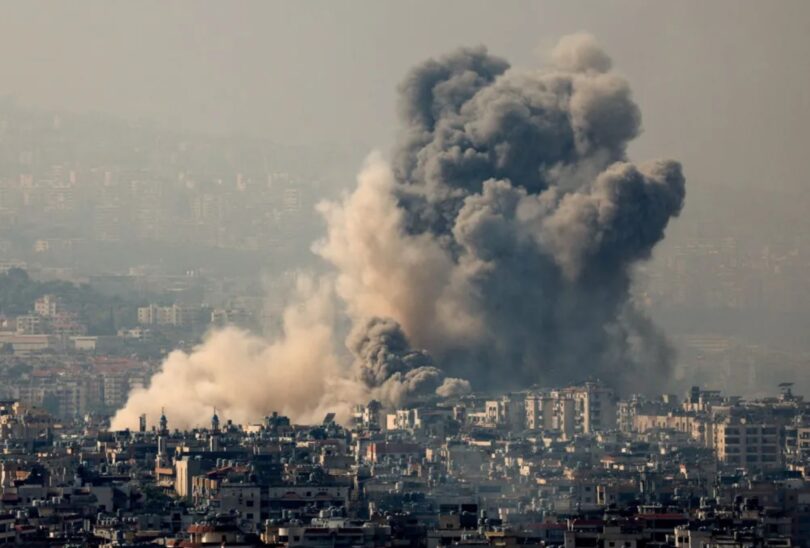
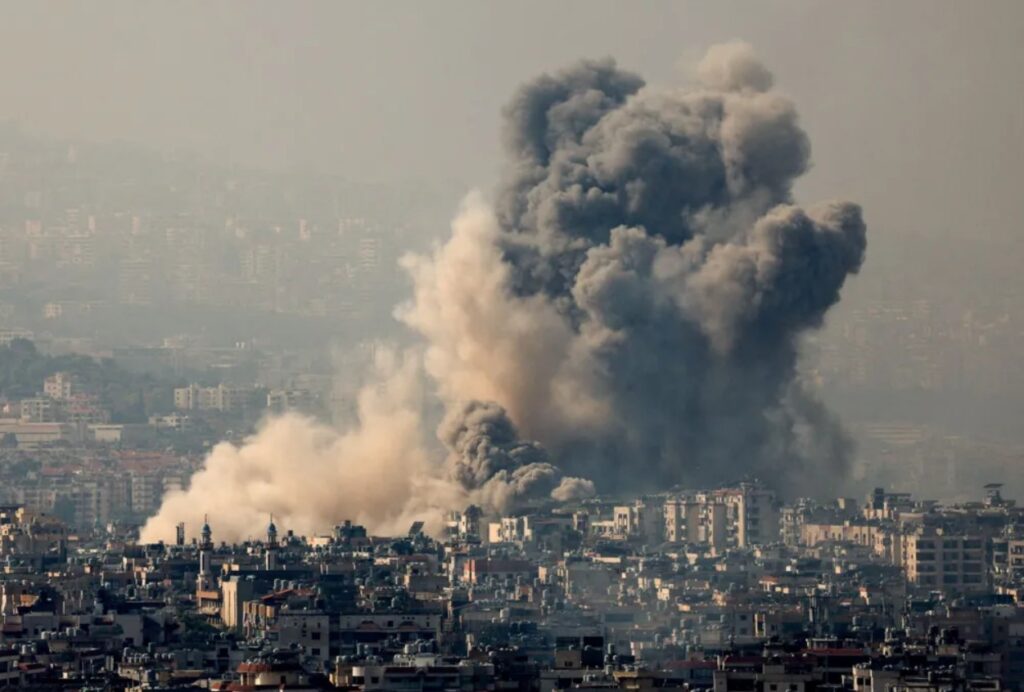
Following the 2006 Lebanon War where the IDF heavily bombarded the Dahiya quarter, which housed Hezbollah’s administrative headquarters and the strikes effectively flattened the entire urban area, the 'Dahiya Doctrine' was formally articulated in 2008 by Major General Gadi Eisenkot, the then head of the IDF Northern Command during the 2006 war and later became the IDF Chief of General Staff. Core strategic pillars of the Dahiya Doctrine include: Reclassifying Urban Zones - entire villages or neighbourhoods utilized by asymmetric militant groups to launch rockets or embed assets are viewed structurally as military bases rather than civilian quarters; Targeting National Infrastructure – the strategy extends targets beyond direct military assets to encompass critical state and civilian infrastructure, including power grids, water treatment facilities, communication centres, bridges, and ports; Psychological and Economic Warfare - by escalating the cost of postwar recovery and creating immense domestic disruption, the doctrine aims to sever the social fabric and political support tying a militant group to its host population.
The Dahiya Doctrine guided major IDF military operations in the Gaza Strip, including Operation 'Cast Lead' (2008–2009), Operation 'Pillar of Defence; (2012), Operation 'Protective Edge' (2014), and the post-October 2023 military campaigns in both Gaza and Lebanon, citing the total destruction of entire residential districts and civilian infrastructure. As a veteran IDF Chief of Staff associated with the military's "Dahiya Doctrine," Eisenkot remains a dedicated security hawk, maintaining that the military capacities of Hamas must be entirely neutralized. Politically, Eisenkot differentiates himself from Israel's far-right by firmly opposing the annexation of the West Bank and forcefully rejecting settler extremist violence. Also, despite favouring diplomatic channels alongside military pressure, Eisenkot continues to firmly oppose the implementation of a fully independent sovereign Palestinian State.
The Dahiya Doctrine and Israel's post 2023 military campaigns are highly controversial and widely condemned by international bodies, legal scholars, and human rights organizations: Violation of International Humanitarian Law – the International Committee of the Red Cross (ICRC) and various UN bodies state that the doctrine directly violates the principle of proportionality governed by international law; Geneva Conventions - Article 51 of the Fourth Geneva Convention explicitly prohibits indiscriminate attacks, collective punishment, and military actions that expect to cause incidental loss of civilian life or damage to civilian objects that is excessive in relation to the concrete military advantage; War Crimes - critics and international legal investigators argue that treating an entire urban area as a single military target constitutes a war crime, state terrorism, and acts of "domicide" – the deliberate, widespread destruction of the home environment.
Eisenkot may be averse to reviving attacks on Iran, unless coaxed by the whimsical Donald Trump, but he is certainly no peace dove for Gaza/Palestine and Lebanon although perhaps less aggressive. He will need to strengthen his relations with the US Administration although Trump views him and Netanyahu not much different. The fact is that Trump's intransigence to the genocide in Gaza and the US-Israel War on Iran did cause political setbacks to both Trump and Netanyahu.
Trump is happy that the US, Denmark and Greenland signed a trilateral security agreement on September 22, 2026, granting the US military greater access to the Arctic; including establishing two new military bases in Greenland. But whether Trump will soften his hardline on Iran and let the Straits of Hormuz reopen, remains doubtful having made it a prestige issue; that if Iraq was invaded on the false pretext of Baghdad going nuclear, he can subjugate Iran under the American version of the Dahiya Doctrine.
Incidentally, the Trump Administration has reaffirmed its love-hate policy towards India. The US State Department has served summonses to the Government of India in a civil lawsuit filed by India-designated terrorist Gurpatwant Singh Pannun, which names NSA Ajit Doval and former R&AW chief Samant Goel among the defendants (https://www.telegraphindia.com/india/us-delivers-summonses-to-nsa-ajit-doval-ex-raw-chief-in-lawsuit-by-sikh-separatist-pannun/cid/2188769?utm_source=facebook&utm_medium=social&utm_campaign=tt_daily). This could be because US national Mathew VanDyke claiming he and six Ukrainians were jailed by India because of the Russia-Ukraine war. But if India takes no action on the US summons for Ajit Doval and Samant Goel, America could declare them Most Wanted in USA and globally designated wanted individuals through the UN.
The author is an Indian Army veteran. Views expressed are personal.