

The question of why and how China will attack India has been doing the rounds for a long time. Strategic analysts point to unresolved historical disputes, regional rivalry, and shifting power dynamics as the primary triggers for potential military conflict. For China, strategic dominance is also vital for maintaining stability in Tibet and Xinjiang.
Sovereignty of territories along the Line of Actual Control (LAC), specifically Aksai Chin in the west and Arunachal Pradesh in the east, remains unsettled. Chinese scholars refer to the McMahon Line as the McDonald Line, while China, by design, refuses to formally demarcate its claim lines, which creates recurring flashpoints. Beijing is sensitive to India’s hosting of Tibetan exiles and pro-Tibet Western delegations, particularly from the US.
Because of its large economy, Beijing doesn’t view India as a strategic equal. China dislikes India’s growing alignment with Western powers and presence in the South China Sea as threats to its regional dominance. China dislikes and is wary of India being part of the following:
- Quad (US, India, Japan, Australia). Beijing views the Quad as an anti-China grouping.
- I2U2 (India, Israel, UAE, USA). Dubbed “Middle Eastern Quad”, Beijing views it as a direct competitor to its growing economic and diplomatic footprint in the Middle East.
- IMEC (India–Middle East–Europe Economic Corridor). Beijing views this as a Western-Indian-backed alternative to China’s Belt and Road Initiative (BRI) to bypass Chinese-controlled ports and trade routes.
- Trilateral Groupings (India–Japan–Australia and India–France–Australia). Beijing views initiatives like the Supply Chain Resilience Initiative (SCRI) to reduce dependence on China and disrupting its global trade networks.
- BIMSTEC (Bay of Bengal Initiative for Multi-Sectoral Technical and Economic Cooperation). Beijing views India’s push for deeper connectivity and security cooperation within BIMSTEC as an effort to consolidate influence in South Asia and limit China’s access to the Bay of Bengal.
A veteran scholar-analyst writes: “China sees itself in competition with the US, not India. Today, India is at least a decade, if not two, behind China in the military, economic, and tech spheres, having five times the economy, a decade gap in military capacity, that is in AI and air platforms (already having 5th generation stealth aircraft and testing 6th generation), three aircraft carriers, the largest number of naval vessels in the world, not to miss the point that the next full-fledged war with China will have Pakistan, maybe even Bangladesh, as an active or passive participant in the conflict, which will tie up sizable military resources on the Pakistan-Bangladesh border. That there will be war with China in the next few years is for sure.”
Beijing views eastern Ladakh as a vital security buffer for the G219 highway that connects Tibet to Xinjiang through Aksai Chin. Now China is building a second expressway (G-695) through Aksai Chin, which is designed to run closer to the LAC than the G-219 highway, touching Depsang, Galwan Valley, and Hot Springs by 2035.
In 2024, China formally established two new counties (He’an and Hekang) to administer Aksai Chin, signaling its intent to permanently integrate the plateau and back up its infrastructure with civilian and paramilitary logistics. How will China secure depth for the G-695, given that its alignment makes the road more vulnerable to Indian observation and artillery? Analysts differ in perceiving China’s actions in this context.
One view is that China will occupy Karakoram (KK) Pass and attempt to capture Depsang, Daulat Beg Oldi (DBO), Galwan, Hot Springs and Pangong Tso. Another view is that Beijing will secure its depth through forward territorial denial, fortifications, and link up with Pakistan north of the Siachen Glacier through the Shaksgam Valley, since China’s 2020 aggression in eastern Ladakh pushed Indian artillery and observation posts further away from the G-695 expressways alignment.
A third view is that if China were to capture Depsang Plains and KK Pass, it could establish a direct overland link with Pakistani forces across the northern tip of Ladakh, isolating Indian troops on the Siachen Glacier. However, such a manoeuvre would trigger a full-scale two-front war with India, which is why Beijing and Islamabad currently rely on road construction, joint exercises, and intelligence sharing rather than an active military invasion to connect their positions.
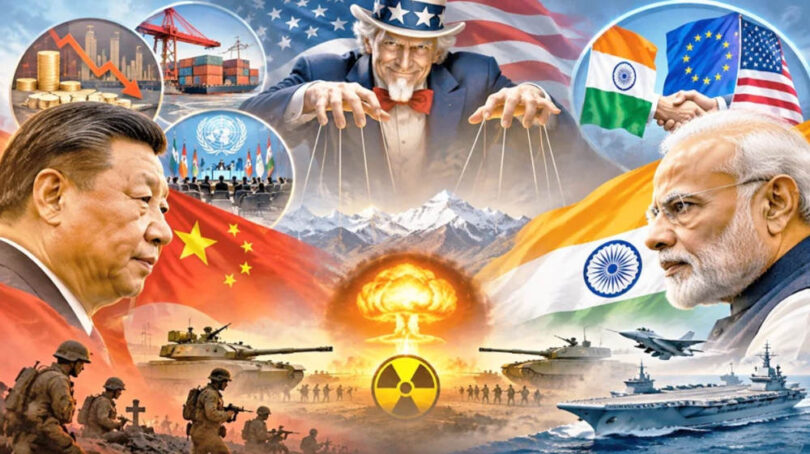
Many strategists believe the political, economic, and military costs of a full-scale war with India outweigh any potential gains for Beijing due to: possible nuclear escalation; Indian missiles, like Agni, targeting Chinese cities would imply mutually assured destruction; India could retaliate by disrupting Chinese trade and vital energy shipments passing through the Strait of Malacca; India would be pushed into a formal military alliance with the US and Western powers.
A former Indian army chief recently said in Pune, “We have been having and will keep having clashes. The Galwan clash was just another example of such an incident. However, what is important is that the events following Galwan have clearly demonstrated that, as far as China is concerned, a military solution to the boundary dispute is off the table.”
Whenever Indian troops took a stand, the PLA retreated. But this can hardly be said about eastern Ladakh and Arunachal Pradesh. In Ladakh during 2020: India failed to blame China’s aggression, whereas China called India the aggressor; India lacked the national will to fire even at PLA tanks advancing on Indian positions; Kailash Range was vacated on a nudge from China without linking PLA withdrawal from Depsang; India no longer demands reversion to pre-April/May 2020 deployment; Indian troops can’t patrol up to areas as was the case before April 2020.
China has been releasing video clips of captured Indian troops in the Galwan clash. The defence minister met some of the injured soldiers in the hospital in Leh. India did not provide evidence of any PLA troops taken prisoner. In December 2025, the defence minister inaugurated the Galwan War Memorial remotely from Leh, which is 230 km away from the memorial. Is this the geopolitical signal we should be giving to China? George Fernandes, defence minister, never hesitated to land at posts on the Saltoro Range (Siachen Glacier area) that were periodically subjected to enemy fire. There was no such threat in Galwan, and the memorial is open to the public. Just before Prime Minister Narendra Modi was to proceed to the ASEAN summit in Manila, a Chinese military aircraft violated Indian airspace and stayed over Sikkim for 25 minutes despite warnings by the Indian Air Force (IAF).
Reports of PLA ingress in Arunachal Pradesh have been coming over the years. On October 22, 2026, the serving DG Indo-Tibetan Border Police (ITBP), who is an IPS officer, said that Indian and Chinese troops have been involved in active face-offs at multiple locations along the LAC in Arunachal Pradesh, acknowledging that these standoffs have been ongoing since July 2026 and continue at certain points. He further said the border with China remains highly challenging, prompting the force to actively enhance drone and anti-drone capabilities, accelerate bunker construction, and develop underground shelters to safeguard assets.
There is a view that China’s maximalist claim over the entire state of Arunachal Pradesh (90,000 sq km) is actually a bargaining chip rather than a realistic goal for total conquest, with India recognising China’s control over Arunachal Pradesh in exchange for India formally ceding Aksai Chin in the west. Analysts note that maintaining pressure across all of Arunachal Pradesh gives Beijing leverage to force concessions in Ladakh or Sikkim during boundary negotiations.
The talk by General David Petraeus at the NDTV World Summit in New Delhi in October 2026 included the following: China has the unmatched industrial capacity to mass-produce cheap drones at a scale few can rival; China’s use of bullet-less aggression along the LAC in Eastern Ladakh and Arunachal Pradesh forces India to stretch its conventional resources, making it highly vulnerable if it fails to integrate digital and autonomous countermeasures quickly.
Beijing’s main focus in Arunachal Pradesh apparently is the Tawang tract that holds immense religious and political significance for Beijing’s control over Tibet, as it houses the 400-year-old Tawang Monastery, the birthplace of the sixth Dalai Lama and a potential site for the current Dalai Lama’s reincarnation.
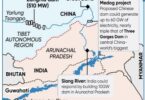
Whether to wage war will be Beijing’s choice, but China can be expected to continue salami-slicing Indian territory. The manner in which China has drawn Pakistan, Nepal, Myanmar and Bangladesh into its strategic sphere has serious ramifications in a multi-front, multi-domain conflict. The China-built submarine base for the Bangladesh Navy is the largest in Asia. China and Bangladesh are advancing the $1 billion Teesta River Comprehensive Management and Restoration Project (TRCMRP) after years of stalled water-sharing talks with India. In addition, China is establishing an airbase in Lalmonirhat (Bangladesh) in proximity to the Siliguri Corridor.
India aims to complete its Siliguri Corridor underground railway line (roughly 20-24 metres deep) by 2029. China can station engineers and heavy dredging equipment along the Teesta basin (10-22 km from the Siliguri Corridor), allowing Beijing to monitor Indian construction logistics, map regional groundwater/soil hydrology, and conduct electronic surveillance. China’s deeper infrastructure and defence ties in northern Bangladesh increase the risk of a coordinated pincer threat that could target the tunnel’s exposed entry and exit junctions from both north and south. In a conflict, China’s deep-penetrating ballistic missiles, bunker-buster bombs and long-range rocket artillery can collapse the tunnel portals, ventilation shafts, and approach tracks.
Indian policymakers and the military must take the above into account. But this is not all. For example, India’s AI layer is sovereign, but the entire physical computing layer underneath is foreign-rented, which poses serious risks for national security, including military operations and preparedness, critical infrastructure, and everything AI-enabled. Beijing can exploit semiconductor dependencies to degrade our military’s readiness, embed hardware vulnerabilities, and choke wartime resupply. Massive outages in the US, concurrent with the bilateral Donald Trump-Xi Jinping summit in Shenzhen, resulting in the sacking of the US National Cyber Director Sean Cairncross, leave little doubt who caused these outages.
According to defence analysts and industry estimates, China can produce roughly 16,000+ small tactical drones daily (scaling higher in wartime), compared to India’s current output of roughly 10 to 200+ units per day depending on whether large-scale platforms or small first-person view (FPV) drones are counted. Because military drones range from multi-million-dollar high-altitude strike aircraft to cheap, disposable FPV attack drones, daily output varies dramatically by drone class and peacetime to wartime mobilisation.
India faces a major supply chain and security challenge with Chinese-origin components in domestically built drones. According to analysts and industry founders, roughly 70% to 90% of critical sub-components, like flight controllers, navigation modules, motors, and batteries, are imported, with a substantial portion originating in China. Even components sourced through third-party countries like Poland/Singapore often trace back to Chinese factories. Army’s internal reviews indicate instances where crashed or compromised drones were tampered with or contained banned Chinese electronics, prompting the cancellation of contracts involving roughly 400 drones from domestic vendors. A post on X says: “The Army Design Bureau’s framework to secure military drones against cyber threats has been awaiting MoD approval for nearly 20 months. Industry is still waiting for an approved component list and vetted Indian vendors. Why the delay?”
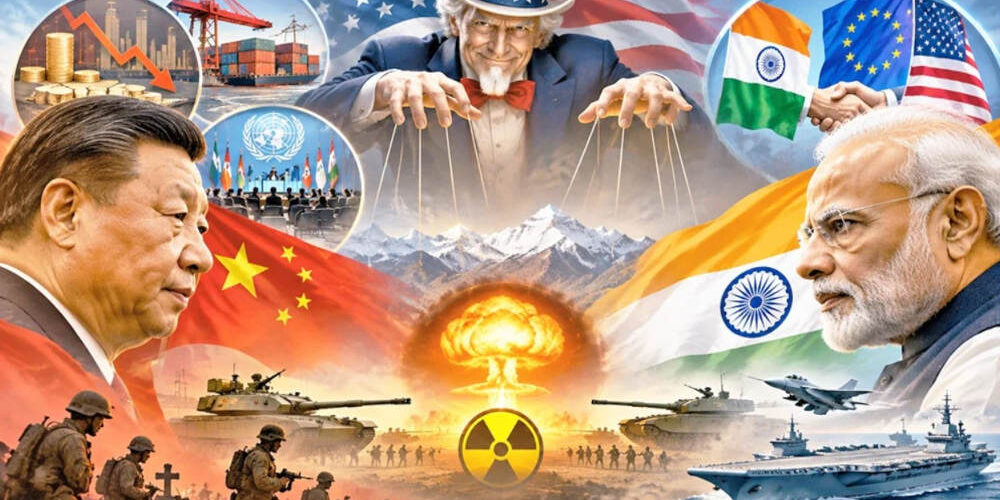
Finally, it needs no intelligence to decipher that the US would love an India-China war to draw strategic and economic advantage without getting into direct conflict with China, using India as a proxy like Ukraine and without firing a single shot at China.
The author is an Indian Army veteran. The views expressed are of the author and do not necessarily reflect the views The Strategic Perspective.
The article was first published in Raksha Anirveda on 23 November 2026 and can be accessed here.