

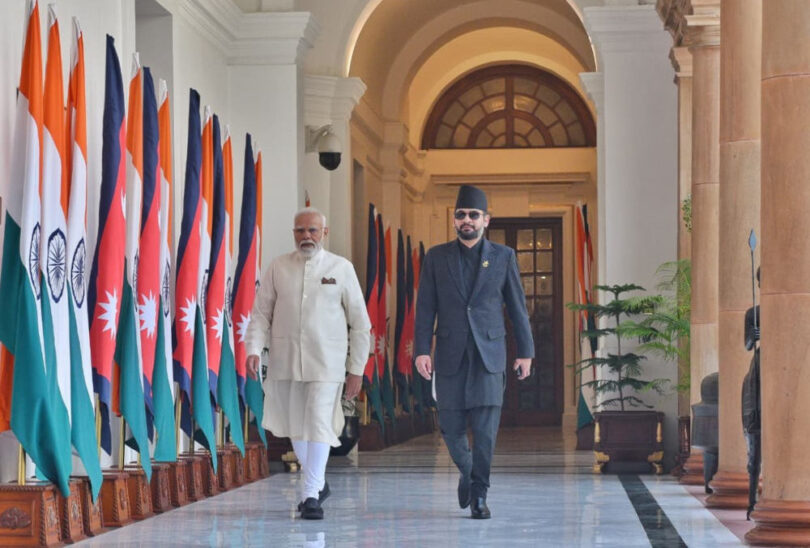
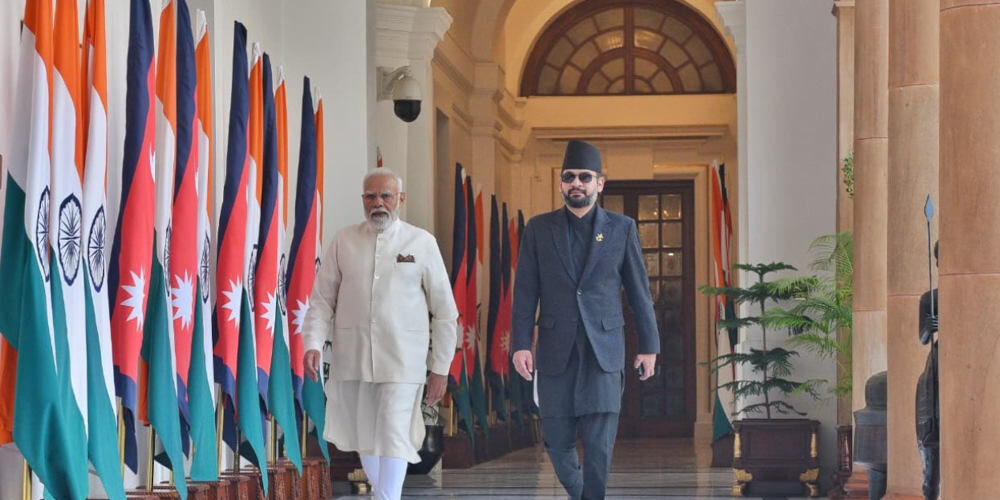
Nepal's Prime Minister Balendra "Balen" Shah visit to India on November 22–23, 2026, marked his first bilateral foreign trip since taking office in March 2026. His predecessor KP Sharma Oli, a Beijing-stooge, had first visited China. Balen Shah was accompanied by a high-level official delegation, including Foreign Minister Shishir Khanal and Finance Minister Swarnim Wagle, as well as a 52-member private-sector delegation participating in the Nepal-India Business Forum.
Following talks in New Delhi with Indian Prime Minister Narendra Modi, the two nations announced major financial assistance, infrastructure launches, and bilateral agreements:
- Flood Reconstruction Package. Modi announced a Development Cooperation Package of NPR 24,000 crore (₹15,000 crore or US$1.6 billion) to support Nepal's post-flood recovery and long-term development.
- Education Initiatives. India announced plans to establish an offshore campus of the Indian Institute of Technology (IIT) in Nepal and expanded scholarships for Nepali students studying in India.
- Cross-Border Connectivity & Infrastructure. Both leaders jointly flagged off the Saryu-Kamala Rail Service connecting Ayodhya in India to Janakpur Dham in Nepal, linking two major cultural and religious centres.
- Dharchula Road Bridge. Both leaders virtually inaugurated the Dharchula road bridge connecting Uttarakhand and Nepal.
- Integrated Check Posts. Both laid the foundation stone for the Integrated Check Post (ICP) at Banbasa and agreed to expedite construction on the Dodhara Chandani ICP on the Nepalese side.
After delegation-level talks at Hyderabad House, India and Nepal exchanged following eight Memorandums of Understanding:
- Academic and Research Collaboration. Between
India's National Forensic Sciences University in Gandhinagar (Gujarat) and Crime Investigation Department, Nepal Police. - Police and Security Training. Between India's Rashtriya Raksha University (RRU) and Nepal's National Police Academy (NPA).
- Civil Service Capacity Buiding. Between
National Centre for Good Governance, Department of Administrative Reforms & Public Grievances, Government of India, and Nepal Administrative Staff College, Ministry of Federal Affairs and General Administration, Government of Nepal. - Traditional Medicine. Between Government of India and the Government of Nepal on Cooperation in the field of Ayurveda and other Traditional Systems of Medicine.
- Space and Satellite Communications. Between Indian Space Research Organisation (ISRO), Government of India, and Ministry of Information and Communication (MOIC), the Government of Nepal, on Establishment of Satellite Communication (SATCOM) Network for the Utilization of South Asia Satellite.
- Urban Development. Between Government of India and the Government of Nepal on Technical Cooperation in the field of Sustainable Urban Development.
- Health and Medicine. Between Ministry of Health and Family Welfare, Government of India, and Ministry of Health and Food Safety, Government of Nepal, on Cooperation in the field of Health and Medicine.
- Agricultural Cooperation. Between Government of India and the Government of Nepal on Cooperation in the field of Livestock and Fisheries Development.
India and Nepal finalized an NPR 184 billion ($1.1–$1.2 billion) energy-sector credit line, laid the foundation stone for the 669 MW Lower Arun Hydroelectric Project, dedicated Phase II of the Motihari–Amlekhgunj petroleum pipeline, and agreed to fast-track major multipurpose river projects and cross-border transmission grids. India's development package advanced the 400 kV cross-border transmission corridors like Inaruwa–New Purnia and Dodhara–Bareilly. Both nations reaffirmed long-term electricity trade agreements. Phase II of the Motihari–Amlekhgunj pipeline was formally dedicated and a foundation stone was laid for the Jhapa oil terminal alongside plans for the Siliguri–Jhapa pipeline.
Majority of India’s NPR 24,000 crore (approximately INR 15,000 crore or $1.62 billion) development package announced is structured as a soft loan, combined with a smaller non-repayable grant component; split into two components: Concessional Line of Credit (INR 11,500 crore) - roughly 77% of the total package is extended as a soft loan earmarked for energy and infrastructure projects; Grant Assistance (INR 3,500 crore) – the remaining portion is direct, non-repayable aid dedicated to post-flood reconstruction and disaster resilience following the devastating August 2026 floods.
India delivers its concessional loans through the Exim Bank under the government’s Indian Development and Economic Development Scheme (IDEAS). These qualify as "soft" loans, meaning they offer terms significantly more generous than standard commercial market loans: countries like Nepal typically receive fixed interest rates between 1.5% and 1.75% per annum; borrower is given 20 to 25 years to repay the principal, including an initial 5-year moratorium (grace period) during which no principal repayments are required; projects are exempt from local corporate taxes, import duties, and value-added taxes in the recipient country, lowering overall project execution costs; at least 75% of the goods and services used in the funded projects must be sourced from Indian companies.
During their joint press conference in New Delhi on November 23, after both leaders virtually flagged off the Saryu–Kamala Express, Modi told Balen Shah that "Lord Ram is incomplete without Nepal" ("Nepal ke bina hamare Ram bhi adhure hain") to highlight the religious, cultural, and civilizational ties linking Ayodhya in India (birthplace of Lord Ram) with Janakpur in Nepal (birthplace of Goddess Sita). Balen Shah comes from a Newar Buddhist family, though he actively practices and incorporates both Buddhist and Hindu traditions in his public life.
Both leaders adopted a Joint Vision for a “Viksit Bharat and Samunnat Nepal”. The Joint Vision statement provides the roadmap for an aspirational and future-oriented partnership between India and Nepal; encompassing initiatives to augment traditionally strong areas of bilateral cooperation, like economic and development partnership, connectivity, energy and water resources, and people-to-people linkages, as well as new synergies in the domains of climate resilience, disaster mitigation and management, sports, start-ups, digital services, space and innovation.
The China-built Pokhara International Airport (funded by a $216 million China EXIM Bank loan) sparked widespread domestic backlash after opening without regular international flights, prompting Nepal to ask China to convert the loan into a grant and leading Nepal's anti-graft body to file corruption charges against Chinese contractor CAMC Engineering and dozens of officials.
Following the devastating August 26, 2026, ice-rock avalanche and flash floods near the Nepal–China border, which killed over 1,400 people, leaving thousands missing, both India and China responded with immediate emergency aid. Nepal's Foreign Minister demanded legal and moral climate compensation from top greenhouse gas emitters, specifically China, the US, and India; but later retracted his demand and thanked India and China for their relief efforts. Addressing the UNGA on September 24, 2026, Balen Shah formally proposed a trilateral Himalayan Climate Resilience Mechanism co-led by Nepal, India, and China to protect the fragile mountain ecosystem and manage cross-border disasters.
India's 2015–2016 border blockade was the single biggest catalyst that pushed Nepal to actively seek strategic and economic alternatives in China, though geography and economics eventually prevented Kathmandu from fully shifting into Beijing's orbit. Beijing stepped in by signing a landmark 2016 Transit and Transport Agreement, granting Nepal access to four Chinese seaports and three land ports to theoretically break India's transit monopoly. While the blockade permanently broke India's psychological and diplomatic monopoly, giving Nepal a "China card" to balance New Delhi, practical realities, like the Himalayan geography and stalled BRI projects, pragmatic balancing acknowledges that while China offers useful leverage and investment, Nepal's economic survival and energy trade remain inseparably tied to India.
India’s proposed Raxaul–Kathmandu railway is roughly twice as long and faces far fewer extreme geological hurdles than China’s Kerung–Kathmandu line, though both projects remain stalled in the pre-construction phase over financing. Meanwhile, China’s active operational footprint in Nepal is concentrated in cement manufacturing, aviation, and hydropower, producing both major industrial successes and high-profile debt controversies.
Balen Shah's choice of India over China for his first foreign trip is seen as a pragmatic focus on economic ties and administrative delivery following Nepal's recent political transition. At the same time, it must be remembered that China has drawn Nepal into its strategic sphere primarily by capitalizing on Nepal's desire to end its historic geographic dependence on India, using transit agreements, BRI infrastructure pledges, and deep political outreach.
According to Nepal’s Economic Survey 2025/26, China accounts for 48% of Nepal’s total approved FDI investment and 45.5% of all approved foreign projects, making it the single largest source of new investment pledges. However, while China dominates new annual pledges, its actual realized FDI stock is roughly NPR 35-40 billion, as many pledged Chinese projects face delays over tax disputes, regulatory hurdles, and geopolitical friction.
Finally, only time will show how Balen Shah's visit will usher a new chapter in India-Nepal relations, especially since he did not raise the boundary issue, which has been left to officials of both sides. Meanwhile, Nepal must continue with its balancing act between India and China. Nepal recently appointed a new ambassador to Beijing and maintains coordination on reopening flood-damaged northern trade routes like Rasuwagadhi. Having already been invited, Balen Shah should be visiting China soon.
The author is an Indian Army veteran. Views expressed are personal.
More on related topics:
Shifting Power Dynamics: Will China Wage War Against India?: https://www.thestrategicperspective.org/shifting-power-dynamics-will-china-wage-war-against-india/
India-China Eight-Point Agreement: A Tactical Thaw, but Trust Remains Elusive: https://www.thestrategicperspective.org/india-china-eight-point-agreement/
China-Nepal’s joint Military Drill in September 2025: https://www.thestrategicperspective.org/china-nepals-joint-military-drill-in-september-2025/
Regime Change in Nepal: https://www.thestrategicperspective.org/regime-change-in-nepal/
Burning Nepal: https://www.thestrategicperspective.org/burning-nepal/