

Netaji Subhash Chandra Bose is a central figure in the early military history between India and Japan, although modern India–Japan defence relations are built on a separate, post-2000 strategic partnership. Renko Temple in Japan (half-hour drive from Tokyo), where Netaji's ashes are interned, and has Netaji's bust in the courtyard, has been visited by Indian President Rajendra Prasad and Prime Ministers Nehru, Indira Gandhi and Atal Bihari Vajpayee. However, the return of Netaji's ashes to India, and even a DNA test of the ashes remains mired in internal politics in India, despite Bose's relatives wanting so.
Japan holds Netaji in very high esteem. On November 18, 2018, Hiroshi Hirabayashi, former Ambassador to India and President of Japan India Association, speaking at Ahmedabad questioned: why India has failed to take the ashes of Netaji back home; why there is no representation from the Indian Embassy at the annual memorial prayers in August at Renkoji Temple; why there are no major visitors from India to Renkoji anymore?
In 1952, India signed a separate peace treaty with Japan, waiving war reparations, but Japan's pacifist constitution and Japan-US security alliance kept defence ties with India minimal. Ties briefly froze after India's 1998 nuclear tests. However, relations recovered 2000 onwards. In October 2008, Indian Prime Minister Manmohan Singh and Japanese Prime Minister Taro Aso signed the 'Joint Declaration on Security Cooperation', making India only the third country (after the US and Australia) with which Japan had such a security pact.
During the visit of the Indian Navy Chief Admiral Vishnu Bagwat to Japan in 1997, first Indian Service Chief invited by Japan, Japan had offered: one, amphibious aircraft to India; two, positioning of Japanese helicopters at Andaman under joint control for maritime surveillance; three, technological upgradation and maintenance of Pokhran field firing ranges by Japan. But India did not pursue these issues.
In 2014, Indian Prime Minister Narendra Modi and Japanese Prime Minister Shinzo Abe elevated the bilateral ties to a 'Special Strategic and Global Partnership'. Both nations signed agreements on defence equipment transfer (2015), joined the Quad framework, and finalized the Acquisition and Cross Servicing Arrangement (ACSA) in 2020, allowing their militaries to share bases, fuel and logistics. Cooperation expanded into regular tri-service drills; 'Dharma Guardian' (Army), 'JIMEX' and 'Malabar' (Navy), and 'Veer Guardian' (Air Force), which saw Japanese fighters deploy to India in 2026.
In October 2026, a Japanese delegation visited India to evaluate infrastructure that could support Japan's expanding long-range strike and unmanned systems requirements. The delegation spent approximately a week examining infrastructure that could support Japan's expanding long-range strike and unmanned systems requirements. Geography remains Japan's limitation in conducting long-range missile trials within its own territory. The delegation showed interest in the Integrated Test Range of the Defence research and Development Organization (DRDO) at Chandipur in Odisha. India is reportedly allowing Japan access also to two upcoming state-of-the-art testing centres being developed in West Bengal and Andhra Pradesh.
Japan is advancing plans for a layered coastal defence architecture that integrates large numbers of comparatively low-cost unmanned aerial, surface and underwater vehicles for reconnaissance and strike missions; alongside an expanding inventory of stand-off weapons. The country is developing a new generation of missile systems to strengthen deterrence amid increasing Chinese military activity and North Korea's advancing missile capabilities.
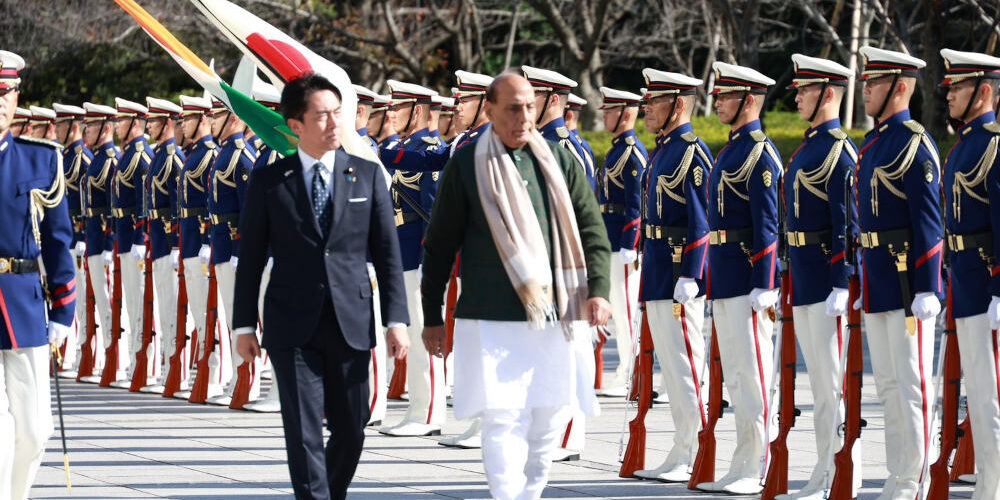
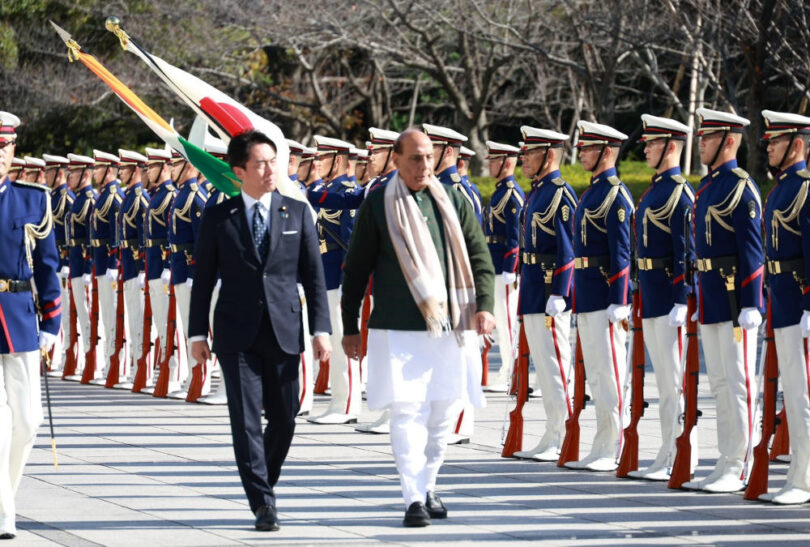
On November 19, 2026, the fourth India-Japan 2+2 Foreign and Defence Ministerial Meeting took place in Tokyo, resulting in landmark agreements on live-fire military training, naval co-development, and critical technology partnerships. Major outcomes of the Dialogue included cooperation in the following spheres:
- Live-Fire Training and UNICORN. Japan's Self Defence Forces (JSDF) will gain access to Indian ranges for live-fire exercises starting in 2027. Also, both nations targeted February 2027 for India's Acceptance of Necessity (AoN) regarding the Unified Complex Radio Antenna (UNICORN) Naval Mast System under "Design with Japan, Make in India".
- Maritime Cooperation. Operationalized maritime security frameworks to enhance Domain Awareness, Search and Rescue, mine countermeasures, reciprocal ship repairs, and potential naval shipbuilding, alongside supporting India's hosting of the 5th Coast Guard Global Summit in 2027.
- Cyber, Space and Supply Chains. Expanded collaboration in AI-driven cybersecurity, Space Situational Awareness, undersea cables, semiconductors, critical minerals, and clean energy.
- Indo-Pacific and Geopolitics. Aligned India's Indo-Pacific Oceans Initiative (IPO) launched by in 2019 to promote maritime security, ecology, and resource management in the region / MAHASAGAR with Japan's Free and Open Indo-Pacific (FOIP) - Japan's strategic vision aimed at ensuring rule of law, freedom of navigation, and regional connectivity, following the Quad Summit.
Japan is set to conduct live-fire military training in India for the first time, with drills involving surface-to-ship missiles expected to begin next year under a new bilateral arrangement between the two countries. This development follows the signing of a Letter of Intent (LoI) on the utilisation of Indian firing ranges by the JSDF. Both sides agreed to accelerate coordination between their respective defence authorities to ensure the arrangement is implemented at the earliest opportunity.
Japanese Defence Minister Shinjiro Koizumi described the agreement as “a major step strategically”, underlining its significance for the growing security partnership between the two countries. The initiative marks a notable expansion of India-Japan defence ties, which have steadily deepened in recent years amid a changing security environment across the Indo-Pacific region. Japan has long faced limitations in conducting certain large-scale missile training activities domestically because of geographical constraints and restricted training space.
The two nations also reaffirmed their commitment to strengthening military cooperation through more advanced and complex exercises. Future drills are expected to include greater operational coordination and the integration of emerging technologies, including unmanned systems. Officials from both countries welcomed the recent expansion of bilateral military engagements, including the participation of JSDF fighter aircraft in Exercise Veer Guardian 26 in India, a milestone that highlighted the growing level of interoperability between the two Armed Forces.
Beyond live-fire training, India and Japan are seeking deeper collaboration across a range of defence sectors. Discussions during the dialogue covered maritime security, underwater and missile technologies, naval cooperation, information sharing, humanitarian assistance and disaster relief operations, as well as the possibility of joint development initiatives in naval shipbuilding and design.
The agreement adds further momentum to the India-Japan strategic partnership and reflects a shared commitment to enhancing regional security cooperation in the Indo-Pacific. As preparations move forward, the planned missile exercises are expected to become one of the most visible demonstrations yet of the increasingly close defence relationship between India and Japan.
India and Japan are to hold commemorative programs throughout 2027 to celebrate the 75th anniversary of the establishment of diplomatic relations in 2027 as the India-Japan Year of Shared Horizons. The recent India-Japan Cricket Match held at Sano City in Japan was the curtain-raiser to these celebrations.
China's Foreign Ministry and state media typically frame such agreements as "Cold War mentality," "bloc confrontation," and destabilizing regional peace, while warning Japan against abandoning its postwar pacifist constraints. When JSDF units deploy to Indian coastal ranges in 2027, the People's Liberation Army Navy (PLAN) is likely to deploy intelligence-gathering (AGI) spy ships into the Bay of Bengal and Indian Ocean to monitor telemetry and missile performance. Beijing may also respond by stepping up joint naval patrols, defence exercises and missile cooperation with Pakistan to maintain pressure on India's western and maritime flanks.
China has been keenly observing the war in Ukraine. The manner in which Ukraine sank Russia's naval corvette 'Merkury' on November 22, 2026, near Libya's Benghazi port, 2,400-km from the Ukrainian front and also destroyed a Russian Ka-27 combat helicopter, would have been of interest. Ukraine used seven domestically produced Sea Baby unmanned surface vessels (USVs) explosive-laden drone boats that skim just above the waterline rather than fully submerged submarines. Ukraine launched USVs from an undisclosed "mothership" operating in the Mediterranean; operators guided the drones remotely via satellite/data connections and drones using onboard visual-recognition AI to lock onto vulnerable sections of the hull during their final approach. Later that same day, Ukraine hit the dry cargo vessel MV 'Angara' off the coast of Benghazi and disabled the vessel. China should be expected to incorporate such attacks in its Indo-Pacific strategy.
Japan has been offering amphibious aircraft to India over the past several years but India is yet to take a decision about this. In late 1980's there was talk in India about developing a Dornier amphibious aircraft, which did not materialise into any action. Despite lacking active amphibious aircraft since the 1960s, and facing operational limitations across its vast maritime domains, it is only now that the Indian startup 'AlphaX Aerospace' is developing hybrid-electric amphibious platforms to address strategic surveillance and logistics needs.
Finally, 2027 has been designated as the India–Japan Year of Shared Horizons for their 75th diplomatic anniversary, with the fifth 2+2 dialogue scheduled in India. The 'Special Strategic and Global Partnership; between India and Japan should get stronger in the years ahead.
The author is an Indian Army veteran views expressed are Personal.