

Executive Assessment
Pakistan's political landscape has considerably evolved since 2018. It reveals a pronounced transformation with regards to its relationship between its military establishment, elected governments and constitutional institutions. The change is not adequately explained by the replacement of General Qamar Javed Bajwa by General (now Field Marshal) Asim Munir. It indicates an intrinsic reconfiguration which displays how the Pakistan Army maneuvers political authority, controls its institutional influence and manages the civilian political order.
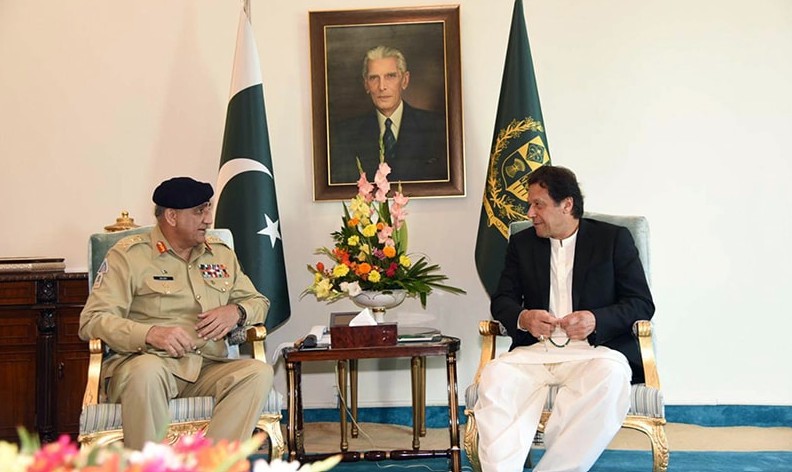
The Bajwa era was characterised by a project-based, personalised fusion: the military establishment and a politically ascendant civilian leadership operated in a relationship of mutual or symbiotic dependence. Imran Khan and the Pakistan Tehreek-e-Insaf (PTI) provided political legitimacy, mass mobilisation and a civilian governing platform. The military maintained decisive influence over national security, strategic policy, intelligence and the political environment. The relationship was managed through informal arrangements and the assumption that civilian and military leadership would remain aligned.
Initially, the arrangement seemed effective, yet its primary vulnerability seemed hardwired in its underlying architecture. The civilian partner , Imran Khan was not merely a passive instrument. Khan possessed an independent political identity, a substantial popular constituency and ambitions that only consistently clashed with the military establishment's institutional interests. The events in 2022 exposed the fragility of this construction.
Munir's approach represents a different configuration. Instead of depending on a single populist political vehicle, the military establishment has made a decisive effort to work with a coalition of established political parties, while constitutional and legislative changes have bolstered the formal position of military leadership and reshaped the institutional environment in which political competition takes place.
The 26th and 27th Constitutional Amendments, the restructuring of the defence command, the creation of the Chief of Defence Forces position, and the Defence Forces of Pakistan Act, 2026, should be evaluated together rather than as disconnected developments. It is imperative to comprehend if Pakistan has simply formalized an already present hybrid arrangement or whether it moved towards a different form of custodial or authoritative rule.
Bajwa's hybrid was an arrangement in which the military utilized politics to influence its power. Munir's emerging order is one in which political and constitutional structures increasingly accommodate the military's exercise of power.
Understanding Pakistan's Hybrid State: Historical Foundations
It is crucial to highlight that Pakistan’s civil–military relationship never developed on the conventional lines of a parliamentary democracy in which elected institutions exercise authority over the armed forces. Post Pakistan’s independence in 1947, the military has acquired a position which is not limited to just national defence. It has progressively influenced foreign policy, relations with India and Afghanistan, nuclear strategy, intelligence, internal security and, at various points, economic management and political succession.
Additionally, the coups of 1958, 1977 and 1999 reinforced the military rule through direct assumption of power. Direct military government, however, has never been the only mechanism through which the army exercises influence. The post-2008 era further transition happened, the: civilian governments remained in office, elections continued and parliamentary institutions functioned, while the military retained extensive influence over strategic decisions and the limitations within which elected governments would be allowed to operate.
This type of mechanism came to be dubbed as a hybrid regime. This was a political system which integrated both electoral and civilian institutions with authoritarian constraints and unelected centres of power. Hybridity does not necessarily equate to equal power sharing. A civilian government can possess constitutional authority and administrative responsibility while lacking any form of autonomy over strategic areas of national policy.
The military's influence is in this case be better understood through the concept of tutelage. In a tutelary system, the armed forces do not necessarily govern every department or administer every ministry. However, they maintain the authority to determine the permissible boundaries of political action. The elected government governs, but the military establishment holds the veto over matters it considers fundamental to institutional security.
The scope of military intervention fluctuates across governments and army chiefs. The underlying asymmetry, however, has persisted.
Bajwa’s Personalized Fusion Model
The political construction of the Khan experiment
In November 2016,General Qamar Javed Bajwa assumed command as the COAS of the Pakistan Army. Notably, Bajwa’s tenure overlapped with the growing political prominence of Imran Khan. Khan’s anti-corruption rhetoric, populist appeal and criticism of established political elites offered an alternative to the Pakistan Muslim League-Nawaz (PML-N) and Pakistan Peoples Party (PPP).
Khan’s leadership was viewed as an opportunity especially for the establishment which was displeased with the political direction of the country. This provided a chance to construct a new civilian governing arrangement. In 2018 PTI came to power, despite of several controversies surrounding its win owing to allegations of pre-election interference, pressure on political opponents and favourable treatment of PTI .
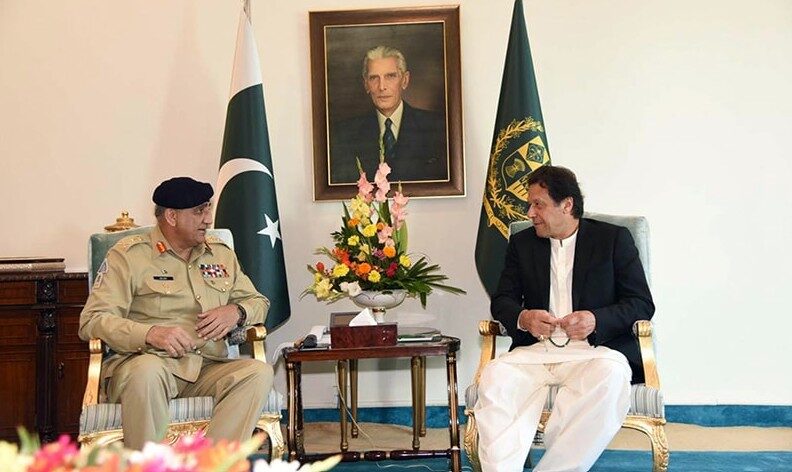
At the time, the arrangement seemed beneficial to both parties. Khan received the military support which helped him to consolidate parliamentary power and weaken his principal rivals. The military establishment acquired a civilian leadership with popular appeal which could govern without requiring the army to assume direct responsibility for administration and maintain deniability. Regardless, this relationship was not a formal constitutional compact and may be understood as an informal political agreement maintained through shared common interests.
The logic of fusion
Political legitimacy: Khan was able to showcase the civilian face, public mandate and the appropriate political narrative. His language presented the government as a break from the previously established political order.
Institutional leverage: the arrangement allowed the military establishment to keep its influence over intelligence, national security, strategic policy and the political environment. The relationship between army leadership and the intelligence apparatus was especially important.
Political coordination: The display of civilian government and military leadership on the same page, working in coordination projected a possibility of two institutions working in unison unlike the previous eras.
This was the essence of fusion which projected complementary components of a single governing arrangement. Despite it, the whole structure lacked a clear constitutional division of responsibility and relied deeply on the continued alignment of personalities and institutional interests.
Bajwa, Faiz Hameed and the intelligence dimension
The internal mechanics of the Bajwa period must be understood while bearing the relationship between Bajwa and Lieutenant General Faiz Hameed. Hameed's position within the Inter-Services Intelligence Directorate (ISI), followed by subsequent military assignments, placed him at the centre of Pakistan's security and political establishment.
The intelligence apparatus sits at an unusually consequential position in Pakistan's civil military architecture. Its institutional reach penetrates through internal security, counterterrorism, political intelligence and sensitive national-security relationships. The relationship between the COAS and the intelligence head is therefore strategically significant.
Hence the Bajwa–Faiz affiliation became a central pillar of the hybrid arrangement. The two officers didn’t always see eye to eye on some interests or certain political developments. Subsequently, disputes over military succession and Hameed's aspirations contributed to the deterioration of the arrangement.
Intelligence influence can strengthen a hybrid regime, but when intelligence networks become closely associated with particular personalities, they can also create rival centres of influence within the military establishment.
The extension controversy: an institutional weakness
In 2019, the extension of Bajwa’s tenure created a controversy. Imran Khan’s government first issued a notification for increasing Bajwa's tenure. However the Supreme Court raised questions pertaining to the legal basis and procedural deficiencies and allowed only a conditional six-month continuation and asked the Parliament to legislate on the matter.
This controversy shows the weakness of the arrangement. The notion of military’s superseding power over the Pakistani political landscape, was contradicted as it failed able to curb or trump the legal framework governing its highest office. This meant that the judicial and legal system had not been adequately aligned with the political arrangements being constructed around it. The government eventually legislated to provide the necessary statutory basis.
This was nothing short of administrative embarrassment. It exposed the vulnerability of a system which depended on informal political authority without sufficiently clear institutional rules. A military leader could possess considerable practical power while the legal arrangements governing his tenure remained uncertain and not pronounced.
The geo-economics proposition
Bajwa’s open pivot toward geo-economics pushed Pakistan to move away from security-centric ties with its neighbours and global partners to attract investment, boost trade, enhance regional connectivity, and ease the economic burdens of its geopolitical position.
However, this economic narrative could not substitute or compensate for the lack of a stable constitutional and political settlement, as Pakistan remained dependent on an informal military–civilian arrangement rather than the institutional continuity, stability, and credible management required for recovery.
Part 2 of the article can be accessed here.
More on Pakistan policies:
Munir's Map: Pakistan's Plan to Redraw Its Provinces, Explained: https://www.thestrategicperspective.org/munirs-map-pakistans-plan-to-redraw-its-provinces/
Pakistan, Houthis and the Mecca Pact: https://www.thestrategicperspective.org/pakistan-houthis-and-the-mecca-pact/
Trade Pivot Weakens Pakistan’s Grip on Afghanistan, as Others Move in: https://www.thestrategicperspective.org/trade-pivot-weakens-pakistans-grip-on-afghanistan-as-others-move-in/
The “Azad” Kashmir Myth: PoJK’s Protest Movement and Pakistan’s Rights Record: https://www.thestrategicperspective.org/the-azad-kashmir-myth/
Sentenced to Silence? Mahrang Baloch’s Life Imprisonment Raises Uncomfortable Questions for Pakistan: https://www.thestrategicperspective.org/sentenced-to-silence-mahrang-balochs-life-imprisonment-raises-uncomfortable-questions-for-pakistan/
From Gaza to Kashmir: Jihadist convergence of Hamas and Pakistan based Terror groups: https://www.thestrategicperspective.org/from-gaza-to-kashmir-jihadist-convergence-of-hamas-and-pakistan-based-terror-groups/
The 2026 Taliban–Pakistan War: Strikes, Claims and Strategic Reality: https://www.thestrategicperspective.org/the-2026-taliban-pakistan-war-strikes-claims-and-strategic-reality/
Saudi–Pakistani Defence Pact: Operationalizing Hedging and Deterrence in 2026: https://www.thestrategicperspective.org/saudi-pakistani-defence-pact-operationalizing-hedging-and-deterrence-in-2026/
From Kingmaker to Convict: The Rise and Fall of Pakistan’s Ex-ISI Chief Faiz Hameed: https://www.thestrategicperspective.org/from-kingmaker-to-convict-the-rise-and-fall-of-pakistans-ex-isi-chief-faiz-hameed/
Pakistan’s Forged Alliance with ISIS-K: https://www.thestrategicperspective.org/pakistans-forged-alliance-with-isis-k/
Pakistan’s Power Struggle: Old Patterns, New Players: https://www.thestrategicperspective.org/pakistans-power-struggle-old-patterns-new-players/
Policy Analysis: Pakistan–Taliban Relations and the October 2025 Ceasefire — Strategic Fracture or Diplomatic Reset? : https://www.thestrategicperspective.org/policy-analysis-pakistan-taliban-relations-and-the-october-2025-ceasefire-strategic-failure-or-diplomatic-reset/