
The manner in which Dipu Chandra Das was tied naked to a pole, beaten mercilessly, lynched and burnt alive in broad daylight in Bangladesh is more horrendous and heinous than ISIS shooting captives in back of the head. (https://www.youtube.com/shorts/nIifDQIDPH0) The same was resorted to during the violent coup for regime change last year that witnessed genocidal acts against Hindus – hangings, killings, burning and mass rapes. Reports of rapes and killings of Hindu women have been coming periodically even after the regime change in Bangladesh.
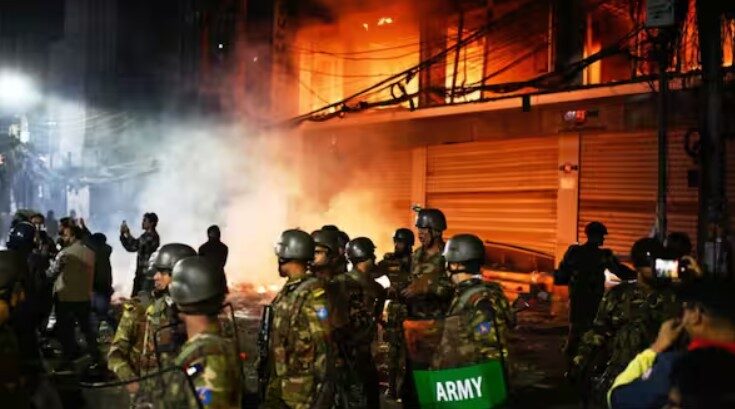
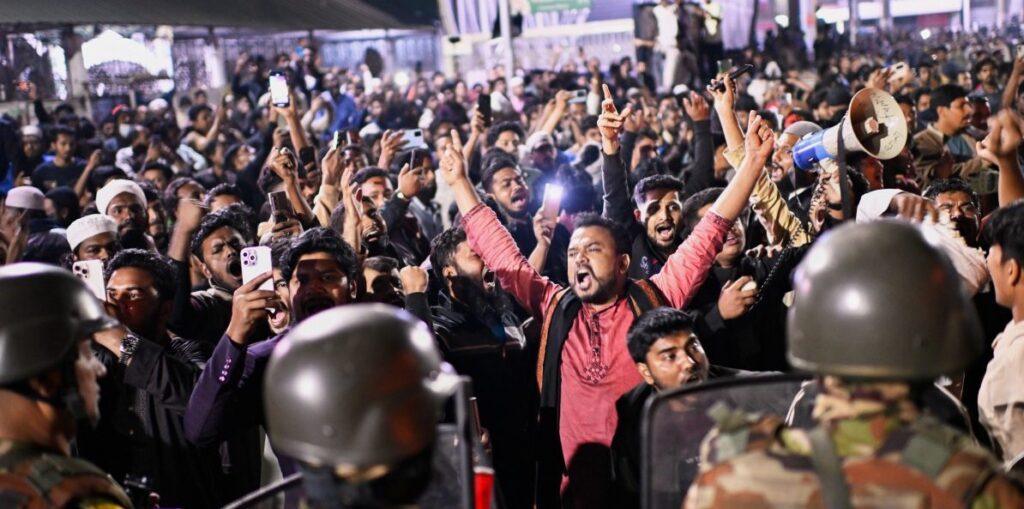
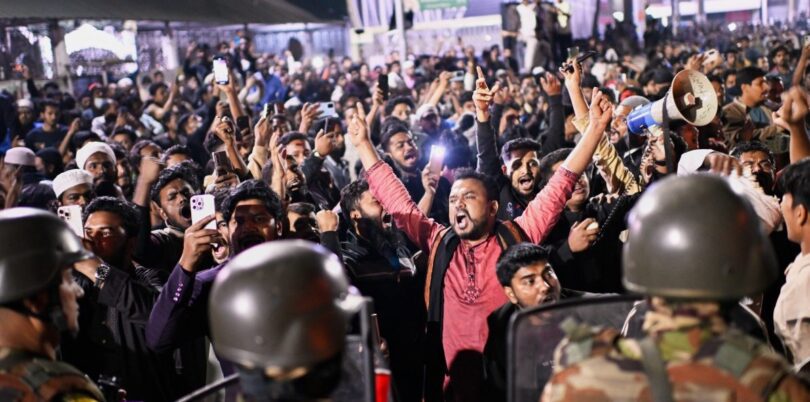
Bangladesh erupted in nation-wide protests, rioting, violence and anti-India sloganeering after student-leader Sharif Osman Hadi was shot dead by three masked men on a motorbike while leaving a mosque in Dhaka, and later declared dead in Singapore, where he succumbed to his injuries (https://www.bbc.com/news/articles/c623rzzenmyo). The Prothom Alo and Daily Star offices were set on fire, as well as houses of Awami League leaders’ houses in Uttara, Chattogram. Prothom Alo’s executive editor Sajjad Sharif condemned the incident as “an attack on freedom of the press, expression, dissent and diversity of opinion”. Radicals carrying sticks marched through Dhaka’s streets chanting slogans in native language that said – “Agents of India beware. Catch Awami League members one by one and slaughter them. Raise your voice simultaneously from all mosques across the country against Indian imperialism and the fascist league. Tomorrow, organize anti-Indian imperialism protests from every mosque. “Everyone should be active so that the killer Hasina and her henchmen, along with the killers of martyr Osman Hadi, are forced to send them back to Bangladesh”. 20-year-old student protester Sajid Al Adeeb told media that the perpetrators were “currently in India”.
Radicals in Dhaka surrounded the Indian Embassy, saying India has no right to have an embassy in Bangladesh, all Indian consulates must be closed immediately, including the border. In addition to the Indian Embassy in Dhaka, radicals also attempted to attack Indian Consulates in Rajshahi, Khulna, and Chittagong. Radicals are blaming India for the attack on Hadi and fueling unrest in Bangladesh. “We are at war. It is now or never”, said Sarjis Alam, Northern Region Chief Organiser of the National Citizen Party (NCP) urging the interim government to act. Sharif Osman Hadi, and his outfit Inquilab Mancha, had emerged as key figures in the July-August 2024 uprising in the country that had eventually led to the ouster of Sheikh Hasina. The attack on Hadi was a day after Chief Election Commissioner (CEC) of Bangladesh, AMM Nasir Uddin announced that the 13th Parliamentary Election in Bangladesh would be held on February 12, 2026. Hadi had just launched his election campaign in Bijoynagar (in central Dhaka) as an independent candidate.
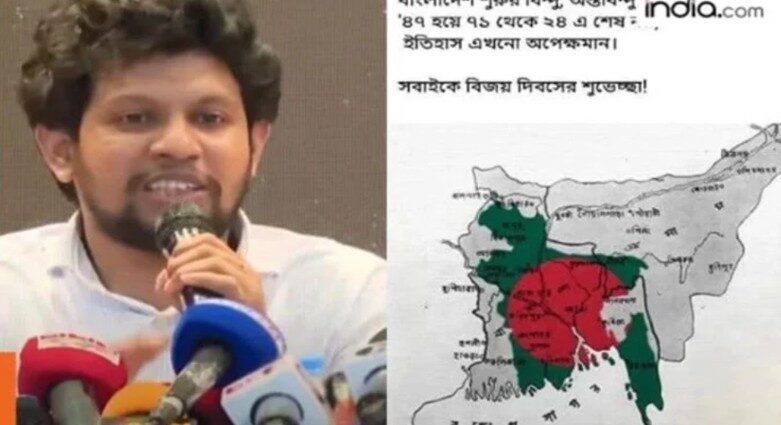
Hadi was a hardcore proponent of Greater Bangladesh; for capturing India’s seven northeastern states and merging them into Bangladesh (https://raksha-anirveda.com/bangladesh-boogies-north-east-india/). Addressing thousands at Hadi's funeral Bangladesh's Chief Adviser Muhammad Yunus vowed to follow the ideals of Sharif Osman Hadi. Stressing that the gathering was not a farewell, but a pledge, Yunus said, "We have come to make a promise to you - that what you told us, we will fulfill. Not only us, but generation after generation of people of Bangladesh will fulfill this promise." The Daily Star quoted Yunus saying, "O dear Osman Hadi, we have not come here to bid you farewell. You are within our hearts, and as long as Bangladesh exists, you will remain in the hearts of all Bangladeshis. No one can remove you from there. Millions of people have gathered today, coming in waves, while crores of people across Bangladesh and Bangladeshis living abroad are waiting for this moment to listen about Hadi." Hadi’s party gave an ultimatum to Bangladesh government to get the killers of Hadi in 24 hours but the Bangladesh police have said there is no specific information on the whereabouts of Hadi’s killers, despite ongoing efforts to track him down.
The latest is that Muhammad Motaleb Shikder, another high-profile leader of student-led National Citizen Party (NCP) has also been shot in the head in Khulna. The house of the Bangladesh Nationalist Party (BNP) leader Belal Hossain was locked from outside and set ablaze. Belal's seven-year-old daughter, Ayesha Akter, was burnt to death in the arson attack (https://www.thehansindia.com/news/international/child-killed-as-bnp-leaders-house-set-ablaze-amid-rising-violence-in-bangladesh-1032529).
It is yet to be seen if Yunus will use the continuing violence in Bangladesh to postpone the elections slated for February 12 next year, but banning the Awami League from contesting elections makes the exercise a farce in the first place. The questions, however, remain as to why Hadi was shot, by whom, and who benefits now with the BNP and NCP also being targeted? The answers to these should not be very difficult to arrive at, deciphering the machinations in India’s neighbourhood over the past few months.
Hadi was probably shot because he had distanced himself from Yunus, wielded considerable influence among the youth and chose to contest the upcoming elections as an independent. This was not to the liking of those who control the regional strings remotely. Yunus is often cited as the courtesan-cum-prostitute of Washington, not wearing lipstick in public, but who also wears the cheongsam gifted by Beijing. Why would he not like to continue in power?
The masked gunmen who shot Hadi are akin to the “unknown gunmen” killing terrorist leaders in Pakistan, also in broad daylight. In Pakistan, it is the ISI who don’t want to continue paying terrorists/terrorist leaders who have outlived their utility and hinder rise of the younger crop of radicals. However, in case of the killings of Hadi and other student-youth leaders in Bangladesh, it could be the ISI, as well as engineered by the US directly, the aim being to establish the “most” radical regime in Bangladesh in the coming elections. To think that these killings in Pakistan and Bangladesh by masked/unknown gunmen were by India’s external intelligence is naïve.
The regime-change in Bangladesh to establish the Yunus regime was engineered by the CIA last year. But while the CIA functions as the covert arm of the USA for regime-change globally, these efforts are overtly augmented by USAID, National Endowment for Democracy (NED) and International Republican Institute (IRI). Leaked files have revealed that the US funded the Gen-Z shadow army of Nepalese youth in the run-up to the violent coup in Nepal, with NED spending hundreds of thousands of dollars prior to the mob violence that overthrew the government of Nepal in September 2025.
Then Washington also has its dancing girl in Pakistan – army chief Asim Munir hosted by the POTUS Donald Trump in the White House twice already. If Trump can get Munir to send his army to Gaza, where is the problem to ask the masked gunmen in Bangladesh. Of course, Dhaka’s courtesan Yusuf may well be in the picture of all this. With critically ill BNP chief Khaleda Zia being treated abroad, efforts appear on to install a Jamaat-e-Islami (JeI)/Jei-headed government in Dhaka. The JeI has been openly spearheading the radicalisation of youth in schools and colleges in Bangladesh, training potential suicide bombers, with Pakistan's ISI providing support for cross-border terrorist activities (https://www.spslandforces.com/experts-speak/?id=1223&h=Talibanisation-of-Bangladesh).
India’s Parliamentary Standing Committee on External Affairs has warned that the evolving political situation in Bangladesh constitutes India’s biggest strategic challenge since 1971, citing the re-emergence of Islamist forces, a shifting domestic political landscape and the growing influence of China and Pakistan (https://www.news18.com/india/biggest-strategic-challenge-since-1971-house-panel-flags-islamists-pak-china-role-in-bangladesh-ws-l-9778709.html). This should be viewed in backdrop of the anti-India interests of the US, China and Pakistan (and Turkey) converging in Bangladesh. William Blum, US historian and critic, who worked in US State Department, wrote in his book ‘Killing Hope: US Military and CIA Interventions Since World War II’ that Britain has been a collaborator in America’s warmongering and regime change all along. Little wonder then that the British High Commissioner to Bangladesh met JeI chief Shafiqur Rahman and senior JeI leaders, with the British High Commission saying the meeting was in connection with the upcoming elections (sic).
India is watching the situation in Bangladesh and Army Chief General Upendra Dwivedi has spoken to his Bangladeshi counterpart General Waker-Uz-Zaman, Gen Zaman has assured all Indian establishments and assets inside Bangladesh remain secure. But we must acknowledge that post the Bangladesh regime-change Zaman was summoned to Washington and briefed by the Pentagon, terrorist leaders released from prison are openly meeting Pakistani counterparts and Bangladesh-Pakistan army/ISI relations have warmed to unprecedented levels. To expect Gen Zaman not to tow the line of the Donald Trump administration would be stupid.
India’s response to media queries about the demonstration outside the Bangladesh High Commission in New Delhi was that it was 20-25 people only sloganeering (https://www.facebook.com/story.php?story_fbid=1384985560333853&id=100064672662562&post_id=100064672662562_1384985560333853&rdid=rPL8k8l59MM2O5Dk#). The media should have been also told to compare this to happening in Bangladesh.
Sajeeb Wazed Joy, Sheikh Hasina’s son has warned that Bangladesh’s interim government is pushing the country towards extremism, posing a serious threat to India's northeastern states (the Seven Sisters). Wazed said in an interview that Yunus is giving free rein to radical organizations like the JeI, and that terrorist training camps are becoming active once again in Bangladesh.
Two views circulating on social media may cause plenty of heartburn in a cross-section in India but needs examination. The first one is an Indo-American view that much of the problems of the Trump Administration with India is because of External Affairs Minister Jai Shankar, who in Trump’s first presidency was bending backwards to appease Trump but now is loudmouthing about strategic autonomy excessively. An Indian view is that Jaishankar is simply following what Prime Minister Narendra Modi wants, while a counterview is that Jaishankar has a free hand in foreign policy formulation. The second view is Indian – in that if we can have a Tibetan Government-in exile, why don’t we have a Bangladesh Government-in Exile in India headed by Sheikh Hasina, giving legitimacy to the Awami League, since we supported the Awami League all these years. If we are not doing so for fear of Uncle Sam, where is our strategic autonomy?
Finally, we obviously have a plan, but the following is also in circulation:

The author is an Indian Army veteran. Views expressed are personal.
More on Bangladesh:
Sheikh Hasina Sentenced to Death Amid Legal and Political Crisis: https://www.thestrategicperspective.org/sheikh-hasina-sentenced-to-death-amid-legal-and-political-crisis/
Bangladesh Makeover: https://www.thestrategicperspective.org/bangladesh-makeover/
New terror outfit launched in Bangladesh: https://www.thestrategicperspective.org/new-terror-outfit-launched-in-bangladesh/
Whither Bangladesh: https://www.thestrategicperspective.org/whither-bangladesh/
Pakistan, Bangladesh and Sri Lanka Stock Exchanges unite: https://www.thestrategicperspective.org/pakistan-bangladesh-and-sri-lanka-stock-exchanges-unite/
Bad Vibes from Bangladesh and Bhutan: https://www.thestrategicperspective.org/bad-vibes-from-bangladesh-and-bhutan/