

In early February 2026, Leader of Opposition Rahul Gandhi caused the eruption of a controversy in the Lok Sabha when he attempted to read from what he described as a magazine article quoting from an unpublished memoir by former Army Chief General M.M. Naravane, titled Four Stars of Destiny. Gandhi claimed that the excerpt indicated that in 2020, during the India-China border standoff, the political leadership did not provide prompt, clear orders when informed of Chinese tanks advancing and accused Prime Minister Narendra Modi and Defence Minister Rajnath Singh of passing the buck. The BJP heavily contested the move, arguing that Gandhi was quoting from an "unverified," unpublished manuscript, which they asserted violated parliamentary rules against using such material in the House and some ministers accused him of creating a "fake news factory".
Some basic characteristics of the Communist Party of China (CPC) and the People’s Liberation Army (PLA), which it is very relevant to point out, are expansionist assertiveness, coercion and intimidation, information control and propaganda, economic coercion, coercive diplomacy and lying as a policy tool. The Chinese are great at projecting their men and machines of war in large impressive army parades and war games, but on the battlefield: (a) A major, widely cited weakness of the PLA is that it has not fought a major, sustained conflict since the Sino-Vietnam War in 1979, which was considered a failure with heavy casualties. (b) In high-altitude, cold conditions like the Himalayas, some reports have questioned the readiness and endurance of Chinese troops, highlighting that they have faced issues with altitude sickness. (c) The "one-child policy" has resulted in a lack of the toughness required for brutal, hand-to-hand, or sustained, high-intensity warfare.
The book, China Bloodies Bulletless Borders, authored by this writer, includes an analysis of the complex, long-term, and often violent, yet officially "bullet-less" (without use of firearms), border management between the Indian Army and the Chinese People's Liberation Army (PLA). The book highlights China’s aggressive territorial, psychological and physical tactics / methods and a much-restrained Indian response.
From September 11–14, 1967, a conflict erupted in Sikkim when Chinese troops opened heavy machine-gun fire and artillery shelling on Indian soldiers installing a wire fence. While local commanders on the ground up to Major General Sagat Singh, the Divisional Commander pushed for a strong response to Chinese aggression, the decision to use artillery required approval from the Prime Minister’s Office. Then PM Indira Gandhi gave the approval and Indian Army responded fiercely with artillery resulting in well over 400 PLA personnel getting killed and many wounded. This was a rude shock to the PLA and the Communist Party of China (CPC).
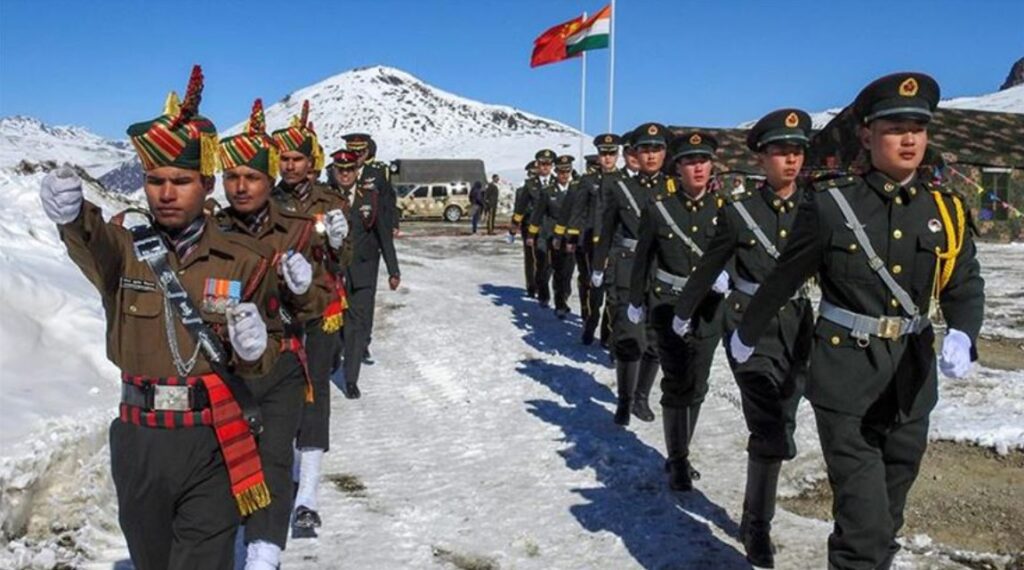
The "bullet-less" paradigm in this book details how, following these skirmishes, China adopted the tactics of avoiding direct, major firearm engagements at the border in favour of, at times, physical or non-firearm tactics like pushing, grappling or fisticuffs. The book portrays the PLA as being indoctrinated by the "hegemonic and devious" CPC, which uses deception, "5-target" tactics, and, sometimes, brute, force, without, or, with minimal, firearms, to push boundaries. It examines key, historical events and, post-1967, border, developments, including the Galwan incident, which marked a shift in how India dealt with this second Chinese, aggression (first being the one in October 1962). "5-target tactics," is PLA utilizing multi-pronged, deceptive tactics often involving, but not limited to, five key areas- camouflage, decoy deployment, misinformation, surprise, and feigned withdrawal.
Bullying by the Chinese who after 1967 became fearful of facing bullets
The "bulletless pact" between the Indian Army and the Chinese People’s Liberation Army (PLA) refers to a long-standing, 1996 bilateral agreement aimed at maintaining peace and tranquillity along the Line of Actual Control (LAC). This agreement dictates that neither side shall open fire, use hazardous chemicals, conduct blast operations, or hunt with explosives within two kilometers of the LAC. India and China signed several agreements over the decades to maintain peace along the Line of Actual Control (LAC). The primary pact specifically prohibiting the use of firearms was signed in 1996, following an initial broader peace agreement in 1993. The 1996 Agreement on Confidence-Building Measures (CBMs) signed on November 29, 1996, is the most direct pact concerning firearms. Article VI explicitly states that neither side shall open fire or conduct blast operations with guns or explosives within two kilometres of the LAC.
The 1993 Border Peace and Tranquillity Agreement signed on September 7, 1993, established that the boundary question should be resolved through peaceful means and that neither side should use or threaten to use force. The 2005 Protocol on CBMs signed on April 11, 2005, reinforced the 1996 pact, reiterating that neither side shall use or threaten to use force against the other "by any means". The 2013 Border Defence Cooperation Agreement (BDCA) signed on October 23, 2013, further emphasized the practice of "maximum self-restraint" and avoiding provocative actions if troops come face-to-face.
Indian Army adhering to the bulletless pact even after PLA brutally killed 20 Indian Army personnel
On October 20, 1975, PLA troops ambushed and killed four riflemen of the 5th Battalion of the Assam Rifles not by firing, but by brutally torturing them at Tulung La in Arunachal Pradesh. 5 Assam Rifles is renowned as the "Dalai Lama Battalion" because it escorted the 14th Dalai Lama to safety during his escape from Tibet into India in 1959.
A very basic drawback by Indian Army was adhering to an agreement of not using firearms even after PLA brutally killed the Commanding Officer of 16 Bihar Regiment and nineteen other ranks on June 15, 2020, making a mockery of the bulletless pact by using crude medieval weapons like rods with nails/bound with barbed wire. Indian Army personnel who immediately reacted, did so without firearms. Reports in 2020–2022 indicated that a large number of Chinese soldiers died during the June 15, 2020, Galwan Valley clash, often attributed to intense, hand-to-hand combat and drowning in the icy river. While China officially acknowledged four deaths, reports based on investigations suggested 38–45 Chinese soldiers died.
Bullying by the Chinese in 2020 resulted in loss of territory
Based on reports and satellite imagery analysis following the June 15, 2020, clash in the Galwan Valley, the territorial impact involved a shift in the effective Line of Actual Control (LAC) and the creation of buffer zones, resulting in India losing access to previously patrolled areas. Following the violent clash which occurred near Patrolling Point 14 (PP-14) in the Galwan Valley, Chinese troops maintained positions in the area, resulting in the creation of a "buffer zone" that prevents Indian troops from patrolling up to their traditional limit. Satellite imagery indicated that China extended its road construction and established a full-blown post near the 90-degree bend in the Galwan River, which is closer to the confluence with the Shyok River than the pre-2020 Chinese positions. The effective LAC in the Galwan Valley shifted by roughly one kilometer in China's favor. Beyond Galwan, the 2020 standoffs led to disengagement agreements that created buffer zones in other areas of Eastern Ladakh, including Gogra-Hot Springs (PP-17A) and the North Bank of Pangong Tso. These zones often involve Indian troops pulling back further than Chinese troops, blocking access to multiple traditional patrol points. While not directly in the Galwan Valley, the broader 2020 Chinese incursions blocked Indian access to5 bottlenecks in the Depsang Plains (sub-sector north), preventing patrols to areas like PP-10, 11, 12, 12A, and 13.
While India officially maintained that no "incursion" took place and no territory was lost, military analysts and observers described the loss as a change in the status quo, wherein Indian forces were restricted from patrolling areas they had previously accessed. The disengagement processes that followed—leading up to agreements in late 2024—involved both sides moving back from these "friction points," but largely kept in place the new, forward positions established by China in 2020.
China again bullied Indian Army to vacate Kailash Range
In a surprise move on August 29-30, 2020, Indian forces pre-emptively occupied the Kailash Range, attaining an advantageous position to overlook Chinese positions at Spanggur Gap and Moldo. This move was a direct response to Chinese transgressions and forced the PLA to negotiate from a weaker position. While the withdrawal from Kailash Range in February 2021 was a part of a mutual disengagement process, analysts considered giving up a valuable hard-won high-ground territory as a major strategic loss as well as giving in to Chinese bullying. Despite this 2021 disengagement, the broader border standoff continued as China persisted in consolidating, building infrastructure, and maintaining a high troop presence in the region.
In fifty-nine years since 1967, PLA has not faced bullets or bombs because the India Army has followed the no use of firearms pacts that PLA has been renewing from time to time in 15 to 20 hours long conferences. While Indian politico-military establishment has made great progress in self-reliance and mastery in use of modern weapon systems as seen in Operation Sindoor, the next time PLA indulges in any intrusion or act of war, it must be made to experience at least a small doze of modern Indian lethality.
The author, a strategic affairs analyst and former spokesperson, Defence Ministry and Indian Army, can be contacted at wordsword02@gmail.com, https://www.linkedin.com/in/anil-bhat-70b94766/ and @ColAnilBhat8252, https://www.youtube.com/channel/UCPJKaZOcAt9K8fcDkb_onng
More on the India-China border issues:
125 Border projects completed by end 2025, many of which have rattled PLA: https://www.thestrategicperspective.org/125-border-projects-completed-by-end-2025-many-of-which-have-rattled-pla/
Paramilitary forces in India are distinct from central police forces: https://www.thestrategicperspective.org/paramilitary-forces-in-india-are-distinct-from-central-police-forces/
India plays the Tibet card with telling effect: https://www.thestrategicperspective.org/india-plays-the-tibet-card-with-telling-effect/
With eye on China, India enhances strategic border infrastructure with world-class construction: https://www.thestrategicperspective.org/with-eye-on-china-india-enhances-strategic-border-infrastructure/
Chinese villages in Western Bhutan: https://www.thestrategicperspective.org/chinese-villages-in-western-bhutan/