
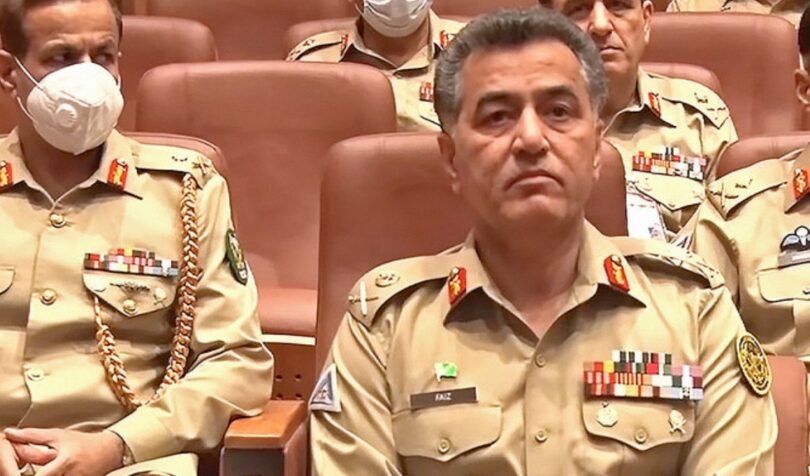

On 11 December 2025, a Pakistani military court handed a 14-year prison sentence for the former Inter-Services Intelligence (ISI) chief Lt-Gen (retd) Faiz Hameed. This has been regarded as an unprecedented punishment for a senior military intelligence officer in Pakistan’s history. The verdict, was delivered after the Field General Court Martial (FGCM), declared him guilty on series of charges. These included political interference, violation of the Official Secrets Act, misuse of authority, and causing wrongful loss to individuals.
The Charges, Trial, and Sentence
According to reports, the FGCM proceedings officially commenced in August 2024, after a complaint was launched pertaining to a private housing development scandal (the Top City case). The case was taken up by Pakistan’s Supreme Court, upon the filing of a petition by Moeez Ahmed Khan, the owner of the private housing society “Top City,” located near Islamabad.
According to the plaintiff, in 2017, Hameed while serving as a senior officer in the ISI, had raided Khan’s residence and office on false grounds, seizing valuables under the facade of a terrorism investigation.
Additionally, Khan stated that Hameed and his associates had also tried to illegally takeover the housing society and had extorted money (including 400 tolas of gold and 40 million rupees in cash) and coerced the owner to sponsor a private TV network.
Post the Supreme Court’s directive for an inquiry, the Pakistan military had reportedly carried a detailed investigation, eventually leading to Hameed’s arrest in August 2024 and subsequent court-martial.
The military stated that Hameed was tried under the Pakistan Army Act on four principal charges:
- Involvement in political activities: This is a breach of Pakistan Army regulations, which prohibits active or retired officers from partisan political involvement.
- Violating the Official Secrets Act: According to the Pakistan investigating agencies, numerous allegations have surfaced of Hameed having mishandled sensitive information which Pakistan deems as detrimental to state security and interests.
- Malfeasance in office and use of government resources: This stems from Hameed’s connection to the alleged misconduct in the Top City incident.
- Subjecting wrongful loss to individuals: The charges are tied to accusations of the misconduct and dereliction of his duty as an officer, using his influence for personal or extraneous ends.
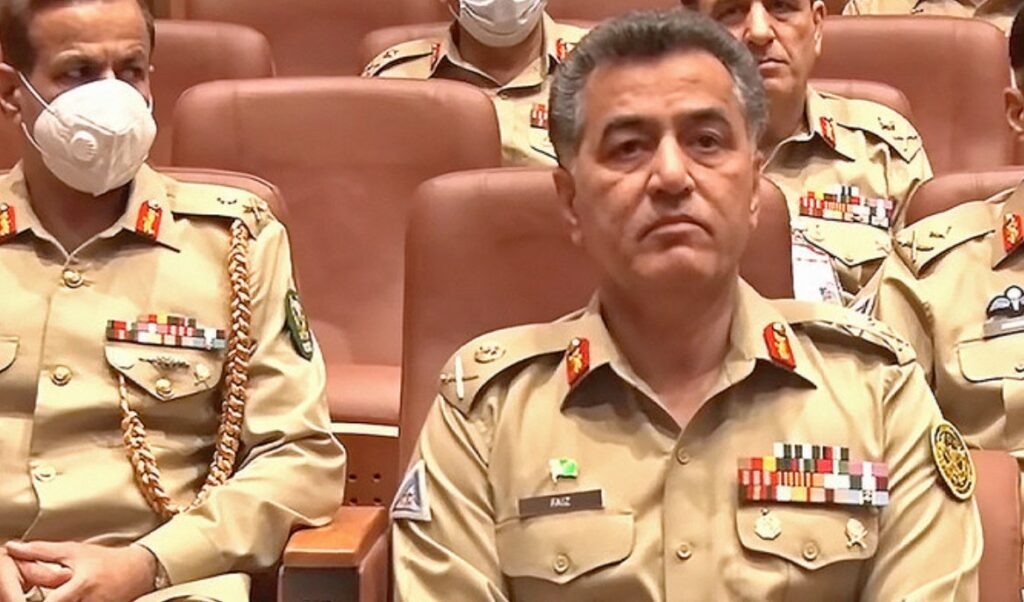
According to the Inter-Services Public Relations (ISPR) statements, the proceedings “complied with all legal provisions” and Hameed was afforded the “rights of a defence team of his choice.”
The conviction and 14-year sentence were enforced on 11 December 2025, and Hameed has the right to appeal within 40 days to a military appellate forum.
Furthermore, the ISPR has stated that Hameed’s “involvement in fomenting vested political agitation and instability in cohorts with political elements … is separately being dealt with,” insinuating that many angles of his case may yet continue to unfold even after the recent verdict.
While keeping the allegiances and alliances in the political ecosystem of Pakistan political figures like the Pakistan Peoples Party (PPP) Chairman Bilawal Bhutto-Zardari and former Defence Minister Khawaja Asif, welcomed the verdict.
In order to comprehend the influence Faiz Hameed executed in the political landscape of Pakistan, it is imperative to mention his background and his ascension to being a prominent Pakistan’s spy master. His name has become synchronous with behind-the-scenes power, political engineering, and Pakistan’s strategic dealings with Afghanistan’s Taliban.
Faiz Hameed hails from Chakwal, a district in Pakistan’s Punjab province.
Like many army aspirants, he attended military preparatory institutions before joining the Pakistan Military Academy (PMA) in Kakul. He was commissioned into the Baloch Regiment. The regiment is considered as one of the Pakistan army’s oldest regiments and is also known for posting officers into key staff and intelligence positions.
In his early postings, Hameed served in command and staff roles typical for officers his cadre. He is known to have had several company commander postings, staff appointments in brigade and division headquarters, and gigs in field intelligence coordination in conflict-affected regions.
He is known to have had his own personal networks to build his influence.
By 2000s and early 2010s, Hameed increasingly was deployed into intelligence assignments. It is a known fact that ISI usually recruits field officers with strong political instincts, and with Hameed tailor made for the role, fit the the profile designed by ISI.
He held several sensitive postings, eventually rising to the powerful Director (Internal Security) and later Director General (Counterintelligence) — known internally as “DG-C” one of the most critical positions inside the ISI.
The DG-C division monitors internal threats, oversees vetting of officers, conducts political surveillance, and maintains channels with civilian power centres.
Given the powers at his disposal, it cannot be ruled out that Hameed may have misused his authority and utilized the resources to his benefit. As DG-C, Hameed would have had intel into political party structures, media actors, militant networks and the internal dynamics of Pakistan’s senior bureaucracy.
During his tenure, political observers first associated his name with political engineering in Pakistan.
In June 2019, Faiz Hameed was appointed as the Director General of the ISI.
His role gave him the power for liaising directly with the prime minister and the COAS. He also had access to coordinate with foreign intelligence agencies, managing counterterrorism, counterintelligence, and political intelligence, influencing security policy and overseeing covert operations.
Additionally, he also participated in informal political discussions, which could point to the allegations presented against him.
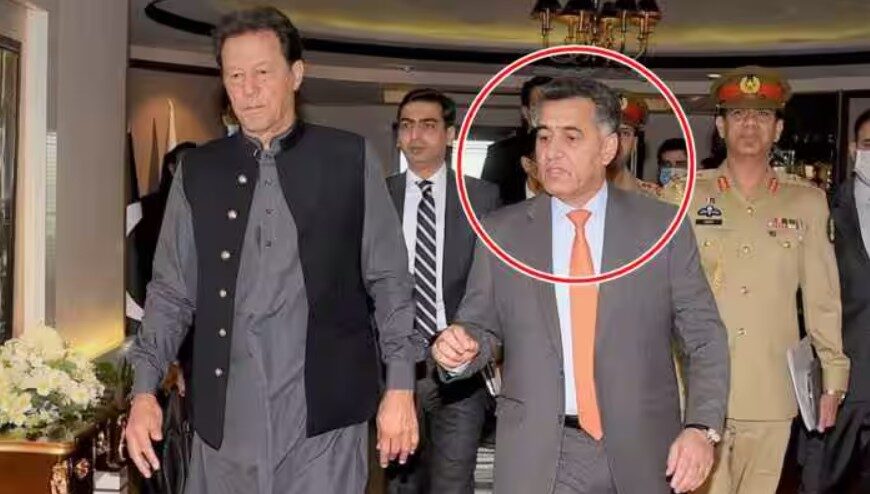
It is important to also point his close proximity to then-Prime Minister Imran Khan, who currently remains imprisoned at the Adiala jail in Rawalpindi.
Another notable turning point for Hameed arrived after the Taliban takeover in Kabul. With Hameed scurrying off to Kabul to intervene and settle a dispute amongst the leaders of the newly established Taliban/Haqqani government made him a prominent international figure to observe. At the time, it was inferred that Pakistan in its attempt to secure a strategic depth in Afghanistan had managed to make an important dent in influencing the new Afghan leadership. However, these efforts can be seen crumbling with Taliban cutting strings from Islamabad while trying to be acknowledged as a legitimate government. The persistent border clashes between the two nations and the blame games over the orchestrated conflicts within their own independent states has also factored the mistrust between the current administrations.
At the time of Hameed’s tenure, the supporters of the Pakistan government at the time viewed the spy master as a stabilizing force. However, it was also ascertained that the ISI chief had already initiated the politicization of Pakistani intelligence.
By 2020–21, opposition parties routinely named him as a central figure in political negotiations, reshuffling of key bureaucratic posts, influencing cases against political figures and guiding the “hybrid system” where civilian and military leadership were closely aligned.
The question whether he acted independently, on institutional directives, or within a political-military consensus remains contested but however the perception remains somewhat true due the history of Pakistan’s political landscape.
This perception was reinforced, when a controversy erupted in 2021 over the appointment of the new ISI chief. It was reported that the former Prime Minister Imran Khan had resisted replacing Hameed and this raised several eyebrows from the opposition. This clearly marked Hameed as a key player for Khan’s party.
Reports suggested he had built his own network of loyalists in the intelligence and administrative services.
After being removed from the ISI, Hameed served briefly as Corps Commander Peshawar and later Bahawalpur — postings seen as sideways moves. By 2022–23, as new military leadership consolidated power, Hameed’s influence rapidly declined.
In August 2024, he was arrested in connection with the Top City housing scandal, alleged political interference, misuse of ISI authority and breaches of national security protocols.
His 2025 conviction and 14-year sentence marked the first time a former ISI chief faced such a public downfall.
More on Pakistan related topics:
Pakistan’s Forged Alliance with ISIS-K: https://www.thestrategicperspective.org/pakistans-forged-alliance-with-isis-k/
Pakistan and Egypt Strengthen Defence Cooperation as Pakistan Army Chief Asim Munir Visits Cairo: https://www.thestrategicperspective.org/pakistan-and-egypt-strengthen-defence-cooperation-as-pakistan-army-chief-asim-munir-visits-cairo/
Pakistan’s Power Struggle: Old Patterns, New Players: https://www.thestrategicperspective.org/pakistans-power-struggle-old-patterns-new-players/
India’s Strategic Engagement with the Taliban: Realignment and Implications for Pakistan: https://www.thestrategicperspective.org/indias-strategic-engagement-with-the-taliban-realignment-and-implications-for-pakistan/
Unknown Bulgarian Airline Appointed 7 flights per week to Pakistan: https://www.thestrategicperspective.org/unknown-bulgarian-airline-appointed-7-flights-per-week-to-pakistan/
Between Partnership and Antagonism: Pakistan–Taliban Relations since 2021: https://www.thestrategicperspective.org/between-partnership-and-antagonism-pakistan-taliban-relations-since-2021/
Policy Analysis: Pakistan–Taliban Relations and the October 2025 Ceasefire — Strategic Fracture or Diplomatic Reset? https://www.thestrategicperspective.org/policy-analysis-pakistan-taliban-relations-and-the-october-2025-ceasefire-strategic-failure-or-diplomatic-reset/