

On 23 February 2026 the Government of India officially introduced PRAHAAR, the country’s first unified national counter-terrorism policy and strategy. The new doctrine was released as an eight‑page strategic document by the Ministry of Home Affairs.
This indicates a paradigm shift from fragmented operational responses to a structured, proactive, intelligence‑led framework for tackling terrorism in all its forms.
India has consistently faced diverse and evolving terror threats such as cross‑border terrorism, proxy militant violence, domestic radicalisation, insurgent networks, technologically enabled threats, such as drone attacks, cyber‑attacks, as well as dark‑web / cryptocurrency based financing. As a result, India in its aim for preparedness developed PRAHAAR to bring coherence to counter‑terrorism efforts that were previously guided by a mix of legislation, agency practices, and ad‑hoc responses. It provides, for the first time, a publicly articulated national doctrine that aligns policy, intelligence, law enforcement, legal safeguards, and international cooperation into a single framework.
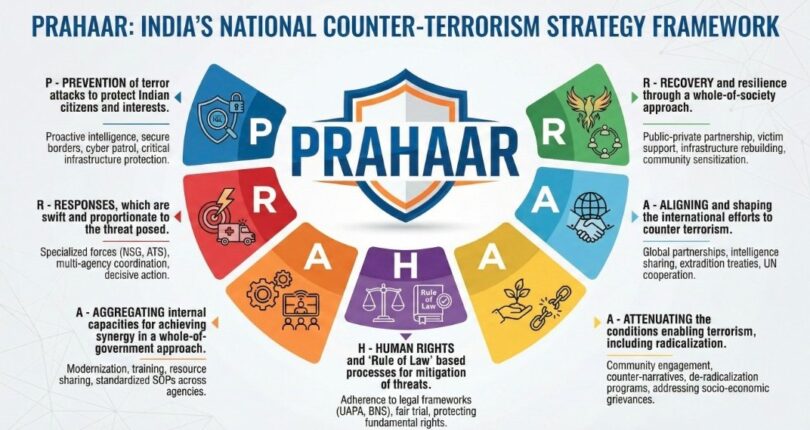
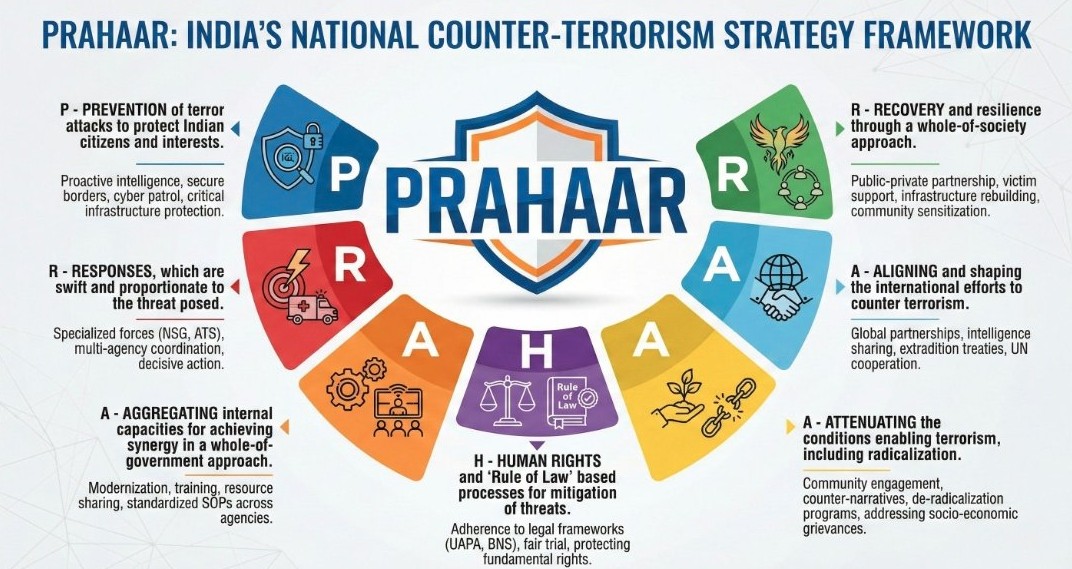
The name PRAHAAR is itself an acronym representing the seven core pillars of the doctrine:
P – Prevention of terror attacks
R – Response that is swift and proportionate
A – Aggregating internal capacities across government
H – Human Rights and the Rule of Law
A – Attenuating conditions enabling terrorism and radicalisation
A – Aligning and shaping international efforts
R – Recovery and resilience through society‑wide engagement
This structure not only organises India’s counter-terror efforts conceptually but also serves as a strategic compass for implementation.
Key Elements of the Policy
Intelligence‑Led Prevention
PRAHAAR prioritises proactive identification and disruption of threats before they materialise. It emphasises real‑time intelligence sharing across central and state agencies, led by mechanisms such as the Multi Agency Centre (MAC) and the Joint Task Force on Intelligence (JTFI) under the Intelligence Bureau.
Swift and Proportionate Response
The doctrine provides guidelines for timely, calibrated responses to terror incidents, enabling security forces to act quickly while adhering to legal and human rights standards.
Aggregation of Capacities
India’s counter‑terror infrastructure consists of multiple specialised entities including the National Investigation Agency (NIA), Central Armed Police Forces (CAPFs), and state police units and PRAHAAR seeks to synchronise their capabilities to overcome jurisdictional gaps.
Rule of Law and Human Rights
The policy emphasizes that all counter‑terror actions must respect human rights and legal norms, ensuring due process and judicial safeguards throughout investigation and prosecution.
Attenuating Radicalisation
Beyond security responses, PRAHAAR includes measures to counter radicalisation, particularly among youth, through community engagement, education, and support systems.
International Alignment
Identifying terrorism as a transnational challenge, the strategy calls for enhanced international cooperation, including intelligence exchange, mutual legal assistance, and efforts to deny safe havens and financial support to terror networks globally.
Recovery and Resilience
PRAHAAR focuses on a whole‑of‑society approach to recovery after terror incidents, involving civil administration, NGOs, and community leaders to foster stability and rebuild confidence.
Official Statements and Reactions
The MHA described PRAHAAR as a milestone in India’s counter-terror evolution, presenting for the first time a documented national strategy to unify prevention, response, legal processes, international outreach, and resilience. It signals a shift from reactive responses to predictive, coordinated action.
Additionally, while India already has substantive counter‑terror laws such as the Unlawful Activities (Prevention) Act (UAPA) and established agencies like the NIA and NSG, PRAHAAR’s significance lies in formalising and integrating these elements into one coherent policy rather than creating new powers.
India has finally put its counter-terror doctrine in writing. PRAHAAR is not a slogan. It’s the country saying, in black and white: zero tolerance, prevention-first, and a response posture that is swift and proportionate. This matters because terrorism is not an “incident”… pic.twitter.com/YH0AeH7x6w
— Mahesh Jethmalani (@JethmalaniM) February 24, 2026
Significance of the Policy
PRAHAAR marks a strategic reset in how India approaches terrorism by:
- Bridging gaps between intelligence, law enforcement, and prosecution
- Addressing modern threat vectors like cyber‑terrorism, drones, and encrypted networks
- Reinforcing a zero‑tolerance approach while safeguarding constitutional rights
- Promoting cross‑border and multilateral cooperation to counter global terror networks
What is expected to follow:
- Operationalising the doctrine through standard operating procedures
- Strengthening training, technology, and analytical tools for agencies
- Enhancing community‑level prevention initiatives
- Updating legal frameworks to reflect evolving threat realities
The success of the doctrine will depend on implementation, inter-agency coordination, and sustained political commitment across federal and state governments.
Conclusion
PRAHAAR represents a watershed moment in India’s security policy as it is the country’s first articulated national counter‑terror strategy which encapsulates decades of experience into a structured, forward‑looking doctrine. By setting out clear priorities, pillars, and mechanisms, PRAHAAR aims to make India more resilient, proactive, and unified in confronting both traditional and emerging terror threats.