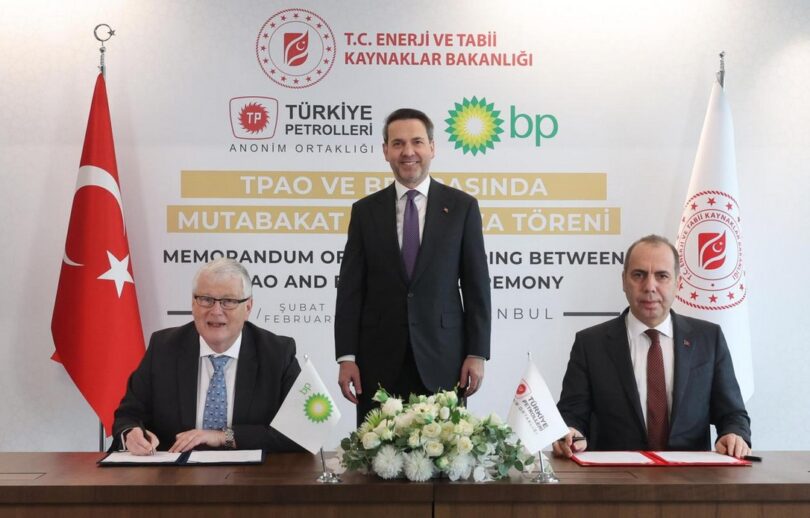

In February 2026, Turkey’s state-owned Turkish Petroleum Corporation (TPAO) and UK energy major BP signed a strategic memorandum of understanding (MoU). The agreement was signed by TPAO General Manager Cem Erdem and BP Head of Global Oil and Gas Business Development Andrew McAuslan in the presence of Turkey’s Minister of Energy and Natural Resources Alparslan Bayraktar.
Taking to X, Alparslan Bayraktar said “In Istanbul, we have signed a Memorandum of Understanding between our national oil company TPAO and BP to deepen our cooperation in the oil and natural gas sector”. The agreement established a broad framework for cooperation in oil and natural gas projects, with Iraq’s Kirkuk region as the top interest. Iraq’s energy system depends heavily on two regions, Kirkuk in north and Basra in south.
The recent agreement focuses on joint development of oil and gas fields, exploration of new potential area, boosting of oil export capacity and bolstering the natural gas transport infrastructure.
Even though, global in scope (including Libya, Kazakhstan, and Azerbaijan), Kirkuk has specifically been identified as the prime priority, signalling its strategic and economic importance.
The signing of the agreement comes soon after the Turkish Petroleum Corporation signed a memorandum with the American company Chevron on energy cooperation. In January 2026, TPAO also inked a memorandum with ExxonMobil focusing on new exploration areas in the Black Sea and Mediterranean.
Additionally, the agreement follows a day after a subsidiary of TPAO which, among several foreign companies, was awarded oil and gas exploration in Libya.
Commenting on the tender, Bayraktar said “Libya launched such an international tender for the first time in approximately 17 years. We submitted bids for two blocks, and we were awarded the license for both blocks. This time, we will be searching for natural gas and oil together with our Spanish partner, Repsol. Turkish Petroleum will have a 40% stake in these fields, both onshore and offshore. One of our partners in the offshore field is the Hungarian company MOL. We also have an important strategic cooperation with them”.
Strategic Significance of Kirkuk
Discovered in 1927, Kirkuk oil field is one of the oldest oil fields which commenced oil production in 1934.
It produces approximately 9 to13+ billion barrels of recoverable reserves according to UNESCO. It is potentially capable of 1 million barrels/day at peak.
The region includes multiple interconnected fields such as Kirkuk (Baba & Avanah domes), Bai Hassan, Jambur and Khabbaz.
The recent redevelopment efforts led by companies like BP aim to unlock up to 20 billion barrels of oil equivalent across the wider area.
Even though Kirkuk lies central to the plans, it also faces persistent challenges due to the aging reservoirs and infrastructure, depreciation in oil quality due to overproduction (as reported by Iraqwho.com), ongoing conflict between Baghdad and the Kurdistan Regional Government and importantly the heavy export dependence on the northern pipeline to Ceyhan, Turkey.
It is essential to mention the redevelopment program was originally led by BP under a 2025 agreement with Iraq. The agreement at the time targeted core fields like Baba, Avanah, Bai Hassan, Jambur, and Khabbaz. Under this agreement, the oil production increases toward 450,000 barrels per day (bpd) in the medium term.
The recent TPAO–BP partnership adds a new geopolitical and operational layer to this redevelopment effort.
Turkey’s Expanding Energy Strategy
The deal reflects a major external expansion by Turkey into upstream energy assets abroad. TPAO is looking to increase the output to 500,000 bpd by 2028, with longer-term goals of 1 million bpd. Their recent partnerships include agreements with ExxonMobil and Chevron for a more coordinated international push.
This may be interpreted as Turkey’s intention to leverage its placement between East and West to increase its influence in regional energy corridors.
The Kirkuk-focused move places Turkey directly into a disputed federal Kurdish zone which is regarded as one of Iraq’s most hydrocarbon sensitive regions.
The joint collaboration of BP and TPAO as a partner will ensure a shared financial and operational responsibility, enhancement of regional political alignment and formulation of a stronger execution capabilities in a complex operating environment.
Gas Utilization and Iraq’s Energy Independence
The central pillar of the cooperation is monetizing associated gas, much of which is currently flared.
The cooperation is aimed at capturing and processing gas produced alongside oil. It is also looking to reduce environmentally harmful flaring.
All these objectives fit well with Iraq’s strategic interests for reducing or limiting dependency on Iranian gas imports and its interest at improving energy security and self-sufficiency.
Reportedly, Iraq continues to provide approximately 40% of its electricity through the import of gas and electricity. If the venture is successful, controlling associated gases and using them to produce electricity or feed for petrochemical industries can aid Baghdad to adopt a more independent energy policy.
Additionally, it is estimated that the lifting cost of many of these barrels will be at or close to Iraq’s average of $2-4 per barrel (pb).
The TPAO–BP cooperation in Kirkuk is not just a commercial deal but also a strategic realignment of energy, politics, and regional power. By combining Turkey’s expansionist energy ambitions with BP’s technical expertise and Iraq’s resource base, the partnership has the potential to reshape both Iraq’s domestic energy landscape and the broader regional balance of power.
Impact of the TPAO–BP Kirkuk Deal on India
The cooperation between Turkish Petroleum Corporation (TPAO) and BP in Kirkuk may seem regionally focused, but it also carries strategic implications for India across energy security, geopolitics, and market dynamics.
India through Indian Oil Corporation, Bharat Petroleum, and Hindustan Petroleum imports over 85% of its crude oil, much of it from the Middle East. If Kirkuk production rises toward ~450,000 bpd, global supply improves, which can ease the upward pressure on oil prices.
Turkish and Western involvement may reduce India’s direct leverage in upstream investments and increase competition for long-term supply contracts. Indian firms, such as ONGC Videsh, have sought overseas assets to secure energy supplies. Strategic implications on India may require India to expedite its efforts in securing assets and focussing on less contested areas, such as Africa or Latin America.
Importantly, Iraq’s primary objective is to limit its dependency on Iranian gas.
India has consistently tried to balance its relations with Iran for energy and connectivity (e.g. Chabahar Port). Chabahar provides the access and connectivity, bypassing Pakistan. Losing Iran would indicate losing access to Central Asia, falling behind China in regional infrastructure and also weakening India’s westward strategy.
If Iraq reduces Iranian gas imports, then Iran’s regional energy influence weakens. Hence shifting broader Middle East energy alignments.
More on Turkey’s international influence:
Turkey’s TPAO Enters Pakistan’s Hydrocarbon Frontier: Strategic Stakes Beyond Headlines: https://www.thestrategicperspective.org/turkeys-tpao-enters-pakistans-hydrocarbon-frontier-strategic-stakes-beyond-headlines/
Turkey Explores Joining Saudi–Pakistan Defence Pact: https://www.thestrategicperspective.org/turkey-explored-joining-saudi-pakistan-defence-pact/
Somaliland Sparks Turkey–Israel Clash: https://www.thestrategicperspective.org/somaliland-sparks-turkey-israel-clash/
Turkey’s Transnational Jihad: Proxy Warfare, SADAT and Terror Financing: https://www.thestrategicperspective.org/turkeys-transnational-jihad-proxy-warfare-sadat-and-terror-financing/
Turkey Extends Syria and Iraq Military Mandate to 2028: https://www.thestrategicperspective.org/turkey-extends-syria-and-iraq-military-mandate-to-2028/