

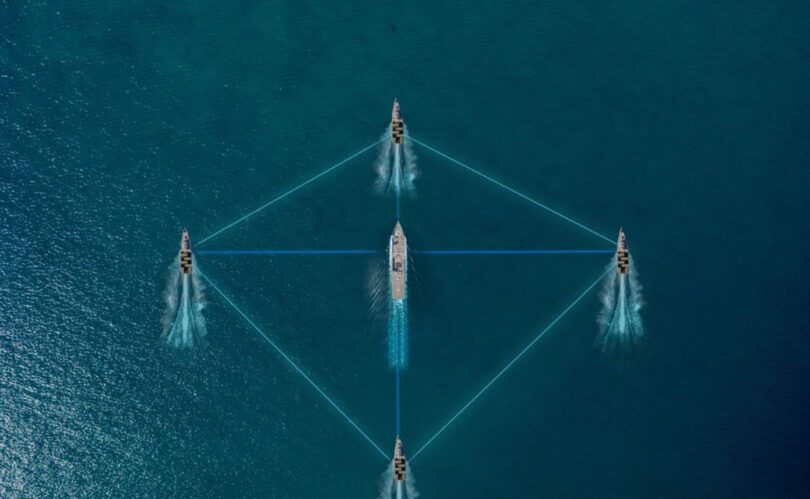

DIAMOND, a new hybrid and modular navel warfare concept has been announced by Israel Aerospace Industries (www.iai.co.il).
It is designed to augment the combat capacity of existing frigates by pairing them with remotely operated “wing ships” carrying containerized weapons, air defence systems and mission payloads.
Additionally, DIAMOND disperses offensive and defensive capabilities across a networked flotilla controlled from the mothership instead of treating a frigate as a single combat platform.
DIAMOND
It is vital to mention that DIAMOND is not a new warship class. It is a modular naval combat architecture built around a mothership frigate (main combatant) with multiple small remotely operated “wing ships”. It is containerized plug-and-play combat modules. It is armed with a shared radar, fire-control, and battle-management integration.
At the crux of the creation of DIAMOND lies a key idea, which is to enable the frigate to command weapons and sensors mounted on nearby distributed vessels as though they were physically installed on the frigate itself. This allows the navies to cover a wider combat area without having to build more large warships
According to what was reported, the Wing Ships, which are the smaller vessels operating alongside the frigate carry modular mission packages. Their purpose is to expand magazine depth, extend interceptor numbers, supply strike capability and also increase the potential of survivability through force dispersion.

Additionally, DIAMOND uses standard container-footprint combat packages that can be installed swiftly which can be swapped within hours and can also be reconfigured per mission. Another additional value comes from the fact that it can also be upgraded without redesigning or customising the ship.
This suggests a naval equivalent of “plug-and-fight” modular combat packaging.
IAI has disclosed that DIAMOND can integrate offensive and defensive systems in plug-and-play mode, including the type of payload, various mentioned Systems such as
- loitering munitions (Harop, Harpy, Mini-Harpy) meant for strike / SEAD / anti-radiation
- Cruise missiles - Blue Spear, which play a role in anti-ship / land attack
- Ballistic strike- LORA, meant for long-range precision strike
- Air defence system-BARAK MX family
- Counter - UAS
- Drone defence
- Mission packages with additional modular payloads for flexible tasking.
Final Remarks
DIAMOND is best comprehended as a combat force multiplier for existing frigates, not a replacement for major warships. If its networking, survivability, and autonomy claims hold up in real operations, it could aid navies in expanding firepower and magazine depth without waiting for expensive shipbuilding processes.
A DIAMOND-type distributed naval warfare would prove to be advantageous.
To access further, the analysis of recent US-Israel and Iran conflict has been given as an example
- Single ships are vulnerable
Recent regional naval fighting showed that even when ships have strong sensors and missiles, a single hull remains a concentrated target such as one radar mast, one combat management centre, one missile magazine, one propulsion system and one kill chain. This becomes problematic if the ship is disabled, as its combat value disappears instantly. This becomes a “platform kill problem” which could cripple its own strategic ecosystem. Thus, systems like DIAMOND break that concentration by moving weapons and some functions onto multiple remote nodes rather than keeping everything on one frigate. This would force the incoming threats toto kill multiple nodes, not just one warship.
- Magazine depth
A matter of concern in high-intensity regional conflict is missile depletion. A frigate may carry dozens of missiles, but if facing a large quantity of drones, Cruise missiles, anti-ship salvos or ballistic threats, then can be expected to burn through interceptors rapidly.
Based on what is disclosed, DIAMOND’s wing ships act like remote missile magazines carrying additional BARAK interceptors, loitering munitions, and Cruise missiles and Strike weapons. Thus, increasing the frigate’s combat persistence and capability.
Usually, a ship fires until VLS cells empty and this makes it more vulnerable. With addition of DIAMOND, the wing ships will be capable at adding more interceptors / shooters to increase battle endurance.
This gives DIAMOND a practical battlefield advantage.
- Saturation attack defence
Iranian doctrine (and many regional doctrines) focus on drone swarms, missile salvos along with mixed attack vectors and utilization of cheap attrition weapons. These prove to be a disadvantage for expensive warships. In case of such scenario, a DIAMOND-type architecture spreads defensive systems across several vessels with multiple dispersed launch nodes.
- Decoys and targeting confusion
A major naval engagement depends on locating, identifying, tracking and assigning weapons. The DIAMOND creates multiple radar / missile-bearing nodes around the mothership. This also creates confusion for the attacker, in regard to which vessel is the real command ship or which vessel contains the interceptors or strike missiles etc.
- Better offensive persistence
Based on the reports surrounding the Iran conflict scenarios, it can be inferred that most attacks often involve simultaneous strikes. In such scenarios, there are various defence requirements, which become visible, such as the probability of defending frigate not having sufficient launchers for anti-ship strikes, land attack or Counter-drone missions. In such a case DIAMOND would prove beneficial. It can divide those roles with one node carrying the interceptors, another strike missiles or loitering munitions. This would allow both offensive operations and defensive actions to remain active simultaneously.
With regards to Iran conflict, it is important to mention that Iran is known to invest heavily in Electronic warfare (EW), GPS disruption and communications interference.
Given that DIAMOND depends on network connectivity between mothership and wing ships, if the links are jammed then several challenges will have to be encountered. The probability of sensor sharing failing and the possibility of the collapse of the distributed architecture which could isolate the nodes. Additionally, Wing ships may be easier to destroy. In areas as confined as the Persian Gulf topographically, the probability of exploiting dispersion may fall short of an advantage.
DIAMOND would likely perform best in open-ocean or Eastern Mediterranean operations.
More on defence technology:
Future Submarines: https://www.thestrategicperspective.org/future-submarines/
The BrahMos Bubble: https://www.thestrategicperspective.org/the-brahmos-bubble/
Airbus Tests “Bird of Prey” Interceptor Drone: https://www.thestrategicperspective.org/airbus-tests-bird-of-prey-interceptor/
SDA Launches First Operational Satellites on SpaceX Falcon 9: https://www.thestrategicperspective.org/sda-launches-first-operational-satellites-on-spacex-falcon9/
Volkswagen in Talks to Produce Iron Dome Components at German Plant: https://www.thestrategicperspective.org/volkswagen-in-talks-to-produce-iron-dome-components-at-german-plant/
Indo-Israeli Fire Control Systems Clear Trials, Boosting India’s Armoured Capability: https://www.thestrategicperspective.org/indo-israeli-fire-control-systems-clear-trials-boosting-indias-armoured-capability/









[…] IAI DIAMOND Naval Warfare System: https://www.thestrategicperspective.org/iai-diamond-naval-warfare-system/ […]
[…] surface warships. More on related topics: IAI DIAMOND Naval Warfare System: https://www.thestrategicperspective.org/iai-diamond-naval-warfare-system/ India's Reconsideration of the K30 Biho: […]
[…] IAI DIAMOND Naval Warfare System: https://www.thestrategicperspective.org/iai-diamond-naval-warfare-system/ […]