


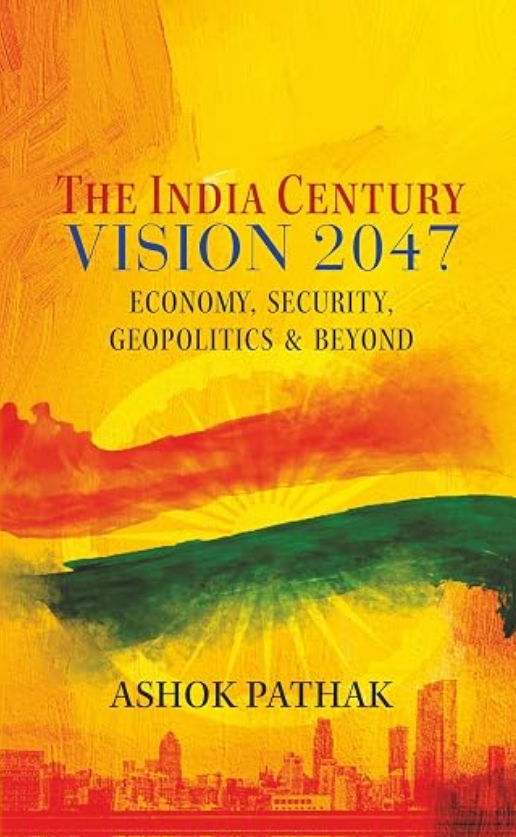
The India Century: Vision 2047
Economy, Security, Geopolitics & Beyond
Brig (Dr) Ashok Pathak (Retd)
Pentagon Press
Pages: 109 in hard cover
Price: Rs. 695/-
Reviewed by Anil Bhat
INDIA AIMING TO BE A MULTI-TRILLION ECONOMY
This book has been sponsored by Bharat Global Industries Forum (BGIF), a premier national think-and-action platform uniting India's top corporations, policymakers, and global investors to support the concept and accomplishment of Atmanirbhar Bharat (self-reliant India) and helping this nation to grow into a manufacturing hub with a $30 trillion economy. BGIF is linked to DPI@2047 for Viksit Bharat, a Strategic Roadmap to Enable Non-linear Inclusive Socio-economic Growth was launched on April 27, 2026, by NITI Aayog. Developed in partnership with the EkStep Foundation and Deloitte, it charts India’s digital transformation strategy to support a $30 trillion economy by 2047.
The central theme of the book aims at Vision 2047 going beyond headline numbers of GDP ($30 Trillion) and GDP per capita ($18000/-) to the overall well-being of ordinary citizens. NITI Ayog’s ambitions of creating an India of 2047 where the citizens are intimately connected to governance, assured best of education, health care, social services and public infrastructure are discussed against the backdrop of past inertia and baggage of organizational slack. Thus, while mentioning the national ambition of becoming global hub for manufacturing he brings out the dismal state that exists today in this sector. He describes the unsatisfactory state of private sector investment in R&D and the inefficiencies of SMEs. At the same time some early silver linings are also highlighted – like the high percentage of indigenous defense systems, India’s achievements in space, quantum computing and semi-conductors. The unique feature of author’s style is his dependence on hard data without diluting the readability for an ordinary student of the subject.
In a broader sense linking ‘Viksit Bharat 2047 Vision’ to the three major pillars- economy, national security and geopolitics makes the road to 2047 much more distinct and meaningful. Students of macro and political economy will find the chapter on economy very lucid and informative as it links the current milieu with the ancient - Kautilya’s Arthashastra; and western economic philosophy of Adam Smith. The suggested strategic model is based on the vast experience and knowledge base we have as the most ancient civilization on the planet. The book highlights the Indian philosophy of oneness of humanity and one planet for all living and nonliving in the context of international trade. Ekatmavad, or Integral Humanism, is a socio-economic and political philosophy propounded by Pandit Deendayal Upadhyaya in 1964. It presents an integrated approach to human existence, balancing individual needs with societal welfare, and serves as a guiding doctrine for the Bharatiya Janata Party (BJP) and the broader [Rashtriya Swayamsevak Sangh (RSS)]
The author has emphasized that national security should not be looked at only in terms of military strength, but holistically and that defense expenditure should be viewed as economic investment. The issues of indigenization of defense production have been very lucidly explained with the help of case study on HF 24 and LCA Tejas and the overall strength of Indian Air Force. The theme of jointness of the three services, and related concepts, practices, culture and the requirement of mind set of innovation in the armed forces has been highlighted in the book.
On geopolitics the book has exposed to the global challenges arising out of national ambitions based on power, assumed roles in global affairs and theology driven undercurrents that trigger conflicts. India’s strength, challenges, compulsions and their impact on achieving the vision 2047 have been neatly explained. The author has done well to bring out the role of soft power in achieving geopolitical goals.
Since the Bharatiya Janata Party came to power under Prime Minister Narendra Modi in 2014, India has witnessed a profound shift toward mainstreaming Hindu civilizational identity and state-backed cultural nationalism. This movement views its current trajectory as a long-overdue decolonization and public reclamation of indigenous heritage, contrasting sharply with decades of post-independence “secular” governance. This post-2014 era in India is at last emerging as a vital correction to centuries of cultural and political marginalization, during which foreign Islamic rulers and British colonial powers suppressed native Hindu identity, history, and traditions. This political shift in 2014 of democratic reassertion of India's indigenous civilizational ethos was waiting to happen.
Massive development of roads, railways, and ports; growth in manufacturing through production incentives; expansion of the tech and renewable energy sectors and strong domestic consumption of the rising middle class are indications of the strong possibility of the aims stated.
The author served in the Corps of Signals and retired in 2006 as Deputy Director General of Army Signals Intelligence. His earlier two books are India's Strategies for Information War & Cyber Deterrence (2020) and Unified Theatre Command: Breaking Free of Military Silos (2025).
Col Anil Bhat, VSM (Retd) is a strategic affairs analyst and former Defence Ministry and Indian Army spokesperson; Views presented are personal.
Other book reviews:
Commanded by Destiny – by Gen. S.M. Shrinagesh: https://www.thestrategicperspective.org/commanded-by-destiny-by-gen-shrinagesh/