



Executive Assessment
The establishment of Pixxel Federal in the United States is an important development in India’s emerging commercial space sector. Bengaluru-based space technology company Pixxel is transitioning from commercial Earth observation to becoming a supplier of advanced satellite sensing, geospatial intelligence and space-based capabilities to the US federal government, its defence and intelligence establishments.
On 29 October 2026, the company announced that the subsidiary is intended to pursue contracts across US civilian, defence and intelligence agencies. It will build upon Pixxel’s already existing engagements with NASA and the National Reconnaissance Office (NRO), while expanding its capabilities in advanced sensing, satellite systems and Earth intelligence software.
The development is viewed as strategically significant. First, it indicates the growing international competitiveness of India’s private space industry. Second, it clearly projects how commercial satellite companies are increasingly becoming part of the national security architecture of major powers.
However, it is imperative to mention that establishing a US subsidiary and securing access to government procurement opportunities does not mean that Pixxel has already been awarded a new series of American defence or intelligence contracts. Its existing NRO engagement provides an established entry point, but further operational and commercial success remains to be demonstrated.
Pixxel’s transition projects a broader transformation in the global space economy: satellite companies are no longer focusing on simply photographing the Earth but are increasingly competing on their ability to collect, interpret and deliver intelligence which can support government decision-making.
Founded in 2019 by Awais Ahmed and Kshitij Khandelwal, Pixxel has developed a commercial hyperspectral satellite constellation known as Firefly. Its business has progressively expanded into three interconnected areas:
- Space-based sensing: Developing and operating advanced Earth observation satellites.
- Geospatial intelligence: Processing satellite imagery into usable information through its Aurora platform.
- Satellite systems: Developing satellite infrastructure and mission capabilities for commercial and government customers.
The US subsidiary, Pixxel Federal, officialised the company’s effort to build a more reliable presence in the American government procurement ecosystem.
The appointment of Allyson Jenkins as its chief executive is also significant. Jenkins has served as Pixxel’s Vice President for Public Sector and has 18 years of experience in national security and geospatial intelligence, with additional nine years at the National Geospatial-Intelligence Agency (NGA) to add to her portfolio.
The subsidiary’s board also includes retired US Army Lieutenant General Ray Palumbo, former Northrop Grumman executive Patrick M. Antkowiak, and former senior intelligence executive Frank X. Avila, who has served with the CIA and NGA.
It is evident from the appointments of the individuals who are from defence, aerospace and intelligence fields that Pixxel's aspirations lie beyond the conventional commercial sales operation. Based on its efforts, it is evident that it is seeking to build an institutional access and capabilities to comprehend the desired requirements of American federal customers.

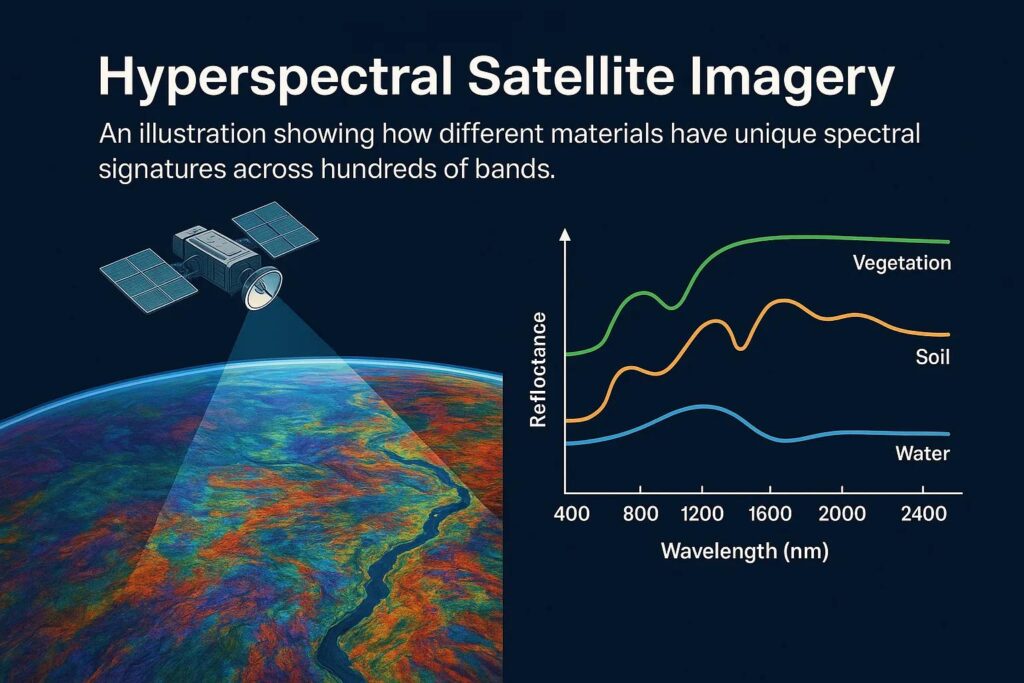
The principal technological differentiator in Pixxel’s offering is hyperspectral imaging (HIS).
Conventional optical satellites predominantly capture imagery across a limited number of broad spectral bands. Hyperspectral satellites divide reflected electromagnetic energy into numerous narrow wavelength bands, this will aid analysts to identify and distinguish the materials and surface conditions through their spectral signatures.
Pixxel’s operational Firefly constellation provides more than 135 spectral bands in the visible and near-infrared range, with approximately 5.36-metre ground sampling distance, according to NASA’s published technical specifications.
The defence implications are considerable.
Camouflage and concealment: Different materials can display different spectral characteristics despite of resembling similar in conventional imagery. Hyperspectral analysis may therefore identify disturbed terrain, artificial materials and changes associated with concealed installations.
Military infrastructure monitoring: any changes in surface composition around airfields, logistics facilities, military installations and other strategic locations may supply additional indicators for intelligence analysts.
Terrain characterisation: Spectral signatures can also distinguish soil, vegetation, exposed rock, water and other surface materials. This would help in terrain assessment and operational planning.
Critical minerals and resource intelligence: Hyperspectral imaging can be apt for identifying mineral-bearing geological formations, with implications for strategic resource mapping and supply-chain security.
Environmental and maritime monitoring: Detection of oil spills, vegetation stress, water contamination and other environmental changes can aid both civilian and military situational awareness.
Additionally, Hyperspectral imaging is not equivalent to seeing through camouflage, underground facilities or cloud cover. Its effectiveness depends on spatial resolution, atmospheric conditions, sensor calibration, spectral libraries, revisit frequency and the quality of analytical processing.
Pixxel’s present Firefly specifications are based on what remains visible and near-infrared sensing. The company’s next-generation Honeybee programme is also looking to extend capabilities into shortwave infrared (SWIR), with its first satellite expected in 2027. Synthetic aperture radar (SAR) and ultra-high-resolution optical imaging are also part of its expansion plans.
The most consequential element of Pixxel’s American expansion is its engagement with the National Reconnaissance Office.
On 4 May 2026, the NRO announced additional Strategic Commercial Enhancements (SCE) Commercial Solutions Opening awards to three companies:
- EarthDaily for electro-optical capabilities.
- ICEYE for radio-frequency sensing.
- Pixxel for hyperspectral imaging.
The programme is designed to diversify the NRO’s access to commercial remote-sensing technologies and strengthen its intelligence, surveillance and reconnaissance architecture.
Pixxel’s subsequent announcement on 5 May indicated that its contract would involve demonstrating the value of commercial hyperspectral data through its operational Firefly constellation.
This is important because it highlights Pixxel’s transition from a satellite manufacturer into the domain of evaluation and integration ecosystem of a US intelligence agency.
The NRO is responsible for developing and operating America’s reconnaissance satellite systems. Its interest in commercial sensing also indicates that government-owned satellite infrastructure alone may not be sufficient to provide the required diversity, scale and flexibility.
Commercial providers can supplement government systems with additional observations and specialised sensing capabilities.
Pixxel’s engagement with NASA
In September 2024, NASA picked Pixxel as one of eight companies under its Commercial SmallSat Data Acquisition (CSDA) programme. The original multiple-award contract carried a cumulative ceiling of $476 million across all selected providers, not an individual award of that amount to Pixxel.
NASA’s stated purpose was to obtain commercial Earth observation datasets to complement government satellite observations and support scientific research.
NASA’s vendor documentation eventually confirmed that it had acquired Pixxel datasets for scientific purposes. NASA.
NASA’s engagement is indicative of Pixxel’s entry into a formal government data-acquisition framework. Its NRO engagement surely points to a separate and more directly national-security-oriented opportunity.
The Indian Strategic Dimension
It is imperative to examine Pixxel’s American expansion in contrast to India’s own efforts to establish sovereign space-based intelligence infrastructure.
In January 2026, Pixxel-led consortium Allied Orbits formalised an agreement with IN-SPACe to develop India’s privately led national Earth observation constellation.
The consortium comprises Pixxel, Dhruva Space, PierSight and SatSure. The project envisages 12 satellites incorporating very-high-resolution optical, multispectral, hyperspectral and SAR capabilities.
In an August 2026 parliamentary response, the Department of Space confirmed an investment exceeding ₹1,200 crore, with development and operationalisation targeted for 2029. The satellites are to be manufactured domestically and launched on Indian launch vehicles, with mission control based in India.
India needs a reliable access to satellite intelligence for border surveillance, maritime domain awareness, disaster monitoring, infrastructure assessment and strategic planning. Building a privately developed national constellation can diversify the country’s space infrastructure while reducing exclusive dependence on government-owned systems.
Pixxel’s expanding international engagements could also provide commercial experience, technological exposure and financial resources that strengthen its broader capabilities.
However, keeping in mind its own strategic interests, India must exercise caution with careful management of data access, intellectual property, technology transfers and cross-border commercial arrangements. Participation in the American defence ecosystem should not compromise the integrity of India’s sovereign space programmes.
The Regulatory and Geopolitical Challenges
Establishing a US subsidiary does not automatically guarantee access to classified defence or intelligence contracts.
One of the principal challenges for Pixxel Federal will be finding its course around US national security regulations governing foreign ownership, control or influence (FOCI).
The US Defense Counterintelligence and Security Agency (DCSA) examines whether foreign interests could influence a company’s management or operations in ways that compromise classified information or affect the performance of sensitive government contracts.
Companies requiring access to classified information must satiate applicable facility-clearance requirements. Foreign ownership does not automatically disqualify a company, but relevant risks may be assessed and, where necessary, mitigated.
For an Indian-founded company operating through an American subsidiary, corporate governance, access controls, personnel arrangements, intellectual property protection and separation of sensitive information could therefore become important considerations.
Broader geopolitical dimension.
The United States has acknowledged commercial space infrastructure vital to its national security architecture. By bringing specialised sensing companies into its procurement ecosystem, Washington would be expected to diversify its technological suppliers and reduce reliance on a limited number of traditional defence contractors.
In case of India, this presents both an opportunity and a challenge.
Greater integration of Indian-origin space technology into international markets can enhance India’s standing as a credible space technology partner. However, American defence and intelligence requirements may involve restrictions on technology sharing, data handling and access to sensitive capabilities.
It would be crucial for Pixxel to balance its international commercial ambitions with India’s strategic and regulatory interests.
Pixxel’s Competitive Landscape
Pixxel’s expansion is supported by a substantial improvement in its financial position.
On 7 September 2026, the company announced a $100 million Series C funding round, co-led by Temasek and Seraphim, taking its cumulative funding to $195 million.
The investment would be a catalyst in expediting the advanced satellite sensing, software development, satellite systems and manufacturing. Its proposed expansion into SAR, SWIR and ultra-high-resolution optical imaging. This evidently projects Pixxel’s goals to build a broader Earth intelligence platform rather than remain dependent on a single imaging technology.
Pixxel operates in a market that includes established commercial satellite intelligence providers such as Planet Labs, ICEYE and BlackSky.
Its competitive edge will be determined on basis of whether its hyperspectral information can consistently provide additional intelligence value beyond the conventional optical and radar imagery.
The company’s proposed Washington-area office is therefore commercially relevant. Proximity to federal customers, defence contractors and government procurement networks can help it comprehend operational requirements and develop long-term institutional relationships.
Strategic Assessment: What Does This Mean for India?
Three developments are worth mentioning
- The internationalisation of India’s private space industry. Pixxel’s move indicates that Indian space technology companies can compete for opportunities within foreign government markets. This highlights important the evolving maturity of India’s private space ecosystem.
- The growing military relevance of commercial satellite intelligence. The NRO’s engagement with Pixxel displays how specialised commercial sensing can complement traditional reconnaissance infrastructure. Future intelligence architectures will increasingly combine electro-optical, radar, radio-frequency and hyperspectral information.
- This development shows the emergence of a new strategic technology export sector for India. India’s private space companies may become important suppliers of satellite systems, remote-sensing data and geospatial analytics to international customers.
While, international commercial success does not translate strategic autonomy, India will continue developing indigenous satellite capabilities, secure data infrastructure, independent analytical systems and domestic defence procurement pathways.
Pixxel’s participation in the American market projects India’s technological reach. It is not as a substitute for building India’s own sovereign intelligence architecture.
More on related topics:
SDA Launches First Operational Satellites on SpaceX Falcon 9: https://www.thestrategicperspective.org/sda-launches-first-operational-satellites-on-spacex-falcon9/
Mission Sudarshan Chakra vs Golden Dome, Iron Dome & Steel Dome: https://www.thestrategicperspective.org/mission-sudarshan-chakra-vs-golden-dome-iron-dome-steel-dome/
Ubiquitous Data Centres: https://www.thestrategicperspective.org/ubiquitous-data-centres/
Golden Dome, Iron Dome, Steel Dome: Comparative Report: https://www.thestrategicperspective.org/golden-dome-iron-dome-steel-dome-comparative-report/
Race for Indigenous GPS: https://www.thestrategicperspective.org/race-for-indigenous-gps/
ISRO Cacophony: https://www.thestrategicperspective.org/isro-cacaphony/
Communication Security versus Insecurity: https://www.thestrategicperspective.org/communication-security-versus-insecurity/