

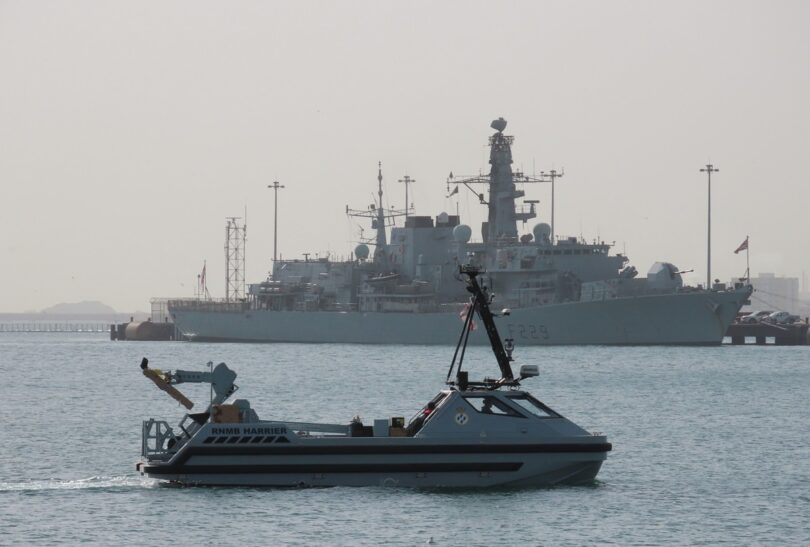

United Kingdom is reportedly prepping to exit the Gulf without a permanently deployed warship, displaying a major turning point in its maritime posture in the Middle East.
The Departure of HMS Middleton
The withdrawal centres on HMS Middleton, a 42-year-old Hunt-class minehunter and the last Royal Navy vessel stationed in Bahrain. Once it departs, England’s long time naval presence in the Gulf since the 1980’s Iran–Iraq War will come to an end.
This move comes with strategic significant consequences especially due to its timing and geopolitical development. The ship’s exit coincides with the rise in the regional tensions and the reported preparation of two US carrier strike groups for potential operations involving Iran.
Undeterred by the regional tensions, the Royal Navy sources have confirmed there are no immediate plans to replace Middleton with another warship.
None the less, officials have left the possibility of a Type 45 destroyer being deployed in the event of a major conflict, indicating a reactive rather than permanent presence.
Strategic Context: A Shrinking Fleet
The withdrawal brings up several questions pertaining to the structural challenges within the Royal Navy. Its escort fleet which consists of destroyers and frigates has reportedly fallen to historically low numbers, limiting the UK’s ability to sustain forward deployments.
Former Royal Navy commander Tom Sharpe commented saying “This problem has been decades in the making… deeply unfortunate… with the possibility of another war getting ever closer.”
According to various reports, the recent developments reinforced this trend with the mention of the decommissioning of HMS Lancaster in 2025, the Gulf’s last British frigate.
The 9th Mine Countermeasures Squadron, once central to Gulf operations, has also been reduced to a single vessel slated for withdrawal.
It is reported that Britain is directing its naval focus toward the North Atlantic and European waters, particularly in response to Russian activity.
Transition to Autonomous Mine Warfare
It is imperative to mention regardless of the traditional warships leaving, UK is not abandoning the Gulf in entirety. Instead, it is shifting toward autonomous and unmanned systems.
Middleton will be replaced not by another crewed vessel, but by a British drone minesweeper capable of detecting and identifying underwater threats.
At the centre of this transition is RNMB Harrier, an experimental Royal Navy motorboat designed for remote and autonomous mine countermeasures.
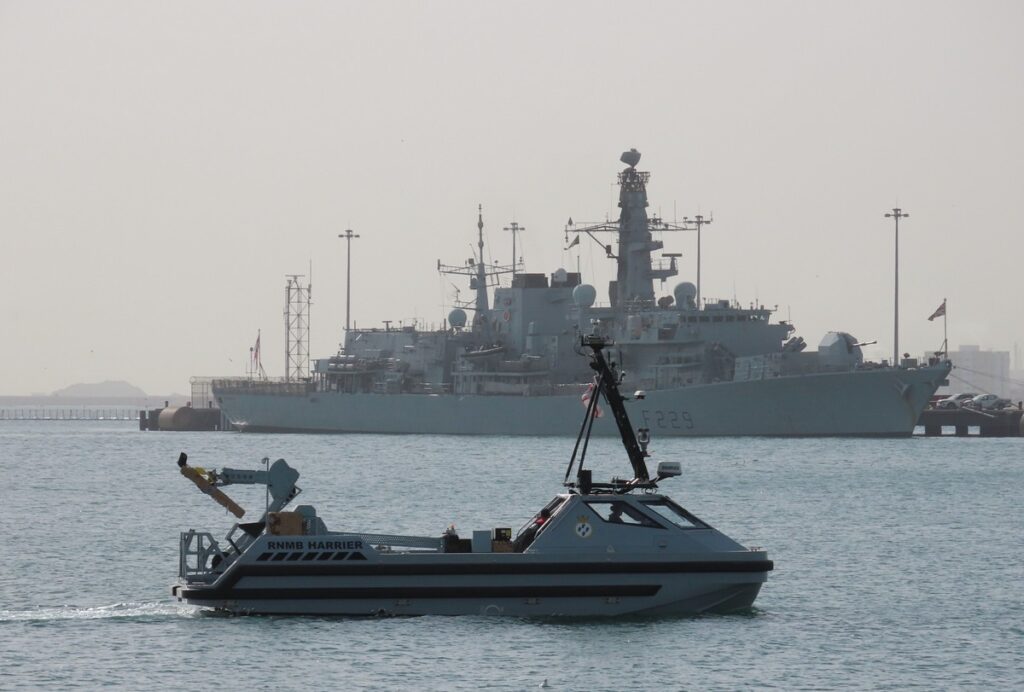
Key capabilities of RNMB Harrier:
- Towing sonar arrays to scan the seabed for mines
- Tracking and identifying underwater threats
- Relaying real-time data to ships and onshore command centres
- Operating without a full on-board crew
The Harrier has already undergone trials in Bahrain since 2023, operating in harsh Gulf conditions to validate its effectiveness.
This becomes indicative of a broader doctrinal shift which is to replace vulnerable, manpower-intensive minehunters with networked, unmanned systems.
Operational Implications
Advantages:
- Reduced personnel exposure in high-risk waters
- Lower operational costs over time
- Enhanced surveillance through persistent unmanned presence
Risks and criticisms:
- Loss of visible naval power and deterrence
- There will be a reduced flexibility in crisis response
- Greater reliance on allies for conventional naval capabilities, which Britain will be limited too.
- Already, British Royal Marines in Bahrain are majorly dependent on allied ships for exercises and potential deployments highlighting the immediate operational gap left by the withdrawal.
A New Model of Presence
The UK’s Gulf strategy is evolving from permanent hard power to a hybrid model combining:
- Command roles in multinational maritime coalitions
- Forward-based personnel in Bahrain
- Autonomous systems for mine warfare
- Surge deployments (e.g., Type 45 destroyers) during crises
This aligns with the long-term transformation of Operation Kipion, which is increasingly expected to rely on unmanned systems rather than traditional minehunter squadrons.
Conclusion
The departure of HMS Middleton signals a fundamental shift in British naval doctrine.
Faced with a shrinking fleet and evolving technological landscape, the Royal Navy is trading continuous physical presence for flexible, technology-driven operations.
More on NAVY topics:
HMS Agamemnon Completes First Submersion in Major Milestone for Royal Navy: https://www.thestrategicperspective.org/hms-agamemnon-completes-first-submersion-in-major-milestone-for-royal-navy/
Indian Navy Assumes First Ever Command of Combined Task Force (CTF) 154: https://www.thestrategicperspective.org/indian-navy-assumes-first-ever-command-of-combined-task-force-154/
Israel Moves High-Tech Defence Manufacturing to India: https://www.thestrategicperspective.org/israel-moves-high-tech-defence-manufacturing-to-india/
Spanish Submarine Isaac Peral (S-81) Embarks on First International Mission Under NATO’s Operation Sea Guardian: https://www.thestrategicperspective.org/spanish-submarine-isaac-peral-s-81-embarks-on-first-international-mission/
Defending India’s vast maritime underwater domain: https://www.thestrategicperspective.org/defending-indias-vast-maritime-underwater-domain/
Newport News Completes Initial Sea Trials of USS Massachusetts, 25th Virginia-Class Submarine: https://www.thestrategicperspective.org/newport-news-completes-initial-sea-trials-of-uss-massachusetts/
UK Carrier Strike Group strengthens partnership with India: https://www.thestrategicperspective.org/uk-carrier-strike-group-strengthens-partnership-with-india/