

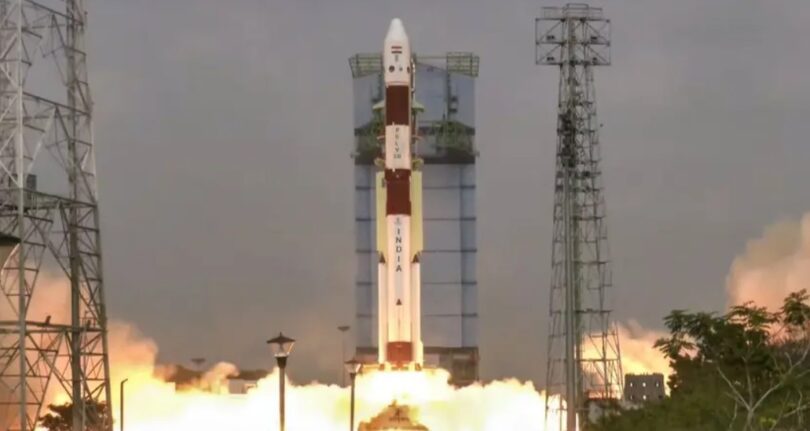
The Indian Space Research Organization (ISRO) marked its first launch of 2026 on January 12 from the first launchpad at the Sriharkota airport with its Polar Satellite Launch Vehicle – PSLV C62 mission. The rocket was to launch an advanced earth observatuon satellite EOS-N1, ‘Avnesha’ (another eye in the sky), to boost India’s surveillance powers from space. Besides the primary payload EOS-N1, PSLV was to carry a European demonstrator satellite and 15 other satellites belonging to Indian and foreign agencies (all told seven satellites from India, two from Europe, five from Brazil and one from Nepal). The secondary payloads included Europe’s Kestrel Initial Demonstraor (KID) and cubesats from Indian startups/ universities, including CV Raman University’s CGUSAT-1, Dhruva Space’s DA-1, Space kid’s India’s SR-2, Assam DON Bosco University’s Lachit-1, Akshath Airspace’s Solaris-S4 and Dayanand Sagar University DSAT-1.
EOS-N1 is a hyperspectral imaging satellite developed primarily for DRDO. It is capable of “seeing” in hundreds of wavelengths to identify materials on the ground – marking it a high priority asset for national security and surveillance; to help India secure its borders and also be used in fields like agriculture, urban mapping and environmental observation.
PSLV-C62 was meant to be a comeback flight after the setback of PSLV-C61 in May 2025, when the PSLV's third stage malfunction led to the loss of the rocket and the EOS-09 radar imaging satellite meant to enhance India's day and night, all-weather space-based surveillance. The PSLV-C61 mission was the rocket's third failure in 63 flights. As a taxpayer-funded civilian space agency founded with the ideals of serving the people of India, ISRO’s Failure Analysis Committee (FAC) reports are made public. However, the FAC report of the May 2025 PSLV-C61 failure and the FAC report pertaining to the failure of the NVS-02 strategic satellite in January 2025 were not made public?
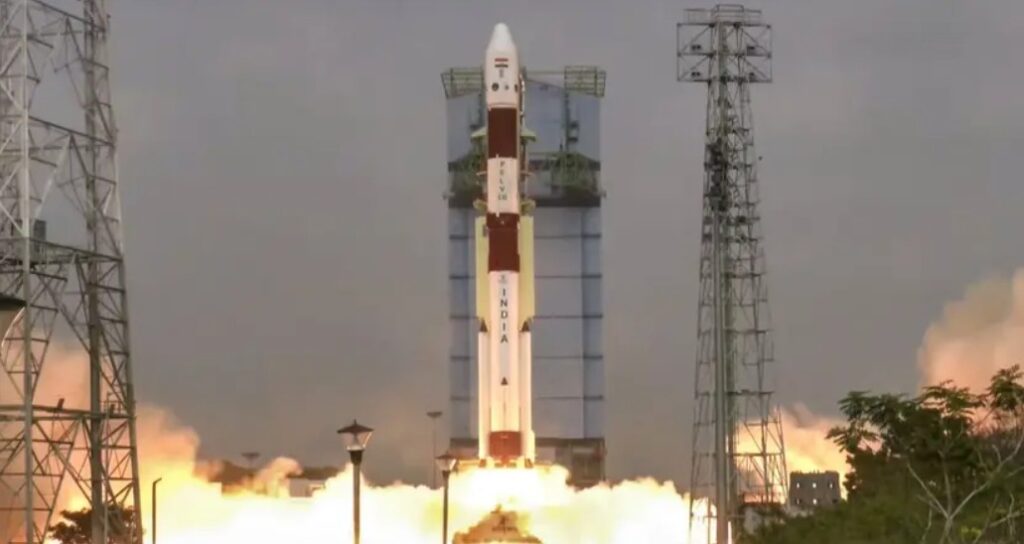
PSLV-C62 flight did mark PSLV's return to flight but ironically suffered a similar failure as the PLSV-C61; linked to third-stage malfunctions, causing the loss of key national security satellites. Cumulatively in these failures, ISRO lost million-dollar satellites meant to serve national security purposes. In a televised statement ISRO Chief V Narayanan said, "We attempted PSLV-C62 mission. PSLV is a four-stage rocket. The vehicle performance up to almost the end of the third stage was as expected. By the end of third stage, we observed a disturbance in the vehicle, and a deviation was observed in the flight path. We are analyzing the data, we will come back at the earliest."
Debuting in 1993, PSLV has evolved into ISRO's backbone with a stellar 94-95% success rate across 62 launches before May 2025, delivering over 350 satellites, including Chandrayaan-1, Mangalyaan and the record 104-satellite C37 swarm. Variants like PSLV-XL (strap-on boosters) and PSLV-DL enhance payload flexibility, making it cost-effective at 250-300 crore per launch versus pricier GSLV for heavier geostationary birds. "Unmatched reliability" has earned global contracts, from foreign satellites to rideshares, funding ISRO's heavier lifters like LVM3 while bridging to reusable technology from heat shield separation, prompted swift upgrades, yielding 58 full successes since. But the recurring failure of the PSLV-C61 and the PSLV-C62 missions is a massive setback to India and ISRO.
Given ISRO's role in launching foreign satellites belonging to governments and private firms, FAC reports being made public are crucial for maintaining transparency and re-establishing confidence. It must be emphasized that the PSLV-C61 and PSLV-C62 have failed due to a malfunction in the third-stage, raising questions about quality control and reliability. Is the government hiding something by not making public the two above mentioned FAC reports public? On the other hand, can we rule out sabotage by inimical elements (external, internal within ISRO, or both), given the current geopolitical dynamics, including America’s Donald Trump Administration doing its utmost to undermine India, and China aiming for the same while monitoring all ISRO launches? If sabotage is indeed the reason, it would affect all future launches as well.
Beyond the PSLV C62. other missions of ISRO during 2026 include the following: one, PSLV TDS; two, HLVM3 Gaganyaan-1 (G1) Uncrewed Orbital Test Flight; three, Gaganyaan TV-D2 Test Vehicle Abort Mission-2: four, GSLV IDRSS1 (CMS-04); five, HLVM3 Gaganyaan-2 (G-2) Uncrewed Orbital Test Flight-2; six, HLVM3 Gaganyaan-3 (G3) Uncrewed Orbital Test Flight. ISRO’s HLVM3 Gaganyaan-4 (H1) “Crewed Test Flight” is scheduled in 2027.
The Bhartiya Antriksh Station (BAS) is expected to be launched by 2028. ISRO has invited the indigenous industry to develop the first module. The Vikram Sarabhai Centre under the Department of Space (DOS) has issued an Expression of Interest (EoI) on January 8, 2026, seeking qualified Indian aerospace manufacturers to build two sets of the BAS-01 structure of the first module planned for India’s future space station in Low Earth Orbit (LEO). Bidders must be Indian entities with at least five years of experience in aerospace manufacturing, a minimum annual average turnover of Rs 50 crore over the last three financial years, relevant quality certifications, and no record of blacklisting.
ISRO described BAS as the next major milestone in India’s human spaceflight program, aimed at sustained human presence in space, following the Gaganyaan missions. The BAS-01 module is expected to be the first operational element of the station. BAS-1 is scheduled for deployment by 2028 and is the first step towards developing five modules by 2035 to complete the full station. Union Minister Jitendra Singh confirmed that Rs 720 crores was allotted for development of the first module, and procurement for the long lead items have begun. ISRO is targeting several advanced technologies through this mission, including autonomous rendezvous and docking, robotics, in-orbit refuelling, dedicated crew quarters, intra-vehicular activity suits and modular racks for conducting microgravity experiments.
But while we talk big about BAS, Gaganyaan and other future missions, will ISRO will be able to resolve the issue soon. But in case it cannot, we are faced with a serious problem, especially since we are two decades behind China in space and the US or its commercial space firms can never be relied upon. While all advanced countries will have their own constellations, our target of even the 52 satellites to meet our ISR requirements may be pushed back inordinately. ISRO’s failures in 2025 were two, not one; the naval communication satellite and NAVIC. In terms of PNT/GNSS, the NAVIC/GAGAN is down to four satellites (with two in end of shelf life) against minimum requirement of 12. Similarly, in terms of RS/ISR, our old satellites are insufficient for adequate revisit, adequate resolution or accuracy, as well for Intelligentisation of IMINT procedure. Moreover, compartmentalisation of efforts is not allowing edge computing - massive data harnessing.
Finally, with the Department of Space directly under the PMO and the military hierarchy in submissive mode, will the issue be examined in all its seriusness or brushed under the carpet; with main focus of the political apex on electioneering, the “no mistake” syndrome and self aggrandisement? Prudence demands we examine all options, including incorporating foreign satellites into our self-sufficiency program in order to not lose precuios time.
The author is an Indian Army Veteran. Views expressed are personal.
More on ISRO related topics:
ISRO’s invaluable contribution to Op Sindoor in its year of the 101st satellite: https://www.thestrategicperspective.org/isros-invaluable-contribution-to-op-sindoor-in-its-year-of-the-101st-satellite/
India’s Air Power Ranking Ascent: Strategic Brief 2025: https://www.thestrategicperspective.org/indias-air-power-ranking-ascent-strategic-brief-2025/
Munir’s Anti-India prattle and blame games: https://www.thestrategicperspective.org/munirs-anti-india-prattle-and-blame-games/
The Russia-India-China Troika: https://www.thestrategicperspective.org/the-russia-india-china-troika/
Aerial Surveillance: https://www.thestrategicperspective.org/aerial-surveillance/
The Spectrum Muddle: https://www.thestrategicperspective.org/the-spectrum-muddle/