
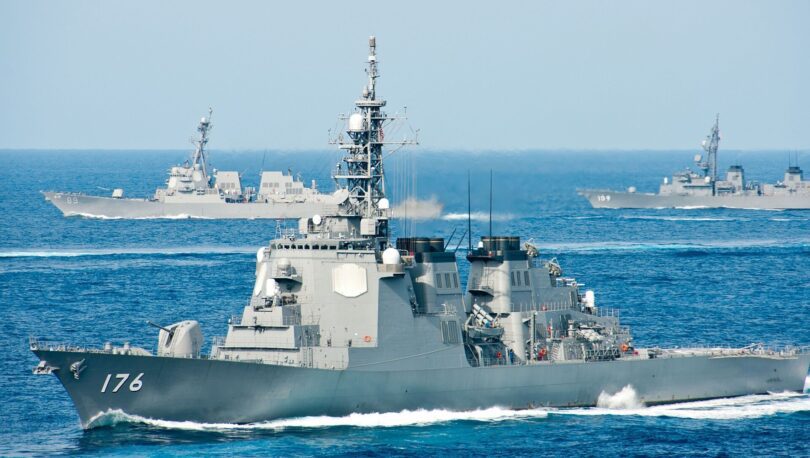

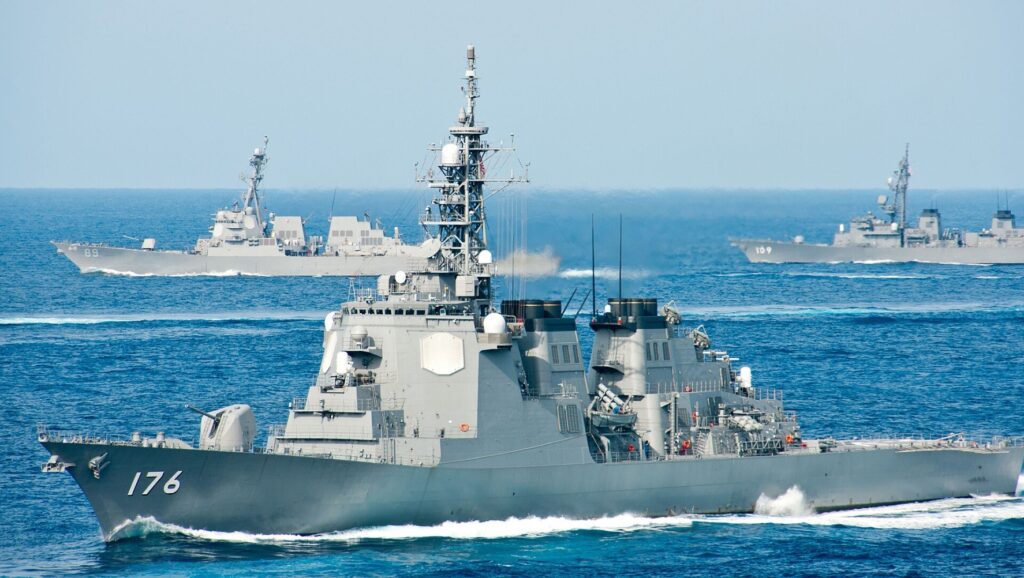
Japan’s has decided to equip its Maritime Self-Defence Force (JMSDF) destroyers with long-range strike capabilities. JS Chokai, a Kongo-class Aegis-equipped destroyer has now been customised to launch U.S.-made Tomahawk cruise missile systems. This marks a turning point in Japanese post war policy. It is the first for Japan, as the Japanese warship possesses the operational ability to strike targets at distances exceeding 1,000 km. This shift marks Japan’s strategic posture from strictly defensive to an offensive one.
Japan’s security doctrine was formulated on basis of its pacifist constitution, focussing on Article 9, which renounces war and limits the use of force to self-defence. While Japan has maintained advanced defensive systems, including ballistic missile defence and anti-submarine warfare capabilities, it has refrained from acquiring weapons designed for long-range offensive operations. However, the dynamic changes in the regional security environment may be a consideration for the shift, especially bearing in mind North Korea’s missile tests, China’s expanding military presence, and broader geopolitical tensions in the Indo-Pacific.
The assimilation of Tomahawk missiles into Japan’s naval fleet is part of a broader defence modernization initiative. Japan has committed to purchasing approximately 400 Tomahawk missiles from the United States, which will be deployed across its fleet of eight Aegis destroyers. According to reports, the ships already possess advanced radar and missile defence systems and are subjected to being modified to accommodate the vertical launch systems required for Tomahawk deployment. The JS Chokai is the first among the ships to having completed this transition.
The Tomahawk missile is a combat-proven system capable of precision strikes against land-based targets having a range exceeding 1,000 km. This will allow Japan to assess and hold adversary assets at risk from a considerable distance, enhancing deterrence. The missile’s ability to be mobilized at low altitudes and follow complex flight paths makes it hard to be detected and intercepted. This would prove beneficial to Japan, enabling it to respond to threats such as missile launch sites or command centres before they can be launched against Japan.
This shift is a part of a comprehensive effort to enhance a layered “standoff defence” capability. Besides acquiring Tomahawks, Japan is believed to be investing heavily in other indigenous missile systems. One of the key components is the upgraded Type 12 surface-to-ship missile, which is being modified for extended range and land-attack capability. These are expected to be deployed in Japan’s south-western islands, which are strategically important due to their proximity to areas such as the East China Sea.
Additionally, Japan is boosting research and development of hypersonic weapons, including hyper-velocity gliding projectile (HVGP) systems. These weapons are designed to travel at speeds exceeding Mach 5 and manoeuvre unpredictably. The deployment of such systems will add another layer to Japan’s deterrence strategy with rapid-response strike options at time of any conflict.
This shift has sparked debate both domestically and internationally. Internally, some policymakers and citizens in Japan have expressed concerns about the implications of expanding military capabilities, fearing it could deteriorate the Japan’s pacifist stance. Others argue that this transformation is essential to the country’s national security given the growing tensions in the region. The Japanese government has clarified that these capabilities are strictly for defensive purposes in response to any or ongoing attacks.
Internationally, Japan’s shift has been closely monitored by neighbouring nations. There are speculations that enhancement of Japan’s military capabilities could contribute to an arms race dynamic, especially in East Asia.
The acquisition of Tomahawk missiles from the United States also hints to a strong security partnership between the two nations. This collaboration also includes joint training, intelligence sharing, and operational coordination.
The operational integration of long-range strike capabilities also requires significant adjustments in doctrine, training, and command structures. The JMSDF is expected to develop new strategies for targeting, mission planning, and for coordination with other branches of the Self-Defence Forces. Additionally, the utilization of such capabilities raises legal and ethical questions in context to the conditions under which counter strikes can be approved.
It is expected that the deployment of Tomahawk-equipped destroyers like the JS Chokai may make way for additional enhancements across Japan’s defence infrastructure. This includes improvements in satellite reconnaissance, cyber capabilities, and command-and-control systems, all of which are essential for effective long-range operations.
Japan’s adoption of long-range strike capabilities represents a significant evolution in its defence policy. Combined with investments in indigenous missile technology and advanced weapon systems, Japan is positioning itself into a state of readiness against the emerging security threats in the region.
More on Japanese Navy related topics:
Kawasaki Launches Sixth Taigei-Class Submarine, JS Sōgei: https://www.thestrategicperspective.org/kawasaki-launches-sixth-taigei-class-submarine-js-sogei/
Indian Navy Assumes First Ever Command of Combined Task Force (CTF) 154: https://www.thestrategicperspective.org/indian-navy-assumes-first-ever-command-of-combined-task-force-154/
Indian Coast Guard’s first pollution control vessel with maiden appointment of women officers: https://www.thestrategicperspective.org/indian-coast-guards-full-pollution-control-vessel-with-maiden-appointment-of-female-officers/
Defending India’s vast maritime underwater domain: https://www.thestrategicperspective.org/defending-indias-vast-maritime-underwater-domain/