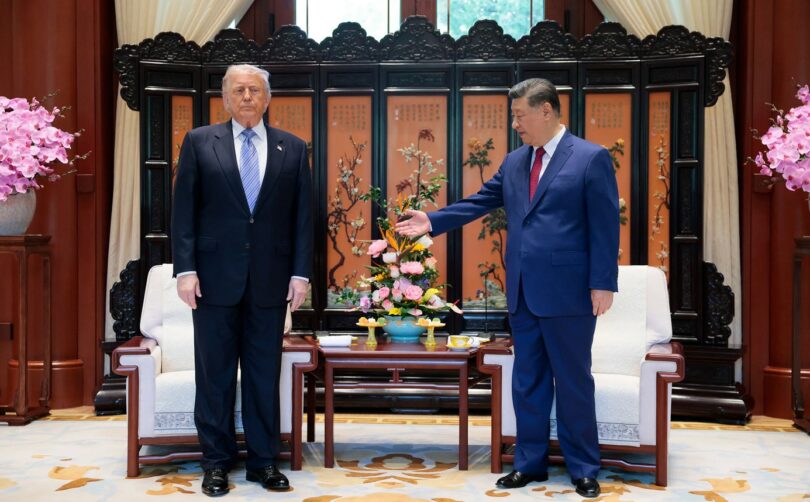
The world looked forward to the Trump-Xi meeting with great interest. Equally interesting were events in the run up to the summit, some of which were:
- Trump sanctioned Chinese companies importing oil from Iran, with Beijing signaling him to go climb a tree. Last year, China halted REE supplies to the US in response to Trump’s tariffs, forcing Trump to climb down and negotiate a truce.
- Japan fired a missile in the disputed South China Sea.
- Satellite imagery showed Philippines construction on two islands in disputed Spratlys.
- Intelligence reports trashed Trump’s victory claim over Iran.
- China approached WTO against unfair Indian practices in the solar and IT sectors; following another EVs dispute.
- Trump declared Venezuela America’s 51st state.
- America set to withdraw all charges against Gautam Adani following his USD 10 billion investment in the US – will Trump host him in the West House?
Having posed as Pope and Jesus, speculation was Trump may land in China attired as Moon, due to China’s Chang’e (嫦娥) legend. Instruction for JD Vance in case he is assassinated (https://www.rediff.com/news/commentary/2026/may/14/trump-leaves-letter-in-drawer-for-vance-in-case-he-dies/7d79d34382288504b59f05a37094db4b) made people wonder if his awkward gait in China was because of diapers? But Trump did wear his red tie reportedly gifted by Jeffrey Epstein.
There were multiple reasons why, despite Trump’s gung-ho stance, tirade of tariffs and displaying sanctions like a special kid of primary school on assuming this presidency, he was compelled to seek talks with Xi. The foremost reason is the shock he received thinking conquering Iran will be a cake walk; it proved how asymmetric tools can blunt a superior military, plus the leverage from controlling chokepoints. The massive damage to US bases in the region, and to American naval-air assets by Iran was hardly visualized. Over 30,000 vessels (80-130+ daily) enjoyed free passage through the Strait of Hormuz annually, carrying over 20% of global oil and LNG exports, before the war. Trump’s inadvertent gift to Iran is charging USD 2 million per vessel for safe passage through the Straits.
The second reason is enormous disruptions caused to global economies and supply chains, which hasn’t left American consumers untouched, with prices shooting up. The energy shock is feeding inflation, eroding political capital and gasoline prices can hardly be ignored. With Trump cutting Medicaid and SNAP last year, 10.9 million Americans were projected to lose health cover in 10 years and 2.4 million food assistance by 2034. Now Trump has slashed WIC fruit and vegetable benefit for breastfeeding mothers from USD 54 to USD 13. Disabled Americans will have to re-prove they need healthcare every six months and rural hospitals will shut their doors. This, while Trump gold-plated his toilet, plans adding a ballroom to White House, and the oil and weapon mafias are making billions. Now Trump’s ratings are crashing down with Democrats accusing him of stock-market manipulation.
Robert Kagan, US foreign policy analyst and senior fellow at the Brookings Institution has already penned how and why Trump has lost the war ion Iran, succinctly explained by Dean Blundell (https://deanblundell.substack.com/p/trump-has-officially-lost-the-war?utm_campaign=post&utm_medium=web&triedRedirect=true).
The third major reason is Trump’s realization that with his penchant for war-mongering and the expanding war in the Gulf region, responding to China’s invasion of Taiwan (amounting to a two-Theatre war) will be difficult to handle with America’s depleted munitions, US mainland will unlikely remain untouched and American casualties could be huge notwithstanding Trump’s plan to use Japan or the Philippines as proxy.
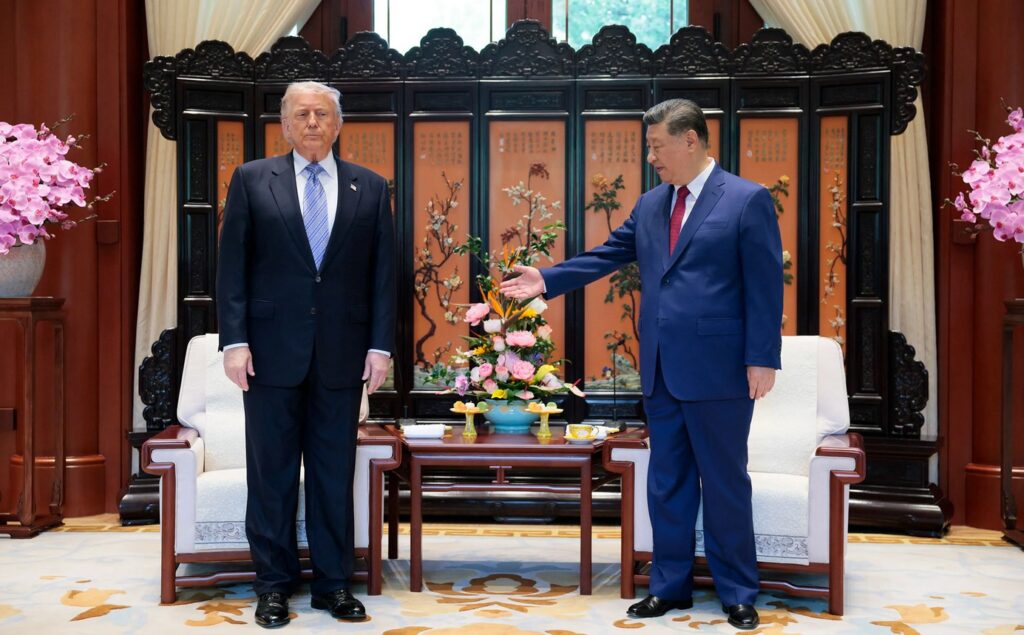
The fourth reason is that Trump want to save face – honourable exit from the war, although the reins controlling Trump and the war on Iran are held by Israeli Prime Minister Benjamin Netanyahu. Netanyahu’s Greater Israel plan is not very comfortable either. IDF Chief of Staff Lt. Gen. Eyal Zamir has warned the Israeli Security Cabinet that the military urgently needs 12,000-15,000 additional soldiers, including about 7,000-8,000 combat troops. Israel is, therefore, recruiting 18-years old (https://www.facebook.com/reel/4302153230002658). Trump is aware that Xi is in a unique position to help ease the situation, be it China’s leverage over Iran as its main oil customer or Beijing’s central role in global supply chains.
Finally, Trump seeks relief from China as a major financier of US government spending. With the US external debt reaching a record high of about $29.4 trillion representing the total public and private debt owed, while borrowings of the US treasury continue to rise. Hence the US needs stable supply chains, not China weaponizing supply chains that Beijing can but the US can ill afford. That’s why Trump welcomed Chinese students in the US while trashing those from other nationalities. Incidentally, India’s Strategic Petroleum Reserves (SPRs) capacity stands at 5.33 million MT or about 39-40 million barrels of crude oil, whereas China’s SPR capacity amounts to 1.4 billion MT or 191.8 million MT of crude oil. Beijing has substantial energy resilience having built stockpiles and overland pipelines from Russia and Central Asia.
Little wonder then why Trump flew to Beijing with a plane load of billionaires (collectively USD 1 Trillion+); Elon Musk (Tesla and SpaceX), Jensen Huang (Nvidia), Tim Cook (Apple), Larry Fink (BlackRock), Stephen Schwarzman (Blackstone), Kelly Ortberg (Boeing), Brian Sikes (Cargill), Jane Fraser (Citigroup), Larry Culp (GE Aerospace), David Solomon (Goldman Sachs), Sanjay Mehrotra (Micron) and Cristiano Amon (Qualcomm). But the US today is in no position to dictate terms to China – leave aside Trump’s missive to China “to open up”. The immediate gain that Trump could triumph over was limited to 200 Boeing planes China wants to import. Trump wants Chinese companies to invest up to USD 1 trillion in factories and other projects across the US but this will depend on what Xi wants.
If Trump thought he could get some sort of Chinese guarantee over Taiwan, it was most foolhardy. Nixon and Kissinger failed to extract one from Mao Zedong in February 1972 when China was nowhere close to the US economically and militarily.
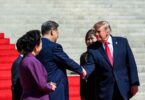
Xi warned Trump of “clashes and even conflict” over Taiwan on the very first day of the summit, with China’s foreign ministry flagging Taiwan “the most important issue in the China-US relations. He invoked the ‘Thucydides trap’, highlighting the risk of war between a rising and established superpower. Xi called Trump’s visit to China “historic”, saying that the US and China should be partners, not rivals.”
Xi mentioned in-depth exchanges with Trump on China-US relations and the international and regional dynamics, saying both believe the bilateral relationship is the most important the world, and adding, “We must make it work and never mess it up.” Trump hailed the US-China relationship, saying that the citizens “have a deep sense of mutual respect.” He thanked China for the magnificent welcome on his historic visit. Talking about his exchange with Xi, he said, “We had an extremely positive and constructive discussion.” Without mentioning Taiwan, the White House statement said, “President Trump had a good meeting with President Xi of China. The two sides discussed ways to enhance economic cooperation.”
Trump said that China will not provide military support to Iran; notwithstanding the fact that both the US and China are known to backtrack on their promises. Trump invited Xi and wife to White House on September 24. Interestingly, Trump warned Taiwan against declaring independence, hours after his summit with Xi. Trump is also contemplating lifting his sanctions on Chinese refineries importing Iranian oil.
Could the Trump-Xi summit resolve the underlying rivalry between the two structurally different superpowers – the majority view is NO. Taiwan remains an explosive issue, technological competition is intensifying and mutual suspicion runs deep. A critic view is: Trump has literally surrendered before China; end of American supremacy; US is in dire economic state; China is supporting Iran; US dominance is challenged by China’s rise; the Middle East is realigning, global institutions are weakening, trade wars and sanctions are fragmenting the world economy, regional powers are becoming more assertive.
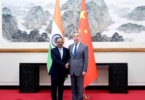
Back home, Trump is threatening Iran once again. Iran says it responded to a new US proposal aimed at ending the war as talks continue through Pakistani mediation. The developments come amid fears of renewed US-Israel strikes on Iran. Netanyahu appears keen to renew bombing Iran. Meanwhile, China’s foreign minister has hosted Iran’s foreign minister in Beijing and called for a “complete cessation of hostilities”, while also defending Iran’s right to peaceful nuclear energy and telling Chinese companies to ignore some US sanctions. Beijing is signalling that it will push for peace on its own terms, not as Trump’s junior partner.
India remains dependent on the Strait of Hormuz as most of its oil and gas passes through the vital chokepoint. The UAE has just announced storing up to 30 million barrels in India’s Petroleum Reserve after Prime Minister Narendra Modi’s recent visit to the UAE. But this has to pass through the Straits of Hormuz. There is talk of the UAE laying an oil pipeline avoiding the Straits of Hormuz; in what time frame and what about sabotage with plenty of mischief afoot? There is speculation that the sinking of the India-flagged vessel off the coast of Oman, while Trump was in China, was orchestrated by the US. Same goes for the recent strike close to a nuclear facility in the UAE, aimed at negating Saudi Arabia’s proposal for a region-wide non-aggression pact with Iran and other Middle Eastern states, akin to the 1975 Helsinki Accords.
There is no denying that the Indian economy faces a storm with oil above USD 100, INR in freefall and inflation back; as hinted by Modi. The trap India faces is not just geopolitical, with India now beginning to discover how many of its own assumptions rested on stability that no longer exists. In addition are the myriad challenges, just two examples being our plans for Mars while struggling to provide clean drinking water to many and asking Indians to conserve fuel while luxury SUVs queue outside brunch restaurants, creating the kind of cognitive dissonance economists rarely include in models. (https://bpweekly.substack.com/p/the-trap-india-faces-isnt-just-geopolitical?publication_id=4338937).
Referring to Robert Kagan’s article about America’s inability in reversing or controlling the consequences of losing its war on Iran, a veteran strategic analyst with years of experience with the United Nations, writes, “The Robert Kagan piece has not been given the attention due to it in India. We continue to back what is (in my humble view) the losing side and ignore our geography and civilizational history.” An India watcher Indo-American is more blunt in saying Trump holds Modi to ransom by announcing “he doesn’t want to spoil the political career of his dear friend Modi, whatever be the handle Trump has.
The author is an Indian Army veteran. Views expressed are personal.