
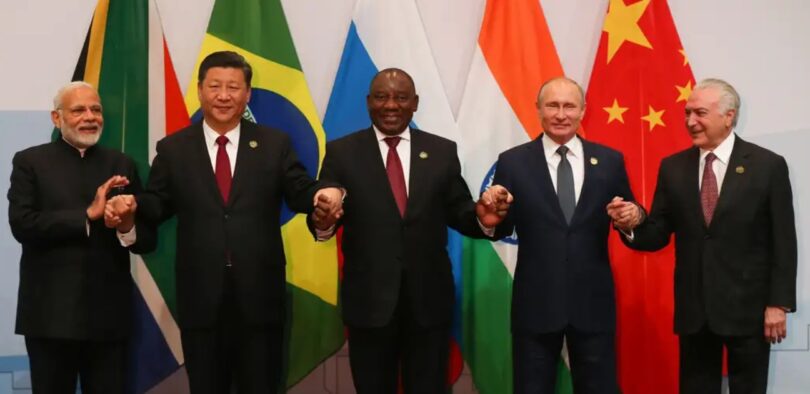
The BRICS Foreign Ministers Meet, held in New Delhi on May 14-15, 2026, themed ‘Building for Resilience, Innovation, Cooperation and Sustainability’, was chaired by External Affairs Minister S. Jaishankar. Key attendees included Russian FM Sergey Lavrov, Iranian FM Abbas Araghchi, South African FM Ronald Lamola, Brazilian FM Mauro Vieira, Indonesian FM Sugiono, plus representatives from Ethiopia and the UAE. Chinese Ambassador to India, Xu Feihong represented China at the meeting.
India had assumed chairmanship of BRICS in January 2026 and the foreign ministers’ meeting was the centrepiece of India’s BRICS presidency. The meeting, however, failed to issue a joint statement in the absence of a consensus, mainly because the UAE wanted Iran to be condemned, while Iran insisted it only targeted US bases (US-Israel having started the war). Ultimately, a ‘Chair’s Statement and Outcome Document’ was issued on May 15, 2026 (https://www.mea.gov.in/bilateral-documents.htm?dtl/41144). This could well be the format for the BRICS Leaders' Summit that New Delhi will host in September 2026, unless a semantically generic joint statement is eked out without naming those responsible for the global mess.
Without naming the ministers or country, the ‘Chair’s Statement and Outcome Document’ mentioned reservations by member/members (not necessarily the same) on the following issues:
- Differing views on the West Asia/Middle East situation, with members expressing respective national positions, plus sharing perspectives.
- Unifying the West Bank and the Gaza Strip under the Palestinian Authority; global community to support Palestinians’ aspirations for independence and statehood.
- Ensuring navigational rights and freedoms of vessels in the Red Sea and Bab Al-Mandab Strait, in accordance with international law.
What caused the Straits of Hormuz from being an open waterway for all to the current state was apparently not discussed despite the US-Israel attacks on Iran bringing the world to the current situation. Similarly, discussion on an alternate to the SWIFT system and trade in local/BRICS currency was bypassed fearing US retaliation.
Jaishankar’s opening address covered the deteriorating global scenario. Conflicts, climate events, and the Covid pandemic, he said, had been "key contributory factors" to widening vulnerabilities, and delivered a sweeping call for global reform, demanding an overhaul of the UNSC, immediate ceasefire in Gaza, and an unrelenting international stance against terrorism. He said, "What we are witnessing is not a series of isolated events, but a convergence of challenges testing the resilience of multilateral systems." He said the cumulative effect was weakening growth prospects and hitting developing countries hardest, through pressures on energy, food and fertiliser security, supply chain disruptions, inflationary trends and constraints on growth. He said, "Collective action and resolve are essential to promote stability, sustainability and prosperity. The BRICS must not only deliberate on these issues but also work towards effective and coordinated responses.”
Iranian FM Abbas Araghchi, arrived in New Delhi on May 14 for the BRICS meeting. “Minab168” painted on the fuselage of his aircraft; related to 168 schoolchildren killed in a US strike on a school in Minab on February 28. At the foreign ministers meeting, Araghchi sharply criticized the US, urging BRICS nations to unite against Western-dominated global order. He said: “This is of fundamental importance to the BRICS+ community because the battle in which Iran has stood is in defence of all members and in defence of the new world we are building. Our brave soldiers have sacrificed their lives to confront Western hegemony and the immunity that America thinks it enjoys.”
At the press conference held by the Iranian FM Abbas Araghchi, a reporter asked whether Iran is willing to allow sustained movement of Indian ships from the Persian Gulf to India? Araghchi responded by saying; “India was a customer of Iranian oil in the past. It was stopped by India because of US sanctions. We are ready to sell our oil to India. We have no problem. It is up to the Indian government to decide. Before sanctions, Iran and India had more than USD 20 billion in trade.
Among the questions raised during the MEA briefing on May 15, 2026 (https://www.mea.gov.in/media-briefings.htm?dtl/41151/Special+Briefing+by+MEA+on+BRICS+Foreign+Ministers+Meeting+May+15+2026), the following two were noteworthy:
- Manish, India Writes Network – Foreign Ministers of Iran and UAE exchanged strong words but what was the position of other BRICS members like Egypt and Ethiopia? Was only UAE holding up consensus or were there other dissenting views, and what is India's strategy to navigate these differences going forward?
- Ayushi Agrawal, ANI – What is India's response to expectations from Iran that New Delhi take a more proactive diplomatic role in these de-escalation efforts?
The MEA response to the first question (as above) was: “There were differing views …. as regard the situation in West Asia… since you asked me the perspective of other members … there was a good discussion…on consequences of the situation on global economy… our responsibility is to facilitate dialogue and discussion….that is why we have an outcome document….we will continue to engage…with other countries and find common grounds”. The MEA official parried response to the second question by saying: “the question is not BRICS related … I'll defer that question for the time being”.
The dissonance in BRICS is set to increase because of multiple reasons, such as: US President Donald Trump’s open threats (sanctions included) against BRICS and BRICS members; the Rogue-Based World Order established by Trump; meaningless ceasefire declarations as seen in Ukraine, Gaza and Lebanon – same will happen in West Asia; speculation is that the strike on Cyprus and close to a nuclear facility in the UAE was by the US to deter Gulf unity; Israel’s continuing genocide in Gaza; US and Israel’s contempt for international law; the UN is reduced to level of the defunct League of Nations.
The UAE and Iran have been blamed for no consensus in the meeting. At the same time, India can hardly absolve itself of blame for the dissonance. India abandoned its traditional position of opposing attacks on another country without UN approval, as well as unilateral sanctions not backed by the UN. Instead, India complied with American sanctions against Iran, Venezuela and Russia. India did not condemn US-Israel attacks on Iran, killing of Ayatollah Khomeini, US bombing of girls’ primary school in Mirab, sinking of IRS Dena by a US submarine, and Israeli genocide in Gaza. India went out of its way targeting Iran-flagged vessels under US sanction in Arabian Sea to appease Washington. India is supplying arms and explosives to Israel amid continues attacks in Gaza, including UN shelters.
India’s apprehensions over the yet to be signed Indo-US trade deal, which Commerce and Industry Minister said would be signed latest by November 2025, is cowing down India. In addition, Trump has announced he doesn’t want to destroy the political career of dear friend Modi (Indian Prime Minister). According to Goyal, a US trade team is coming next week to discuss the issue further. The hubris in Indian media says India can buy Russian oil whenever it can, is a farce. With the US sanction expiring on May 16, 2026, India requested another extension against the background of India’s supply disruptions including its LPG crisis, as reported by Bloomberg. Washington since has given a 30-day extension.
Brahma Chellaney notes: “In global realpolitik, defiant nations command respect while compliant nations must plead for permission. China ignores US sanctions on Iranian and Russian oil because it treats economic friction as an acceptable cost of challenging the Western-led order. India, by contrast, abandoned Iranian oil imports under American pressure in 2019 and now finds itself seeking rolling US waivers each month so its refiners can legally keep buying Russian crude - an arrangement that leaves India periodically waiting on American indulgence to secure its energy needs”.
Ironically, India is continuing to demonstrate that it does not recognise its own strengths. Hence, India will continue to pay price for not standing up and looking the bully in the eye. We are not even taking resolute measures to take our immediate neighbours on board, especially Nepal and Bangladesh. The US-engineered Gen Z coups in Bangladesh and Nepal. With US Vice President JD Vance in India, the Pahalgam massacre happened. Concurrent to Trump’s visit to China, an India-flagged vessel was targeted and sunk off the coast of Oman – need evidence it was ordered by the US? The Modi-Melony-Melody distraction notwithstanding, a criminal complaint is filed against NSA Ajit Doval in Italy; is the US-based CIA-pet Gurpatwant Singh Pannun, Sikhs for Justice (SFJ) legal counsel and primary spokesman, behind this move?
BREAKING 🇮🇳🇮🇹 🚨Criminal Complaint Filed Against India's NSA Chief Ajit Doval in Italy! pic.twitter.com/LGIPU3AiPL
— Shruti Dhore (@ShrutiDhore) May 21, 2026
US-Based Seema Sirohi wrote in her article ‘Yeh Dosti, a Bit Too Asymmetric?’ Sometimes it feels that Sergie Goris running the relationship at both sides (US and India). He is hobnobbing with India’s most powerful. A former US diplomat who served in Delhi feels the Government of India panders to him and treats him as mini-Trump.
This is more than evident with Jaishankar frequenting visits to Gor’s office as well as his residence, is oblivious of the fact that Trump has India in his crosshairs and Sergie Gor is his specially chosen envoy for executing that agenda.
The author is an Indian army veteran. Views expressed are personal.