

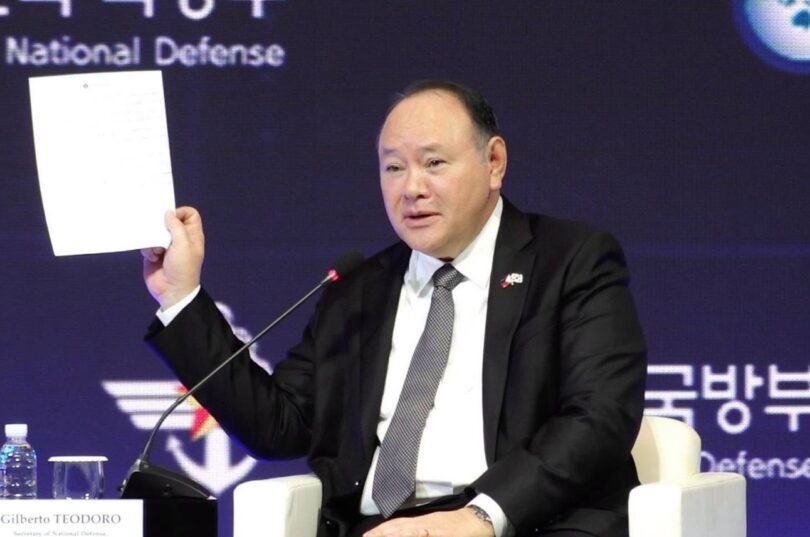

Amidst the mid-session at the Seoul Defence Dialogue, a handwritten note was passed to Philippine Defence Secretary Gilberto Teodoro Jr.
The note was supposedly meant to reassert Beijing's position on the 2016 South China Sea arbitration.
Instead, Mr. Teodoro Jr. read the note aloud and rebutted line by line in front of a live international audience. This gesture by China was inferred as a live demonstration of the coercive habits it was meant to deny.
WHAT HAPPENED ON STAGE
On September 8, 2026, Teodoro in a question-and-answer session at the 15th Seoul Defense Dialogue, was responding on Chinese gray-zone coercion in the South China. Mid speech, a man approached his table from behind and left a folded sheet of paper — later shown to be hotel stationery — in front of him. Clearly caught off guard, Teodoro paused his remarks. "I have a note here. I think this is from China," he told the audience, before asking, "And may I read it?" and moving forward to do so, word for word, in the presence of the assembled delegates and a live forum feed.
The note ran to two paragraphs. Teodoro read the first aloud: that China's position on the South China Sea arbitration was clear, consistent and firm, and that the arbitration violated fundamental principles of international law. He answered as he went, at one point interjecting, "Of course, because you lost."
MAHIYA NAMAN KAYO | Secretary of National Defense Gilberto C. Teodoro, Jr. responded to a note from the Chinese side during the Seoul Defense Dialogue (SDD) 2026 in Seoul, Republic of Korea.#DNDPHL #DiKaPasisiil #SDD2026 pic.twitter.com/fsCRVphkgf
— Department of National Defense - Philippines (@dndphl) September 8, 2026
He did not read the second paragraph aloud, which stated that China would continue safeguarding its sovereignty, rights and interests in the South China Sea in accordance with law, while managing disputes with concerned parties through dialogue and consultation.
Forum organisers later told South Korea's Yonhap News Agency that the note had come from a military attaché at the Chinese embassy in Seoul, who asked a forum staff member to pass it to Teodoro.
TEODORO'S ON-STAGE REBUKE
Rather than set the note aside, Teodoro used it as a live prop for a broader argument about Chinese conduct. "How can you deal with a country in an international forum — beyond the question asked to me — disrespecting the organizers of this forum, how do you expect to deal with it civilly?" he asked.
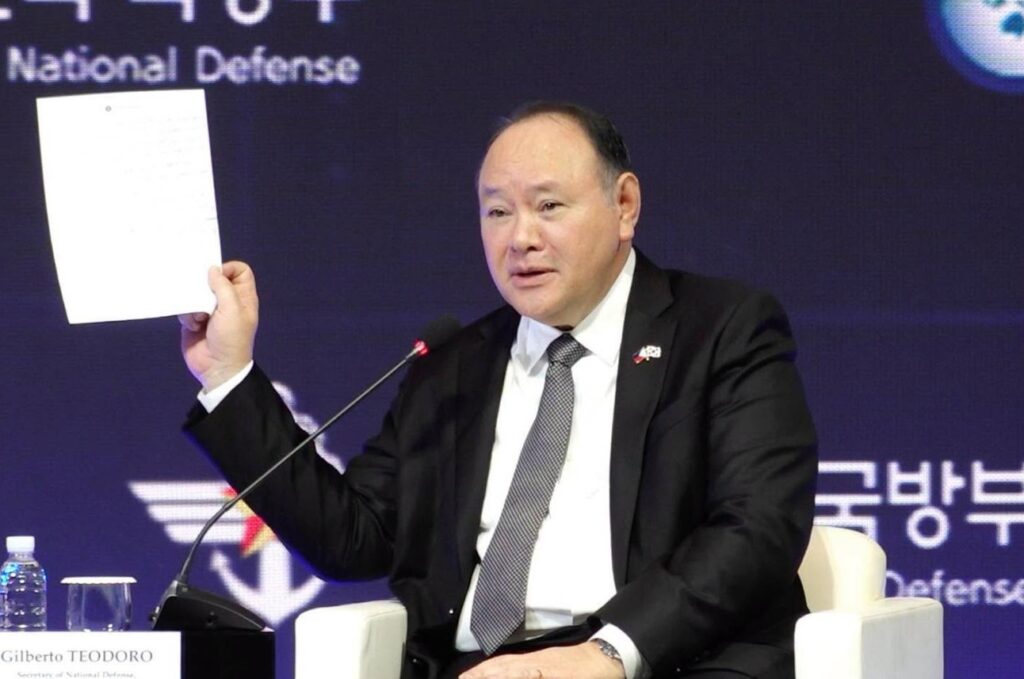
He questioned the propriety of the delivery itself: "Is this the right paper to post to me when I'm being asked a question on the floor?" He went on to frame the episode as illustrative rather than exceptional, telling the audience, "This is actual coercion, bullying and aggression,".
Furthermore he decided to keep the note "as a memento of how desperate China is and how ineffective its position is in the face of a free audience."
He closed by thanking whoever had delivered it: "You have just done your country a great service."
He also highlighted the discourtesy to the summit's South Korean hosts, arguing the note's delivery disrespected both the forum organisers and the other participating delegations.
No Shift in China’s Legal Position
In reality, the diplomatic note introduced no new angle to Beijing’s longstanding position. It largely reinstated China’s established rejection of the 2016 Permanent Court of Arbitration (PCA) ruling, confirming the Chinese stance by the Chinese Foreign Ministry since the award was issued. It was also reaffirmed during the ruling’s tenth anniversary commemorations earlier this year. Beijing continues to maintain that the tribunal exceeded its authority, describing the award as “illegal, null and void” and therefore devoid of any binding force.
The 2016 arbitration case, initiated by the Philippines under the United Nations Convention on the Law of the Sea (UNCLOS), concluded that China’s expansive “nine-dash line” claims lacked legal foundation beyond the maritime entitlements permitted under UNCLOS.
The tribunal also observed that several Chinese land reclamation and construction activities had violated Philippine sovereign rights within its exclusive economic zone. China has consistently refused to acknowledge both the jurisdiction of the tribunal and the legitimacy of its findings.
TEODORO RECEIVES ‘DISRESPECTFUL’ LETTER FROM CHINA
— The Philippine Star (@PhilippineStar) September 8, 2026
Defense Secretary Gilberto Teodoro Jr. showed the handwritten letter he received from the Chinese delegation at the Seoul Defense Dialogue (SDD) 2026 in Seoul on Tuesday.
The letter, which stated China’s position on the 2016… pic.twitter.com/QxoIGQcZpq
Beijing’s Reaction
Chinese officials did not bother to challenge the authenticity or contents of the note after it entered the public domain. However, Beijing’s decide to pass the buck by shifting the criticism on Manila’s poor handling of the incident. The Chinese Foreign Ministry spokesperson Mao Ning censured Philippine officials of distorting the episode, stating that “certain people in the Philippines” should cease “grandstanding and lying” and instead contribute to stable bilateral relations and regional peace in the South China Sea.
Beijing offered no detailed explanation regarding the circumstances under which the note was delivered, nor did it directly address Philippine Defence Secretary Gilberto Teodoro’s criticism of the method used during an event hosted by a third country. The absence of a competing official narrative left many questions surrounding the delivery process unanswered.
The episode also reflects a broader pattern that has characterized exchanges between Teodoro and Chinese officials in recent years. In January 2024, Teodoro slammed Mao Ning’s remarks regarding President Ferdinand Marcos Jr.’s congratulatory message to Taiwan’s president-elect, describing them as “low-level” rhetoric and state-sponsored propaganda.
Beijing responded by warning that it would firmly counter what it viewed as provocations concerning one of China’s core interests.
Similar confrontations have continued.
In October 2023, Teodoro described China as an “illegal occupant” in the West Philippine Sea after Beijing accused Manila of unlawfully occupying Pag-asa Island.
A year later, China’s embassy in Manila rebuked Teodoro’s defence of the deployment of the U.S. Typhon missile system in the Philippines, criticising him of creating a Cold War mind-set and ideological confrontation.
Despite the sharp rhetoric, neither side has altered its fundamental legal, territorial, or strategic positions.
Interpreting the Incident
What elevated this episode beyond routine diplomatic sparring was not the content of the note itself, but the manner in which it was delivered.
The utilization of a third-country forum’s personnel to transmit an unsolicited diplomatic signalling to a cabinet official especially at a live discussion represented an unusual communication channel, even within the often-contentious context of South China Sea diplomacy.
The timing proved significant. Rather than disrupting Teodoro’s message, the delivery provided him with an immediate opportunity to incorporate the incident into his broader argument regarding coercive and assertive behaviour in the region.
The note effectively became part of the discussion it may have sought to influence. The motivations behind the delivery remain unclear. It is possible that the Chinese representative intended merely to restate Beijing’s legal position before an influential audience or simply prod the Philippine delegation. Equally plausible is the possibility that the protocol implications were underestimated.
A further complication is the asymmetry of publicly available information. The most detailed account originates from the Philippine side, including statements by Teodoro and the publication of the note’s image through official channels.
Beijing has not provided a similarly detailed explanation of the incident. Consequently, while the facts surrounding the delivery remain incompletely documented, the broader significance of the episode is easier to assess.
Concluding remarks
Rather than representing a major deterioration in bilateral relations, the incident appears to be another episode in the ongoing contest of narratives, legal claims, and strategic messaging that continues to define the South China Sea dispute.
More on China’s coercive approach to diplomacy:
Arunachal Calling: https://www.thestrategicperspective.org/arunachal-calling/
Chinese villages in Western Bhutan: https://www.thestrategicperspective.org/chinese-villages-in-western-bhutan/
Enforcing 'Ethnic Unity' in China: New 'National Identity' Law has Implications for Dalai Lama Succession and Tibetan Diaspora: https://www.thestrategicperspective.org/enforcing-ethnic-unity-in-china-new-national-identify-law-has-implications-for-dalai-lama-succession-and-tibetan-diaspora/
China’s Water Threats, India’s Malacca Leverage and Growing Indo-Pacific Contestation: https://www.thestrategicperspective.org/chinas-water-threats-indias-malacca-leverage-and-growing-indo-pacific-contestation/
Trump, Hormuz, and Strategic Exaggeration: https://www.thestrategicperspective.org/trump-hormuz-and-strategic-exaggeration/
THE 26TH SCO SUMMIT AT 25 YEARS: https://www.thestrategicperspective.org/the-26-sco-summit-at-25-years/