

The Indian Coast Guard (ICG) organised the 24th National Maritime Search & Rescue (NMSAR) Board Meeting at Bhubaneswar under the Chairmanship of DG, ICG Paramesh Sivamani, AVSM, PTM, TM, on October 6, 2026.
Deliberations focused on strengthening national SAR preparedness, enhancing distress‑alert management, and ensuring faster mobilisation of rescue assets through technology integration and seamless inter‑agency coordination.
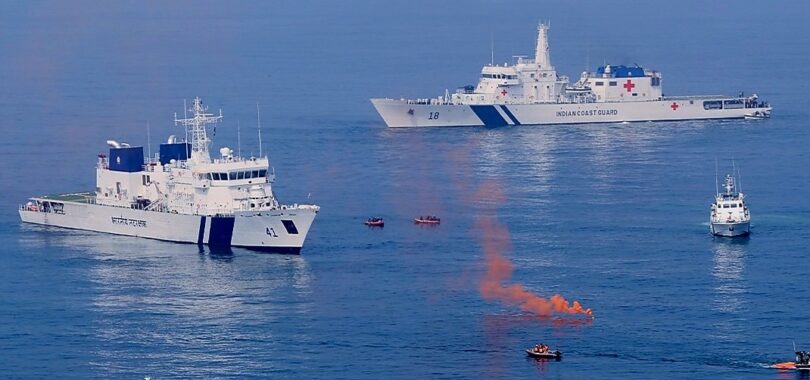
On the sidelines of the NMSAR Board Meeting, Minister of State for Defence Sanjay Seth, inaugurated the 12th National Maritime Search & Rescue Exercise (SAREX‑2026) on October 07 and witnessed a SAR Demonstration off the Paradip coast on October 08, 2026.
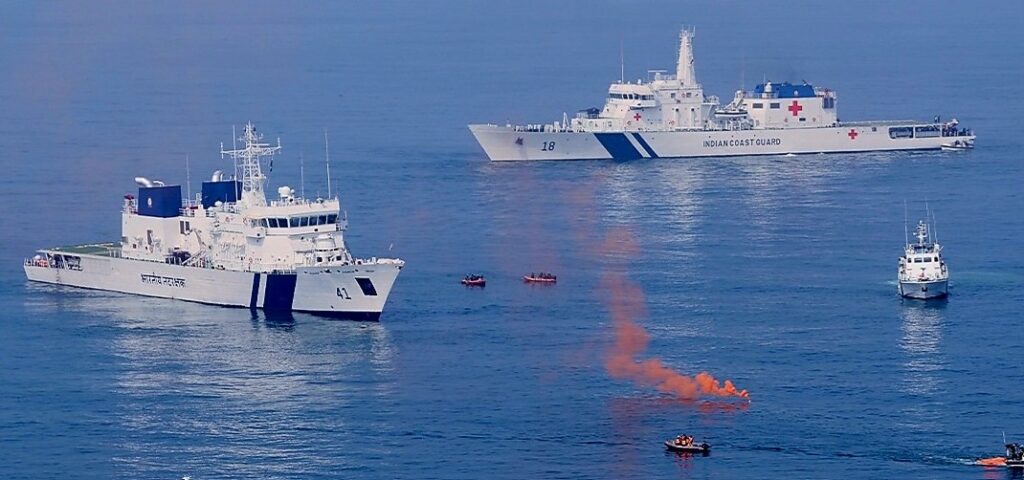
This was one of the largest and most complex SAR exercises ever conducted in the region, in which fifteen Coast Guard ships, two Dornier aircraft, three Advanced Light Helicopters, a Chetak helicopter, IAF C‑130J and Mi‑17 aircraft, two Indian Navy ships, civil/state assets, and shore‑based support units participated.
The exercise simulated a Mass Rescue Operation involving concurrent aeronautical and maritime distress situations; a passenger aircraft ditching at sea with 228 persons onboard and impacting container vessel MV Zumba.
A major highlight of this exercise was international participation of 32 observers from 30 countries, underscoring the cooperative protocols, strategic importance, and global interoperability of the drill.
Known as the leading coast guard in maritime search and rescue within the Indian Search and Rescue Region (ISRR) of the South Asian and Indian Ocean region, ICG’s conduct of the 24th NMSAR Board Meeting and SAREX‑2026 reaffirmed India’s resolve to build a faster, technology‑enabled, and internationally connected Search & Rescue framework, in line with the vision of SAGAR (meaning sea, full form-Security and Growth for All in the Region) and the spirit of MAHASAGAR (meaning great ocean, full form-Mutual and Holistic Advancement for Security and Growth Across Regions).
Ranking as the fourth-largest coast guard globally and operating under the Ministry of Defence, ICG manages a robust force of over 180 ships and nearly 80 aircraft, with plans to further expand capabilities by 2030. It oversees India’s enormous Exclusive Economic Zone (EEZ) of over 2 million square kms and a search-and-rescue region spanning 4.6 million square kms. Within this region operations are directed through 3 Maritime Rescue Coordination Centres (MRCC) located in Mumbai, Chennai, and Port Blair, alongside 36 Maritime Rescue Sub-Centres.
Known as the stalwart guardian of India's 7,500-kilometer coastline, acting in close coordination with the Indian Navy and civil authorities, it is highly regarded for saving thousands of lives at sea, intercepting illegal narcotics and contraband worth thousands of crores and apprehending unlawful vessels. Credited for prompt disaster relief during cyclones and tsunamis, effective marine pollution and oil-spill response, and cooperative regional engagements under India's SAGAR vision.
ICG has evolved into a highly sought-after maritime law enforcement and rescue agency, particularly in the Indian Ocean Region (IOR). Its expanding footprint in international Humanitarian Assistance and Disaster Relief (HADR) missions, coupled with its specialized training programs, has made it a key partner for numerous countries. It frequently leads or assists in high-stakes regional humanitarian missions, providing medical infrastructure, rescue boats, and supplies during crises:
As part of Operation Sagar Bandhu (2025), ICGS Shaurya deployed to Sri Lanka, delivered over 50 tonnes of crucial provisions. Also in 2025, ICGS Sachet conducted strategic deployments to Djibouti, Sudan, and Mozambique. Beyond delivering pharmaceuticals and essential medical equipment, the ICG conducted on-site joint training to develop local disaster management capabilities.
As a signatory to the 1979 International Convention on Maritime Search and Rescue, the ICG consistently manages the vast Indian Search and Rescue Region (ISRR), in which distressed international vessels use its computerized INDSAR system.
Under ongoing strategic frameworks, the ICG and the Vietnam Coast Guard co-chaired high-level meetings in late August 2026. These meetings culminated in live sea drills like the Sahyog-Hoptac (both words mean cooperation in Hindi and Vietnamese) joint exercises, practicing anti-piracy, medical evacuation, and pollution response.
The ICG maintains routine communication check exercises with the maritime authorities of Japan, the Philippines, Thailand, Myanmar, Indonesia, and Sri Lanka to bridge language barriers during cross-border emergencies.
Through Government of India’s Indian Technical and Economic Cooperation (ITEC) program, the Coast Guard Training Centre (CGTC) in Kochi and MRCCs in Mumbai and Chennai have become central hubs for capacity building. The ICG regularly hosts officers and sailors from friendly foreign countries —including Bangladesh, Oman, Seychelles, Mauritius, Myanmar, and the Maldives—training them in specialized domains like:
- Maritime Rescue Coordination Centre (MRCC) Operations
- Deep-sea Search and Rescue (SAR) planning and satellite-aided execution
- Global Maritime Distress and Safety System (GMDSS) tools
The author, a strategic analyst and former spokesperson, Defence Ministry and Indian Army, can be contacted at wordsword02@gmail.com
More on Indian Navy:
BrahMos Fire Control Systems and Launchers for the Indian Navy: https://www.thestrategicperspective.org/brahmos-fire-control-systems-and-launchers-for-the-indian-army/
GRSE’s triple warship tranche to Indian Navy marks a quantum outreach and punch: https://www.thestrategicperspective.org/grses-triple-warship-tranche-to-indian-navy-marks-a-quantum-outreach-and-punch/
Indian Navy Assumes First Ever Command of Combined Task Force (CTF) 154: https://www.thestrategicperspective.org/indian-navy-assumes-first-ever-command-of-combined-task-force-154/
Indian Coast Guard’s first pollution control vessel with maiden appointment of women officers: https://www.thestrategicperspective.org/indian-coast-guards-full-pollution-control-vessel-with-maiden-appointment-of-female-officers/
Recounting Indian Navy's1971 valour: Questions before the nation: https://www.thestrategicperspective.org/recounting-indian-navys-1971-valour-questions-before-the-nation/
100th & 101st Indian built warships adding to India’s military self-reliance: https://www.thestrategicperspective.org/100th-and-101st-indian-built-warships-adding-to-indias-military-self-reliance/