

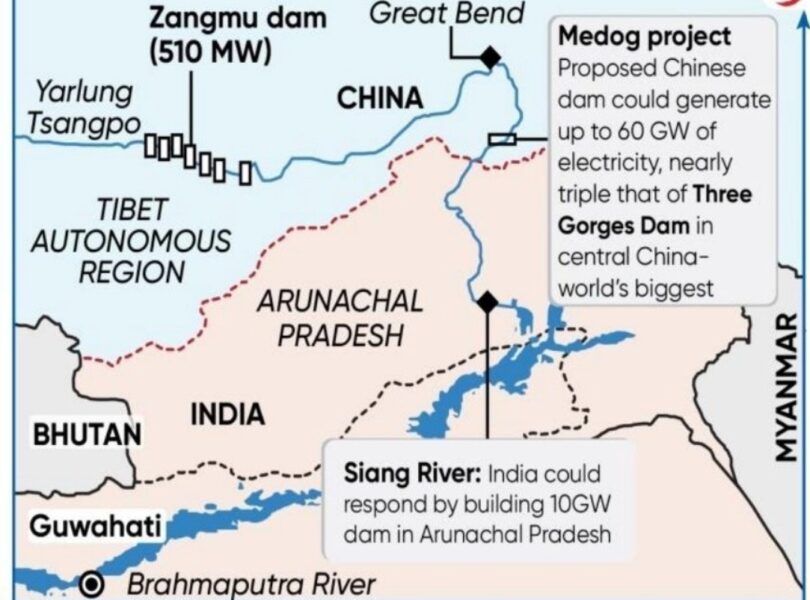

The Brahmaputra River originates in Mansarovar area of Tibet, where it is called Yarlung Tsangpo. It flows Eastwards till the Namcha Barwa Peak and swings south in a loop around it known as the "Great Bend". It enters India through Kepang La near Tuting. It is known as the Siang / Dihang till it hits the plains. South of Pasighat it is called the Brahmaputra. In 2021, China announced constructing a new dam in Medog County some 30-km near the LAC with India (https://raksha-anirveda.com/tsangpo-dams-dangers-to-india-and-bangladesh/). China's dams across Brahmaputra, adversely affect ecology, cause seismic activity, water flow into India; enabling China to use water as a weapon.
The Brahmaputra causes recurring annual floods in India, primarily affecting Assam during June-October monsoons. The accumulated damage data includes: nearly 31.05 lakh hectares (around 39.58%) of Assam’s area is highly flood-prone (4-times the national average); average 9.31 lakh hectares is submerged annually; in addition, severe bank erosion erodes an annual average of 8,000 hectares; flood damage in the past 10-years is estimated at INR 10,000–15,000 crore. The Damage is severe because: the river originates at high altitudes in Tibet before dropping sharply into India; deforestation, climate change, and heavy monsoon rains trigger intense flash floods; the river carries an incredibly high sediment load, which causes it to breach embankments and violently spill into neighbouring villages.
NASA has confirmed that China's massive infrastructural projects, including the Three Gorges Dam, are altering Earth's rotation; all mass movements, from seasonal weather patterns to driving a car, have an effect; global events involving mass movement, such as the 2004 earthquake and tsunami, can influence Earth's rotation. When China announced a new dam in Medog County, India responded by saying it would "protect its interests." But considering that this project would generate 60 gigawatts electricity (3-times the capacity of Three Gorges Dam), strategic implications of controlling the Brahmaputra's upper reaches, lower-riparian flow, proximity of the dam to India's northeast fraught with territorial disputes, and China's strategic alliance with Pakistan in the water politics of South Asia cannot be overlooked (https://www.spslandforces.com/experts-speak/?id=1278&h=Chinas-Mega-Dams).
The ongoing protests in Arunachal Pradesh are directed against the proposed 11,200 MW Siang Upper Multipurpose Project (SUMP), which is being spearheaded by the National Hydroelectric Power Corporation (NHPC). Tensions have significantly escalated into violent confrontations and public unrest. Members of the indigenous Adi community and youth groups are leading the opposition due to multiple apprehensions, including:
- The mega-reservoir could submerge more than 30 villages, forcing local tribal communities to permanently relocate.
- Siang River and its surrounding valleys are deeply tied to the Adi community's cultural heritage, wet rice cultivation fields, and traditional livelihoods.
- Serious safety concerns about constructing one of India's largest mega-dams in a highly fragile, earthquake-prone Himalayan ecosystem.
- Tensions flared specifically after the government deployed Central Armed Police Forces (CAPF), to oversee the technical Pre-Feasibility Report (PFR). Protesters demand security forces withdrawal, stating they will not be coerced into giving consent.
- The protests add to the concerns raised over the years of continuing Chinese intrusions in Arunachal Pradesh and loss of traditional grazing grounds of the locals (https://www.thecitizen.in/opinion/itbp-dg-sets-the-cat-among-the-pigeons-1383257).
There have been violent clashes between the protesters and security forces, with locals opposed to any drilling in the riverbed, saying they will die rather than give up their land, and asking "Are we from Pakistan or China that government is silencing us?" As expected in any protests in India, there are allegations of foreign funding as well.
The SUMP project is currently in its early developmental phases. The initial Pre-Feasibility Report (PFR) technical and strategic assessment phase is scheduled from November 2026 to January 2027) to test the site's structural, geological, and seismic viability. Following successful survey, necessary local consensus and final approvals, construction is tentatively projected to commence around 2028. The mega-dam has an estimated construction timeline of a few years, aiming for commercial operation and final opening by 2032. The project is officially linked to the central vision of Viksit Bharat 2047. The government views the mega-dam as a multi-layered asset; securing clean energy independence, building robust climate infrastructure against flash floods, establishing critical geopolitical water rights in the northeast, and generating inclusive economic growth for the region.
The geopolitical strategic role of SUMP is relative to: China's upstream activities; specific environmental and seismic criteria being tested during the PFR phase; how local village councils (Gram Sabhas) fit into the project's official consent roadmap. SUMP is to serve as a critical geostrategic safeguard and water shield to counter China's Medog project just across the LAC on the lower reaches of the Yarlung Tsangpo River in Tibet. China's Medog project, which formally began construction in July 2025, is five times larger than SUMP. It grants Beijing immense operational control over the river's flow. China could artificially restrict water during the dry winter months (threatening non-monsoon agricultural supplies) or suddenly release massive volumes during high-flow seasons.
The SUMP is designed with a massive 9.2 billion cubic metres of live storage capacity. This huge reservoir is meant to act as a physical shock absorber, catching and regulating sudden upstream surges before they cause catastrophic flash floods downstream in Assam and Arunachal Pradesh. Under international customary water law, a nation that establishes prior beneficial use of a transboundary river gains legal and geopolitical leverage over upstream neighbours; India legally solidifies its status as a critical downstream user. This establishes a diplomatic baseline to demand information sharing, real-time hydrological data, and accountability from Beijing regarding the Brahmaputra basin, preventing China from establishing complete, uncontested control over the river system.
The government analyses highlight that without a defensive infrastructure project, the city of Guwahati and surrounding agricultural zones could face a drop in water supply during crucial non-monsoon months if upstream flows are altered. The storage capabilities of the Siang Dam are intended to stabilize seasonal water availability across the entire northeastern plains.
The local village councils, traditionally known as Kebangs within the indigenous Adi community, and formally recognized under Indian law as Gram Sabhas, hold definitive legal and cultural leverage over the proposed SUMP. Their position within the official consent roadmap is shaped by statutory rights, the state government's multi-stage consultation The Legal Framework: Mandated Consent
Under Indian law, a mega-dam project cannot legally clear land acquisition or environmental hurdles without the formal intervention of the village councils. The roadmap is bound by several statutes: The Forest Rights Act (FRA) 2006 - stipulates that for any project impacting traditional forest-dwelling communities, the formal consent of the Gram Sabha is a mandatory prerequisite; The LARR Act 2013 (Right to Fair Compensation and Transparency in Land Acquisition, Rehabilitation and Resettlement Act) requires a comprehensive Social Impact Assessment (SIA), which must be presented to and approved by the affected Gram Sabhas before tribal land can be acquired; Constitutional Customary Rights - under Article 371(H) of the Indian Constitution, the customary laws and land rights of the tribes in Arunachal Pradesh are protected, elevating traditional Gram Sabhas to an authoritative body over local natural resources.
The Arunachal Pradesh government, led by Chief Minister Pema Khandu, has split the project's progression into distinct consent phases to manage the transition; clarifying that PFR consent is not an approval for constructing the dam but many Gram Sabhas view this as a trap. In the PFR phase, seek agreements with Gram Sabhas to allow NHPC teams undertake non-intrusive drilling (can drilling be non-intrusive?) and technical survey; in the pre PFR phase, the government is mandated to host extensive public hearings and formal Gram Sabha consultations. Khandu has promised that if the Gram Sabhas vote against the project during the public hearings, the dam will be permanently scrapped – how much a politician's word can be trusted is debatable.
Despite the government's attempts to secure early-stage PFR agreements by working through district administrations and appointed village headmen (Gaon Buras), the grassroots traditional councils have actively opposed the process. Multiple key villages, like Peram, Bum, and Pangkang Kumku, have bypassed external political channels to hold independent, traditional Kebang council meetings, passing official resolutions declaring "100% non-consent" to any mapping, technical drilling, or land entry by the NHPC. Grassroots bodies, supported by the Siang Indigenous Farmers’ Forum (SIFF), have accused the state of trying to bypass true Gram Sabha democracy, arguing that deploying security forces to guard survey sites violates the international principle of Free, Prior, and Informed Consent (FPIC).
The state government has taken direct administrative and legal actions against traditional village headmen (Gaon Buras) who have utilized their institutional influence to resist the survey push. Because Gaon Buras are officially recognized by the state government as administrative liaisons under the Arunachal Pradesh Raj Pramukh Gaon Burah Act, the government treats active dissent by these figures as a breach of official conduct. The primary administrative action taken against dissenting village headmen is immediate suspension from their official posts. Punitive action against these village elders has become a central flashpoint in the protests. Major indigenous collectives, including the Adi Bane Kebang United (ABKU) and the SIFF Youth Wing, have elevated the reinstatement of all suspended and terminated Gaon Buras into a non-negotiable core demand alongside the total withdrawal of central security forces from the Siang Valley.
Because the Siang River originates in Tibet as the Yarlung Tsangpo, China possesses a unique blend of geographical, technological, and military advantages. Beijing could potentially employ several direct and indirect methods to compromise, damage, or neutralize the dam. In the event of a full-scale kinetic escalation or border conflict, the Siang Dam would be a high-priority target for China: for precision missiles and long-range munition strikes targeting critical, vulnerable nodes of the dam, like spillway gates, powerhouses, or transformer yards, to permanently cripple the facility; Instead of striking SUMP directly, use explosives or precision strikes to trigger artificial landslides or Glacial Lake Outburst Floods (GLOFs) within Tibet - resulting mega-tsunami of mud, rock, and water traveling down the steep gorges as a battering ram, potentially cracking or overtopping the SUMP downstream.
But Inda should be more concerned about China's asymmetric/grey-zone tactics: by trapping silt behind its own upstream reservoirs, China could release clear water that aggressively erodes the downstream foundations of India's dam over time; China could execute massive, unannounced releases of water during the peak monsoon season, artificially overwhelming the Indian reservoir's holding capacity to cause severe structural strain or catastrophic downstream flooding; during low-flow winter months, China could hold back water to starve the SUMP turbines to neutralize its power-generation capacity and rendering the project economically unviable; state-sponsored cyber warfare units could target the dam's SCADA (Supervisory Control and Data Acquisition) networks – a sophisticated cyberattack could manipulate the dam's automated floodgates, cause turbine failures, or corrupt real-time water-level sensors, leading to catastrophic internal operational failures without firing a single shot. indirectly fund or amplify domestic eco-activism, indigenous protests, and legal challenges through digital disinformation campaigns, leveraging existing local anxieties about tribal displacement to ensure the project remains perpetually stalled or politically unviable.
How India deals with the situation remains to be seen, given that the political hierarchy has demonstrated scant respect in dealing with local sensitivities in border states like Ladakh, Manipur and Arunachal Pradesh; relying more on vote-bank politics and muscle-power. Currently, we hear slogans that any military solution by China is off-the-table (really?). Should we forget that China has repeatedly claimed all 90,000 sq km of Arunachal Pradesh.
The author is an Indian Army veteran. Views expressed are personal.
More on related topics:
China’s Water Threats, India’s Malacca Leverage and Growing Indo-Pacific Contestation: https://www.thestrategicperspective.org/chinas-water-threats-indias-malacca-leverage-and-growing-indo-pacific-contestation/
India-China Eight-Point Agreement: A Tactical Thaw, but Trust Remains Elusive: https://www.thestrategicperspective.org/india-china-eight-point-agreement/
Border Issues: https://www.thestrategicperspective.org/border-issues/
India plays the Tibet card with telling effect: https://www.thestrategicperspective.org/india-plays-the-tibet-card-with-telling-effect/
Influence Ops & Disinformation in India’s Northeast: https://www.thestrategicperspective.org/influence-ops-and-disinformation-in-indias-north-east/