
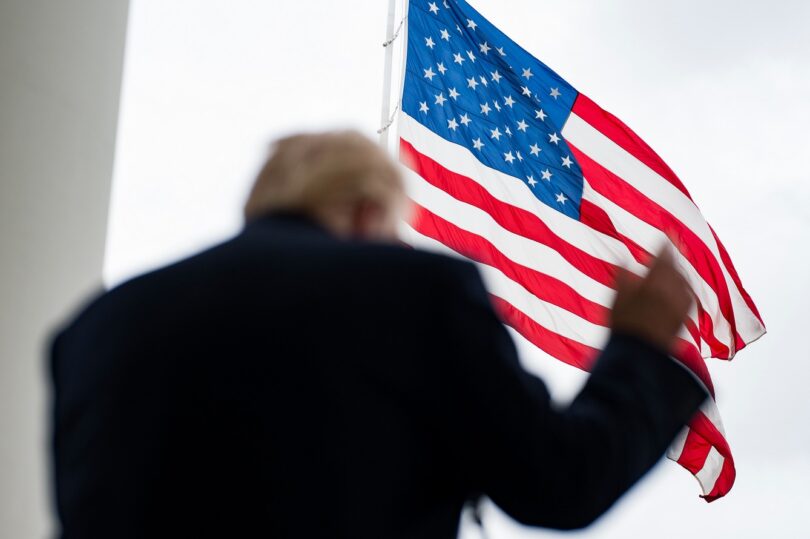

On 31 March 2026, President Trump voiced strong dissatisfaction with European partners for not facilitating logistical support, expressing his frustration with their refusal to assist in the ongoing Middle East conflict. "Go get your own oil", he stated, adding that "the U.S.A. won't be there to help you anymore, just like you weren't there for us".
Following Trump’s statements, the US Secretary of War, Pete Hegseth reiterated the Trump’s sentiments saying it was not just the job of the US to secure what he called a "critical waterway". Hegseth called on allies to “step up” over the Strait of Hormuz.
Explicitly highlighting the United Kingdom and France, Trump censured both nations for their non-cooperation during the conflict. Furthermore, in a post on Truth Social, he argued that nations facing fuel shortages due to disruptions in the Hormuz Strait “Number 1, buy from the U.S., we have plenty, and Number 2, build up some delayed courage, go to the Strait, and just TAKE IT,” (https://truthsocial.com/@realDonaldTrump/posts/116323481956698353 )
The UK “No” by Keith Starmer is likely due to their local elections, which will be held on 7 May 2026. Already facing extensive criticism about home policies and more recently, the fallout from the Epstein files, where the appointed by him Labour politician Peter Mandelson as U.K. ambassador to Washington in 2024, turned out to be a friend of Epstein, Starmer has to find ways to appease the public and secure the Labor party win.
Trump also directed criticism at France, accusing it of obstructing military logistics by denying overflight access to aircraft transporting supplies to Israel.
It is important to mention, while France allowed the US Air Force to utilize the Istres Le-Tube Air Base on guarantees they were not involved in strike missions, Spain announced on 30 March that it had closed its airspace and military bases (Rota and Morón) to any US aircraft involved in the Iran conflict. Spain's Prime Minister Pedro Sánchez described the war as "illegal, reckless and unjust".
Italy had refused permission for US military aircraft to land at the Sigonella air base in Sicily.
According to reports from Daily Corriere della Sera “some US bombers” were supposed to land at the base in eastern Sicily before heading to the Middle East. No approximation of the scheduled landing time was mentioned. Corriere della Sera further stated that permission was denied as the US had not sought authorisation and Italy’s military leadership was not consulted, as per the treaties governing the use of US military installations in Italy. Italian Prime Minister Giorgia Meloni’s government has also mentioned that in case of such requests, it would have to seek parliamentary permission.
French President Emmanuel Macron clarified that France was “neither warned nor involved” in the strikes. France has also blocked Israeli aircraft carrying weapons from using its airspace.
While in compliance with the broad goal of ending the Iranian regime’s nuclear ambitions, Germany too has abstained from participating militarily, citing a lack of resources and the risk of a regional conflagration.
Gulf nations like Saudi Arabia, the UAE, Qatar, Bahrain, and Kuwait which host U.S. bases and have been targets of Iranian retaliation since the beginning of the conflict and have not joined offensive strikes. They expressed frustration at not being notified of the initial attacks on Iran and have largely called for de-escalation.
Poland, Denmark, Finland, and Luxembourg have continued to maintain their neutral stance and have focused on defensive measures while avoiding public endorsement of the offensive retaliation.
Russia’s Foreign Ministry has referred to the strikes as “a pre-planned and unprovoked act of armed aggression against a sovereign and independent U.N. member state.” The ministry has accused Washington and Tel Aviv of duplicity and stated that both nations in pretext of concerns about Iran’s nuclear program were pursuing a regime change in Iran.
The Chinese government said it was “highly concerned” about the US and Israeli strikes on Iran and called for an immediate halt to the military action and a return to table for negotiations. “Iran’s sovereignty, security and territorial integrity should be respected,” stated the Chinese Foreign Ministry.
The Australian Prime Minister Anthony Albanese confirmed his support for the United States in its efforts. He blamed Iran’s current leadership as a destabilizing force and held Tehran responsible for the two attacks in Australia. In August 2025, Australia cut off diplomatic relations with Iran and expelled the Iranian ambassador post the attacks in Australia which were deemed Anti Semitic in nature.
Canada also has expressed its support for the military action against Iran, stating “The Islamic Republic of Iran is the principal source of instability and terror throughout the Middle East”.
UN Security Council has reportedly scheduled an emergency meeting on the US and Israeli strikes on Iran, on the request of Bahrain and France.
US Chairman of the Joint Chiefs of Staff Gen. Dan Caine reiterated that US forces had carried out more than 11,000 strikes against targets in Iran. Caine added that the US had begun conducting “overland missions” of B-52 bomber sorties, claiming US air superiority over Iran.
The Israeli Prime Minister Benjamin Netanyahu told ministers at a cabinet meeting that Israel is “forming alliances with Arab countries that are talking about fighting together on our side”.
Netanyahu has revealed to have clandestine talks with Arab leaders. He reportedly said. “I told them “As soon as Iran can, it will conquer you and overthrow your kingdoms.” Back then, they didn’t really internalize things. Today they understand.”
On a podcast hosted by Danielle Pletka and Marc Thiessen on the American Enterprise Institute’s “What the Hell is Going On?”, the Israeli Ambassador to Washington, Yechiel Leiter stated “Some of our allies have become even greater allies over the past month,” and that despite the relationship dynamics between the Gulf states, they each have requested Israel for assistance.
He also indicated a potential collaborated action with Arab countries by saying “Israel and her allies will continue to act. This could really make the difference going into the future”.
Conclusion
Trump’s argument has been consistent with his long-standing criticism of NATO which can be factored to a collective responsibility approach, which he claims is being denied to the US by its allies and NATO nations.
The US has carried out the costly and risky military campaign against Iran while Europe continues to benefit heavily from Gulf oil flows while refuting military involvement. The evidence of Trump’s multinational coalition failure not only presents a weak US leverage, contrary to Trump’s claims but it has also left the US isolated in a self-initiated war. The coalition would have legitimized the war globally while the cost of operation and military risk would also be shared, reducing the pressure of US.
Despite US strikes on Iran, the key strategic problem remained with Iran blocking the Strait of Hormuz and creating a hike in oil prices, which have gone up nearly 50% since the start of the conflict. The rise, if persisted, will create a very strong inflationary pressure on the economies. Within the US such development would likely decline even further the public support for the war, thus affect the upcoming elections in the US.
In order to tilt the outcome of war in US favour, of either more expensive military escalation would be required or have the allies to step in and secure shipping. Europe’s refusal has placed the US in between “the horns of dilemma”- escalation and withdrawal.
More on the topic:
Kharg Island’s Strategic Role in the Iran–US Crisis: https://www.thestrategicperspective.org/kharg-islands-strategic-role-in-the-iran-us-crisis/
The West Asia War: Its Perspectives & Lessons for India (part 1/3): https://www.thestrategicperspective.org/the-west-asia-war-its-perspectives-and-lessons-for-india-part-1-3/
The West Asia War: Its Perspectives & Lessons for India (part 2/3): https://www.thestrategicperspective.org/the-west-asia-war-its-perspectives-and-lessons-for-india-part-2-3/
The Donroe Doctrine: A Modern Corollary to the Monroe Doctrine in U.S. Foreign Policy: https://www.thestrategicperspective.org/the-donroe-doctrine-a-modern-corollary-to-the-monroe-doctrine-in-us-foreign-policy/
Attack on Thai Cargo Ship in Strait of Hormuz Signals Escalating Maritime Crisis: https://www.thestrategicperspective.org/attack-on-thai-cargo-ship-in-strait-of-hormuz-signals-escalating-maritime-crisis/
Patriot Missile Incident in Bahrain: Civilian Blast Raises Questions in the 2026 Iran War: https://www.thestrategicperspective.org/patriot-missile-incident-in-bahrain-civilian-blast-raises-questions-in-the-2026-iran-war/