

The Space Development Agency (SDA) has launched its first batch of operational satellites, a historic moment in the United States’ effort to build a next-generation military space network.
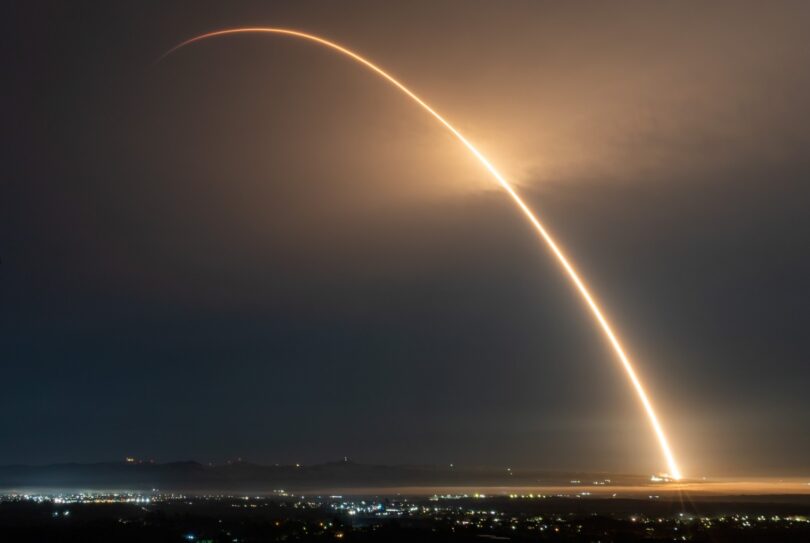
A SpaceX Falcon 9 rocket lifted off from Vandenberg Space Force Base, carrying 21 satellites into low Earth orbit. The spacecraft built by York Space Systems is a part of an extensive plan to deploy more than 150 satellites over the next 10 months.
The newly launched satellites form part of the SDA’s Transport Layer, a key element of the Proliferated Warfighter Space Architecture (PWSA).
This system is designed to provide:
- Fast, low-latency communications
- Secure data transfer for military operations
- Real-time connectivity across global forces
Unlike other satellite systems, which depend on a small number of large assets, the Transport Layer uses a distributed constellation of smaller satellites. These spacecrafts communicate using laser (optical) links, creating a resilient mesh network in orbit.
The 21 satellites launched this week are the first in a series of deployments that will place over 150 satellites in low Earth orbit (LEO) at approximately 1,000 km altitude.

This large-scale constellation is designed to:
- Improve global coverage
- Reduce communication delays
- Increase resilience against anti-satellite threats
The SDA’s approach projects a transition to proliferated space architecture, where capability is distributed across many satellites instead of being concentrated in few high-value targets.
The current mission follows earlier SDA demonstration launches, which successfully tested:
Satellite-to-satellite laser communications
- Data links with aircraft and ground systems
- Low-latency data transfer capabilities
With this launch, the agency has shifted from testing to operational deployment, bringing the system closer to military use.
Officials expect the satellites to begin delivering capabilities within four to six months, once on-orbit testing is complete.
More on related topics:
Alpine Triangle: Germany and Austria’s Airspace Surveillance: https://www.thestrategicperspective.org/alpine-triangle-germany-and-austria-airspace-surveillance/
Fiascos in Space: https://www.thestrategicperspective.org/fiascos-in-space/
America Launches Space Aircraft Carriers: https://www.thestrategicperspective.org/america-launches-space-aircraft-carriers/
US Space Force Unveils New Weapon System Names to Strengthen Guardian Culture: https://www.thestrategicperspective.org/us-space-force-unveils-new-weapon-system-names-to-strengthen-guardian-culture/