
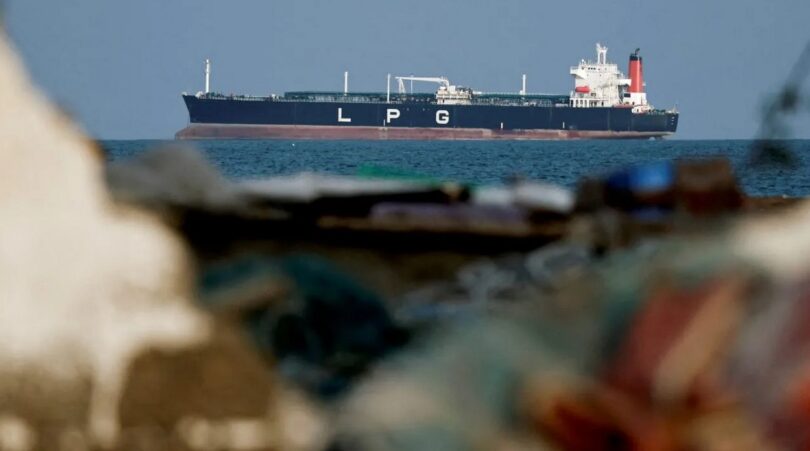

According to several reports, multiple cargo ships and oil tankers connected to Chinese companies have made safe passage through the Strait of Hormuz during the past 48 hours using an Iranian-controlled maritime corridor. The development comes at the time when the US President Donald Trump has been reportedly visiting China for high-level discussions.
Shipping data from MarineTraffic showed the China-flagged crude tanker Yuan Hua Hu passing through the strait near Iran’s Larak Island on 13 May 2026. The vessel’s Automatic Identification System (AIS) reportedly identified its destination as “Chinese owner and crew,” signalling direct Chinese operational control of the ship.
The tanker is operated by COSCO Shipping, one of the world’s largest maritime transport firms headquartered in Shanghai.
The vessel travelled through a maritime route Iran has recently promoted as a “safe” and permit-based corridor for approved ships navigating the Strait of Hormuz. Tehran has tightened its vigilance of shipping activity in the region.
Tracking data also indicated the movement of at least four China-linked vessels using the same corridor between 12 -13 May 2026.
Among them was the Starway, an oil and chemical tanker which moved from Omani waters toward the northern Gulf region near the United Arab Emirates. Another tanker, Deepblue, reportedly linked to a Shanghai-based operator, sailed eastbound through the strait during the same period.
A separate vessel, the Xian Jiang Kou, also completed transit through Hormuz after remaining inside the Persian Gulf for several weeks. The vehicle carrier had departed from Saudi Arabia in March, later moving through Iranian-controlled shipping lanes south of Larak Island. Its AIS destination was similarly listed as “Chinese vsl and crew.”
The increased movement of Chinese-linked vessels comes during a sensitive diplomatic moment. Trump’s visit to China — delayed for weeks because of the regional conflict — is expected to focus heavily on energy security, maritime stability, and Beijing’s relationship with Tehran.
It is apparent that Washington will try to pressure the Chinese President Xi Jinping to help de-escalate tensions and support the reopening of the Strait of Hormuz to broader international shipping traffic. Unfortunately for Washington, that did not happen during Trump’s visit and meeting with Xi Jinping.
The Strait of Hormuz remains one of the world’s most important energy chokepoints, carrying a significant share of global crude oil and liquefied natural gas exports. Since the escalation of the Iran war, commercial activity through the passage has dropped sharply, disrupting energy supply chains and contributing to rising oil and LNG prices worldwide.
Iran has increasingly shifted from threatening to block the strait entirely to selectively regulating access through its own monitored shipping system. Under this arrangement, certain vessels are allowed passage after coordination with Iranian authorities and naval forces.
Energy analysts say the latest vessel movements indicate that China may be emerging as one of the few major trading powers still able to maintain relatively stable maritime access through the Gulf during the crisis.
The continued operation of these shipping lanes could become a major factor in future negotiations between Washington, Beijing, and Tehran as global markets remain highly sensitive to disruptions in Gulf energy flows.
More on the US-Iran war:
Iraq, Pakistan Secure Oil Transit Deals with Iran: https://www.thestrategicperspective.org/iraq-pakistan-secure-oil-transit-deals-with-iran/
“Get Your Own Oil”: Trump Blasts Allies as NATO Splits over Iran War: https://www.thestrategicperspective.org/get-your-own-oil-trump-blasts-allies-as-nato-splits-over-iran-war/
Kharg Island’s Strategic Role in the Iran–US Crisis: https://www.thestrategicperspective.org/kharg-islands-strategic-role-in-the-iran-us-crisis/
Patriot Missile Incident in Bahrain: Civilian Blast Raises Questions in the 2026 Iran War: https://www.thestrategicperspective.org/patriot-missile-incident-in-bahrain-civilian-blast-raises-questions-in-the-2026-iran-war/
US National Defense Strategy and Iran: https://www.thestrategicperspective.org/us-national-defense-strategy-and-iran/
Iran Underestimated: https://www.thestrategicperspective.org/iran-underestimated/