

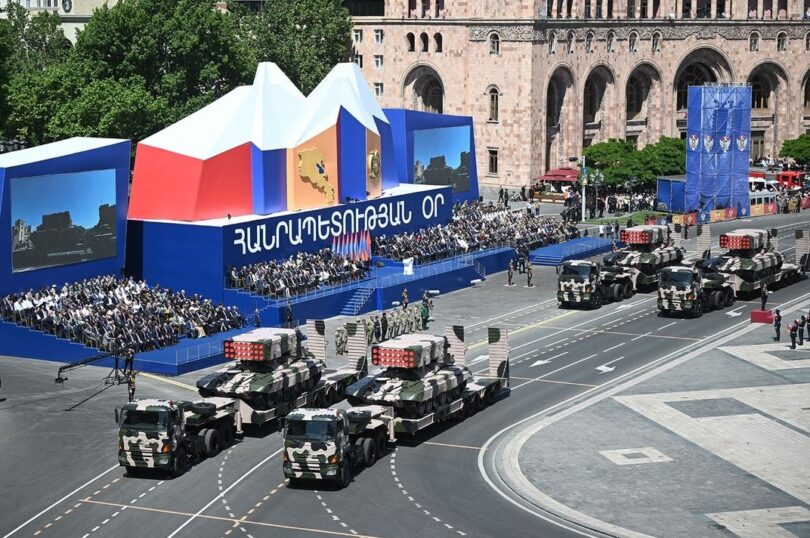

On 28 May 2026, Yerevan displayed a range of recently acquired weapons and equipment at its Republic Day military parade.
Armenia's decision to assign indigenous names to several Indian-made defence systems that have recently entered service with its armed forces became the focal point.
It can be inferred that the move was far more than some ceremonial gesture. By replacing the original Indian designations with names rooted in Armenian culture, mythology and history, Yerevan indicated that these systems are no longer viewed merely as imported military hardware. Instead, they have become integrated components of Armenia's national defence structure.
This initiative also highlighted the strong Armenia-India defence partnership, which has surfaced as one of the most important strategic alliance in the South Caucasus in recent years.
Akash Becomes "Lusan"
One of the most notable systems displayed during the parade was India's Akash surface-to-air missile (SAM) system, which Armenia has renamed Lusan, meaning "Lynx."
The Akash system forms the core of Armenia's newly acquired medium-range air defence capability. Designed to intercept fighter aircraft, helicopters, cruise missiles and unmanned aerial vehicles, Akash works against a wide spectrum of aerial threats.
The name "Lusan" is particularly symbolic. The lynx is known for its sharp eyesight, stealth and ability to detect threats from a distance. These characteristics closely mirror the operational role of the Akash system, which relies on advanced radar networks and rapid reaction capabilities to identify and engage incoming targets before they can threaten protected assets.
For Armenia, which faces growing concerns about drone warfare and precision-guided munitions in the region, the deployment of Akash represents a major enhancement of national air defence capabilities.
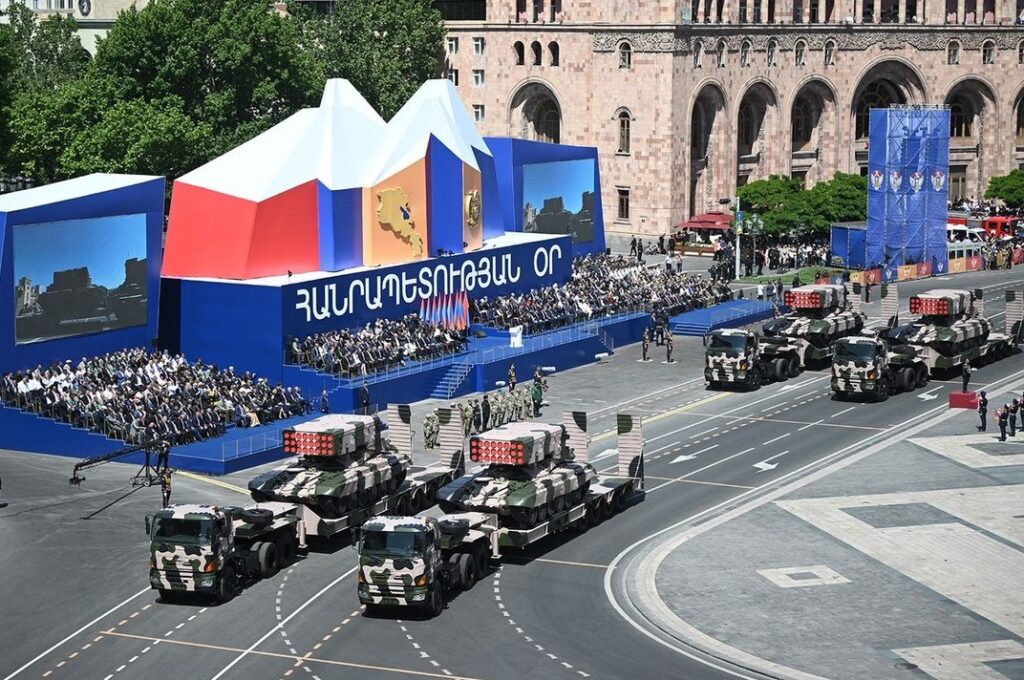
Pinaka Renamed "Shant"
The Pinaka multi-barrel rocket launcher system received the Armenian name Shant, which translates to "Lightning". Among all the renamed systems, this may be the most fitting designation.
Pinaka is designed to unleash rocket salvos over large areas within seconds. Depending on the ammunition used, the system can strike targets at ranges extending beyond 75 kilometres and, in newer variants, much farther.
The term "Lightning" reflects the system's ability to deliver overwhelming firepower with extraordinary speed. Just as lightning strikes suddenly and powerfully, Pinaka can saturate enemy positions, logistics hubs, troop concentrations and artillery batteries before rapidly relocating to avoid counter fire.
Pinaka significantly improves long-range battlefield strike capabilities and provides a modern alternative to older Soviet-era rocket artillery systems.
Swathi Radar Becomes "Paylatsu"
Another key Indian system showcased at the parade was the Swathi weapon-locating radar, which Armenia has renamed Paylatsu.
Weapon-locating radars play a critical role in modern warfare. They detect and track incoming artillery shells, rockets and mortar rounds, calculating the launch position of enemy weapons within seconds.
Once the launch point is identified, friendly artillery units can quickly conduct counter-battery fire operations to neutralize the threat.
The renaming of Swathi to Paylatsu reflects its importance as a battlefield awareness and intelligence platform. Unlike missile systems or artillery guns, radars rarely receive public attention, yet they are among the most valuable assets in contemporary combat operations.
For Armenia, the acquisition of weapon-locating radar technology significantly enhances survivability and responsiveness on the battlefield.
Trajan Howitzer Renamed "Tork"
The Indian-made Trajan 155mm towed artillery gun was renamed Tork, a name drawn from Armenian mythology.
Tork is an Armenian deity associated with immense physical strength and power. The name is therefore well suited to a modern artillery system whose primary purpose is to deliver destructive force over long distances.
The Trajan howitzer combines mobility with firepower, enabling rapid deployment and sustained artillery support across diverse terrain. Equipped with modern fire-control systems, the gun offers improved accuracy and responsiveness compared to older artillery platforms.
By naming the system after a mythological symbol of strength, Armenia appears to be emphasizing the weapon's role as a powerful instrument of battlefield dominance.
ATAGS Becomes "Tir"
India's Advanced Towed Artillery Gun System (ATAGS) has received the Armenian name Tir.
In Armenian mythology, Tir was associated with wisdom, knowledge, scholarship and communication. At first glance, the connection between an artillery gun and a deity of knowledge may seem unusual. However, modern artillery warfare increasingly depends on precision targeting, advanced calculations and networked battlefield information.
ATAGS is among the most technologically advanced artillery systems developed in India. Featuring a 155mm/52-caliber gun, it offers extended range, high rates of fire and sophisticated fire-control capabilities.
The name Tir may therefore symbolize the intelligence, precision and technological sophistication that characterize the system.
ATAGS is expected to become one of Armenia's most capable long-range artillery assets, providing accurate fire support across extended distances.
MArG 155 Receives the Name "Mihr"
The MArG 155 wheeled self-propelled artillery system was renamed Mihr, another name deeply rooted in Armenian history.
Mihr was an ancient Armenian deity associated with light, protection and guardianship. The symbolism aligns well with the role of self-propelled artillery, which provides rapid-response fire support while maintaining the mobility needed to survive on modern battlefields.
Unlike traditional towed artillery, the MArG 155 is mounted on a high-mobility vehicle platform, allowing it to quickly move into firing positions, engage targets and relocate before enemy forces can respond.
This "shoot-and-scoot" capability has become increasingly crucial in conflicts where drones, precision-guided munitions and counter-battery radars make stationary artillery highly vulnerable.
Mihr represents a new generation of mobile firepower designed for the realities of contemporary warfare.
Military equipment is often imported and operated under its original manufacturer designations. Armenia's decision to rename multiple Indian systems is therefore unusual and strategically meaningful.
The chosen names draw heavily from Armenian mythology, folklore and cultural identity. Lusan, Shant, Paylatsu, Tork, Tir and Mihr are not random labels but symbols intended to connect modern military capabilities with Armenia's historical heritage.
Such renaming serves several purposes.
First, it promotes national ownership of imported systems by integrating them into Armenia's military tradition.
Second, it helps create an Armenian identity for equipment that will likely remain in service for decades.
Third, it openly demonstrates the depth of Armenia's confidence in these systems and the permanence of their role within the armed forces.
Most importantly, the renaming reflects the growing strategic importance of India as a defence partner. Armenia is no longer merely purchasing Indian equipment but it is incorporating Indian technology into the very fabric of its defence doctrine and national security architecture.
The Republic Day parade therefore showcased more than weapons. It revealed the emergence of a new defence relationship—one in which Indian-made systems have become so integral to Armenia's security that they now carry Armenian names, Armenian symbolism and an Armenian military identity.