
Relations between India and Japan are ancient. Buddhism originated in India in the 6th century BCE, travelled to Central Asia and China, and was formally introduced in Japan in the mid-6th century CE through South Korea, with monks from India also travelling to Japan. Indian monk Bodhisena arrived in Japan in 736 CE and performed eye-opening ceremony of Buddha at the Todai-ji Temple.
India’s Justice Radhabinod Pal, part of the 11-judge panel at the Tokyo War Crimes Trials following World War II, concluded that all the Japanese defendants were not guilty – arguing that the tribunal was a tool for retribution by the victors and a sham employment of the legal process, also arguing that the tribunal ignored Allied war crimes, particularly atomic bombings of Hiroshima and Nagasaki.
Ashes of Netaji Subhas Chandra Bose are preserved at the Renko-ji Temple in Suginami, Tokyo. Official Japanese and British government inquiries concluded Netaji died in a 1945 plane crash in Taiwan and his remains were subsequently brought to Tokyo. Indian prime minister, including Prime Minister AB Vajpayee have visited the temple, where an annual ceremony is held on August 18. Netaji Bose's daughter Anita Bose Pfaff has been calling for DNA testing of the ashes, but India’s internal politics prevented such action, especially since a positive DNA identification will debunk years of political spin doctoring in India – about his living incognito in India or dying in a Siberian prison. Indo-Japanese historical, cultural, and diplomatic ties are strongly promoted by the Japan-India Association (JIA) and Renko-ji Temple in Japan, and the Kolkata-headquartered Japanese Research Bureau.
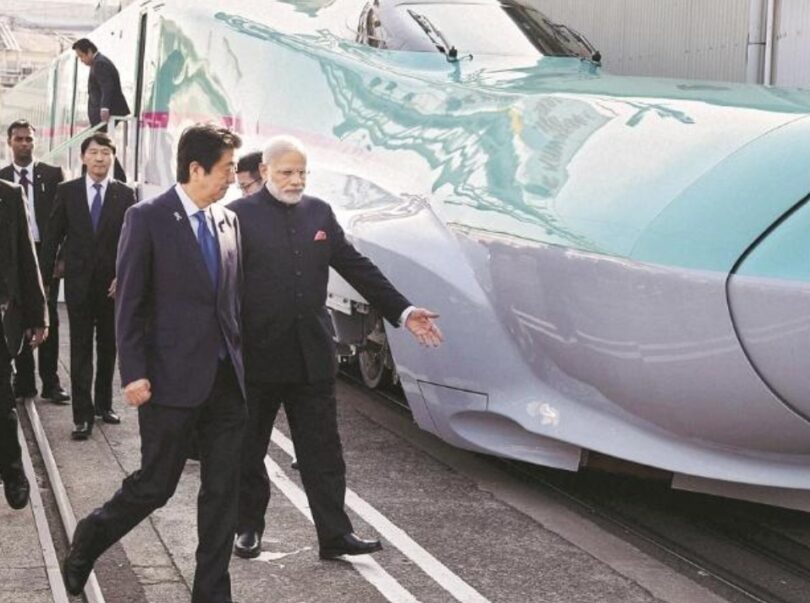
On September 14, 2017, Prime Minister Narendra Modi and Japanese Prime Minister Shinzo Abe jointly laid the foundation stone for the Ahmedabad-Mumbai high-speed bullet train project in Ahmedabad, Gujarat, during PM Abe's official state visit to India. Modi announced that this will be the first bullet train in India with a top speed of 320 km/h and that Japan had offered India a 50-year loan for the project at just 0.1%; which Modi exuberantly said is as good as free. The INR 1.08 lakh crore (USD 16.5 billion) project was given a target completion date of August 15, 2022, coinciding with the 75th anniversary of India's independence.
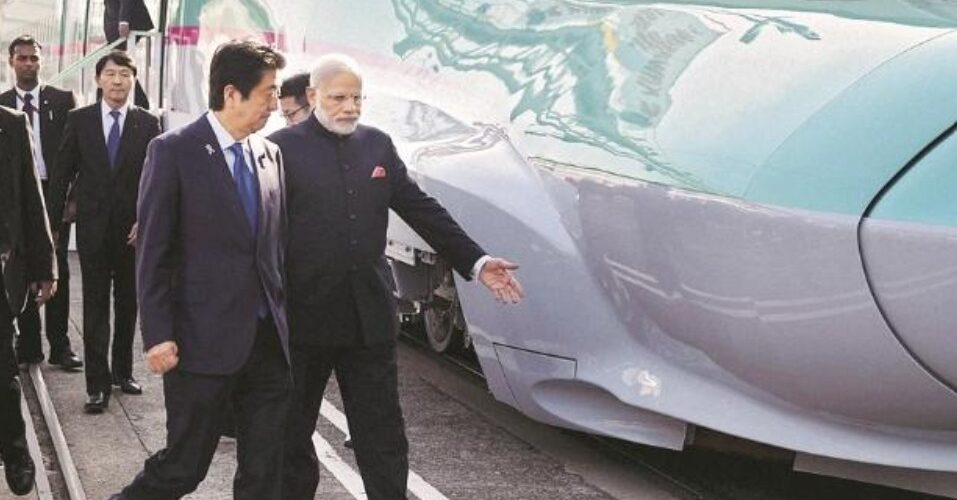
The project cost of INR 1.08 crore, including the cost of 24 trainsets, interest during construction and import duties. Japan agreed to fund 81% of the total project cost – INR 88,087 crore, through a 50-year, 1.5 trillion Japanese yen loan, at an interest rate of 0.1% with a moratorium on repayments up to 15 years and the remaining cost to be borne by state governments of Maharashtra and Gujarat, 20% of the components used were to be supplied by Japan, and manufactured in India
A recent scathing post by Japan’s former justice Minister Hideki Maldhara, who is member of Japan’s ruling Liberal Democratic Party, has openly blamed India for delaying the above Indo-Japanese bullet train project. Hideki Maldhara, who himself was involved in negotiation on the project, has pointed out to the sheer recklessness of the Indian side, over and over. They just don’t keep promises and the minister-in-charge was awful, he wrote. No result from Prime Minister Takaichi’s visit either, he lamented.
1.5 million views on this tweet by ex-Japan minister blaming India for delays in Indo-Japanese Shinkansen project
— Shashank Mattoo (@MattooShashank) July 17, 2026
“Sheer recklessness of the Indian side..”
“They just don’t keep promises..”
“The minister in charge was awful..” pic.twitter.com/sXYsNREvs8
India’s high-speed line is being developed by the National High-Speed Rail Corporation (NHSRC), a subsidiary of Indian railways. The understanding was to use Japan’s Shinkansen technology, including rolling stock, signalling and design standards – with technology transfer to support the Make in India program. A comment on the post by Hideki Maldhara attributes the project delay to India wanting to use the ETCS signaling standard instead of the Japanese one. But surely this could have been resolved over the years, especially before the visit of Sanae Takaichi to India from July 1 to July 3, 2026, for the 16th India-Japan Annual Summit. In fact, media reports had indicated that India initially wanted Takaichi to visit Assam during this trip, which posts on the social media described an effort to divert attention from Manipur burning in ethnic strife.
In 2019, the then Railway Minister, Piyush Goyal, informed the Parliament that INR 3,226.8 crore (USD 460 million) had been spent on the bullet train project as of June 2019. The expenditure already incurred rose to INR 28,442 crore (USD 3.4 billion) by July 2022, and to INR 67,486 crore (USD 8.0 billion) by October 2024, with 47% of civil works completed.
It is now being reported that the inaugural section of the Ahmedabad-Mumbai bullet train project, connecting Surat and Bilimora in Gujarat scheduled to begin partial operations on August 15, 2027 (to be hailed by Modi in his Independence Day address), with the full 508-km high-speed corridor expected to be fully operational by 2029 – before the next election? But this too may be optimistic since India now reportedly wants to integrate East Japan Railway's (JR East) next-generation E10 Shinkansen trains into the Mumbai-Ahmedabad bullet train project. Another news report said Japan wants to supply India with inspection vehicles from the E5 and E3 Shinkansen series, fitted with specialized equipment, arrive in India in early 2026 to assist with testing the rail infrastructure under Indian conditions, since data collected by them will be crucial for the future production of the E10 trains in India.
On August 30, 2025, Modi took a ride on the Shinkansen in Japan, from Tokyo to Sendai accompanied by Japanese Prime Minister Shigeru Ishiba and was briefed on the advanced next-generation bullet train technology, including Japan's ALFA-X and the upcoming E10 series. Earlier, Modi had taken a ride on the Shinkansen with Japanese PM Shinzo Abe on November 12, 2016
How did we expect the project to be completed by August 15, 2022 (coinciding with the 75th anniversary of India's independence) in the first place, given India’s internal politics, including land acquisition, widespread corruption, and the project passing through Gujarat, Maharashtra, and Dadra and Nagar Haveli, with 12 planned stations including key locations like Mumbai, Surat, and Ahmedabad? No doubt, progress on the 508-km high-speed corridor will be shown before the next general elections in 2029, but hopefully demonstrating speed of development at the cost of quality does not happen, as seen from potholed highways and collapsing bridges and tunnels in recent years that cannot withstand even initial monsoon showers. This is more relevant since bulk of the high-speed rail corridor is to be on an elevated platform.
To finance the escalating costs of the project, which were initially projected at INRs 1.08 lakh crore, both governments are working on a new loan framework for the project. Between 2017 and 2023, Japan gave India a total of INR ₹55,317 crore (USD 7.5 billion) as Official development Assistance (ODA), with recent commitments are targeting urban transport, healthcare, and agriculture.
India is presently running deep in a phase of political optics, showmanship, utopian arrogance and endemic corruption (https://www.thestrategicperspective.org/cyber-insecurity/). The E20 blend petrol forced upon the public without any trials, to benefit politicians, is not cheaper than petrol, and damages vehicles.
Similarly, according to environmentalist veteran Captain Amar Jeet. India’s first hydrogen fuel cell train, serves political optics far better than serving taxpayer because of high costs, high-risk, low-efficiency and a novelty project over a proven, cheaper electric infrastructure:
- Standard overhead electric trains are vastly cheaper to build, run, and maintain, operating at a highly refined 80% to 85% energy efficiency, whereas a hydrogen train delivers only 25% to 35% round-trip efficiency because it wastes nearly two-thirds of its input power during production, compression, and conversion.
- Are we deploying hyper-expensive, highly flammable technology on India’s 95%+ electrified broad-gauge network for the sake of publicity?
- Hydrogen is a clean alternative for delicate, non-electrified mountain heritage routes, but scaling it across the main network makes no fiscal sense.
- As long as India's grid remains heavily dependent on coal, the energy-guzzling process of creating this fuel simply shifts pollution to distant chimneys.
Hydrogen-powered trains are in a nascent stage globally. Germany was the first to introduce them as passenger trains, while France, Italy, China, Japan and some other countries are pursuing pilot projects or limited deployments (https://timesofindia.indiatimes.com/life-style/spotlight/hydrogen-powered-trains-how-many-countries-have-them-heres-where-the-worlds-cleanest-trains-are-running/articleshow/132460541.cms). But their infrastructure, climate and environment are vastly different from India. Are the E20 rollout and Hydrogen-powered train changes just for the sake of changes to secure political brownies at the cost of taxpayers?
In terms of international metrics, Japan currently holds a significantly higher global standing than India in both public sector transparency and passport mobility. According to the latest Corruption Perceptions Index (CPI) by Transparency International, Japan ranks 18th globally with a score of 71/100, whereas India ranks 91st with a score of 39/100, placing it below the global average.
The Indian government for the first time has announced that passport is not the proof of citizenship. Incidentally, in terms of Global Passport Power, the latest Henley Passport Index, which ranks passports by the number of destinations their holders can access without a prior visa, Japan ranks 2nd globally, tying with South Korea and the UAE, granting its citizens visa-free access to 188 destinations, whereas India ranks 80th globally, allowing citizens visa-free or visa-on-arrival entry to just 55 destinations.
Finally, Japanese culture is globally renowned for its deep-rooted humility, heavily guided by social codes like kenkyo (modesty) and sunao (honesty) which emphasise putting the collective good above individual ego. If despite this, Japan’s former Justice Minister Hideki Maldhara, has blamed India for delaying the Indo-Japanese bullet train project in the manner he has, it points to the need for India to be more systemic and forthright in dealing with a country like Japan, with whom we have enjoyed close relations since ages.
The author is an Indian army veteran. Views expressed are personal.
More on corruption in India:
Cyber Insecurity: https://www.thestrategicperspective.org/cyber-insecurity/