
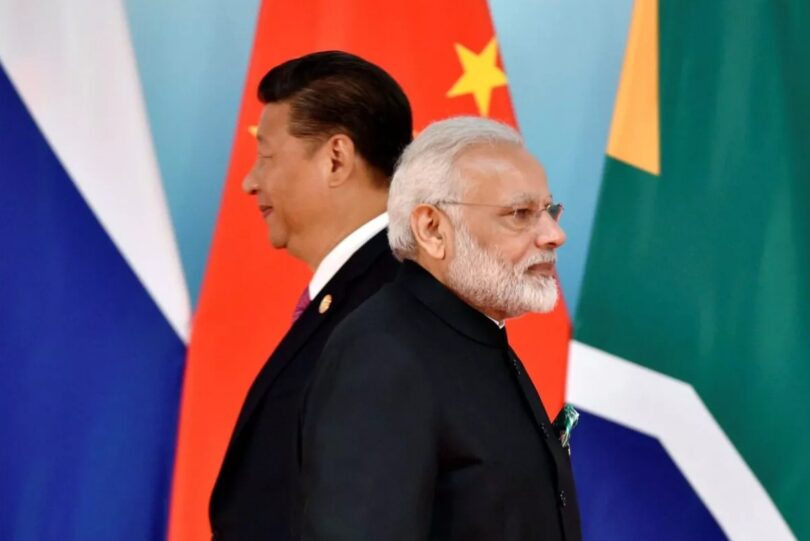
Our hierarchy can’t stop harping about India’s rise, but when we reach USD 10 trillion economy, what will be China’s economy? China’s present nominal GDP is USD $18 trillion compared to India’s USD 3.5 to 4 trillion. China’s per capita GDP of USD 12,000 far outpaces India’s USD 3,000. China contributes 28% to global manufacturing output, while India accounts for 3.3%. What will impede India’s rise in the intervening period? Who applauding us due FTAs, will have no compunctions in backstabbing us, especially after Donal Trump exits? CFR cautions rapidly weakening rupee, dwindling net foreign investment, and AI danger for IT industry – take it or trash it.
"After more than 12 years in office, Prime Minister Narendra Modi faces a painful reality check: His promise to modernize India’s economy hasn’t panned out. Instead, the country faces a rapidly weakening rupee, dwindling net foreign investment, and worries that artificial…
— Council on Foreign Relations (@CFR_org) June 8, 2026
China monitors us 24x7, China-linked surveillance systems and digital infrastructure is just one part. In addition to Chinese CCTV cameras in India, China-made CCTV cameras abroad are also infiltrating India's power grid servers. India is replacing 1,00,000 Chinese CCTVs in Delhi region, which hardly suffices. Indians are increasingly using Chinese smartphones and home appliances, the Indian economy is almost entirely based on Chinese electronics, and India is also dependent on Chinese heavy machinery. Lackadaisical hierarchical attitude exposes India to espionage and sabotage risks, especially in crisis situations. An Indo-American says: “Another method of surveillance Chinese use is heavy lift container cranes at seaports and harbours. The bottom line is unless we develop an Indian operating system and technology, we will remain vulnerable.”
China’s extensive solar infrastructure in Tibet is a grey-zone strategy. By co-locating photovoltaic (PV) stations with military airfields and listening posts, China bolsters border defence and logistics while projecting power, masking military capabilities under the guise of green energy. Satellite imagery shows solar arrays placed next to radar stations, airfields, and listening posts to power sensitive military electronics. Solar power supports advanced air defence bubbles, including retractable missile launch sites on the east bank of Pangong Tso. China could leverage its dominance over hardware and digital software in global renewable supply chains for remote power manipulation through internet-connected inverters and remote-access equipment embedded in solar infrastructure.
China is continuously strengthening surveillance along the border with electro-optical/infrared (EO/IR) sensors, ground surveillance radars, and integrated monitoring systems, termed ‘Smart Border Defence System’. A recent addition is China’s BeiDou Sentinel; a remotely deployable platform built around China’s BeiDou Navigation Satellite System and its Radio Determination Satellite Service (RDSS). BeiDou Sentinel can send short bursts of data through satellite network, conserving power and bandwidth, and handle imagery in a deliberately efficient way.
India is yet to ensure full electronic cover along its borders with China, Pakistan, Bangladesh and Myanmar. The Indian Regional Navigation Satellite System (IRNSS), with operational name of NavIC (acronym for Navigation with Indian Constellation), designed to offer similar level of reliability to the United States' GPS, Russia's GLONASS, and Europe's Galileo, is a failure; failed on-board atomic clocks of the first-generation satellites and launch delay of the second-generation satellites. Pakistani terrorists in India have been using difficult to intercept SATCOM linked to China’s BeiDou. Pakistan has BeiDou cover and all its operational satellites are pointed at India.
India is on the verge of adopting Starlink. According to recent news, final approval for Starlink services in India is frozen due to Starlink terminals operating in Iran without licence, but Lauren Dreyer, VP for Starlink's business operations, has trashed these reports, Starlink cover will have adverse consequences for India, not only because Starlink already covers Bangladesh, and Starlink equipment was recovered in India’s state of Manipur, but because; SpaceX already holds 75% market share of global space economy since 2025 (https://phys.org/news/2026-06-spacex-orbit-east-india-company.html#google_vignette). India will be open to internet manipulation/closure in critical situations. If Starlink satellites have onboard cameras, the threat multiplies security wise. Was NavIC allowed to stagnate and indigenous internet services ignored deliberately?
China's strategy of asserting territorial claims through renaming places and creating new administrative counties aims to strengthen Beijing's influence and pressure India. China recently set up another county, 'Cenling', in its Xinjiang Province near POK to boost security along Wakhan Corridor. The region lies close to where interests of China, Pakistan, and India intersect in a narrow immensely consequential geography.
On June 3, 2026, foundation stone for India’s first ‘Model Border Village’ (under India’s Vibrant Villages Program launched in 2023) was laid at Chumar in Eastern Ladakh, a remote village located at 16,700 feet with 24 houses and 91 inhabitants. By September 2026, all 24 households are to have thermally insulated walls and an additional room for homestay. Focus is to stop migration, generate livelihood, tourism, support Pashmina production and handicrafts. Looking at the expanse of our borders, are we happy with this pace 79 years after Independence? Can we learn something from China? China’s border villages (Xiaokang or "well-off" villages) are dual-use infrastructure; nodes for EW, communication jamming, and short-range AD - force multipliers for frontline troops. Under China's Land Borders Law, inhabitants assist PLA and Chinese People's Armed Police (PAP) in securing borders. PLA veterans ate usually settled in these villages.
A former Indian diplomat says: India’s democracy threatens China ideologically; China ignoring Indian market to overtake US economy makes no sense; China won’t wage major war on India while confronting America in the Pacific; India and China cannot be friends - armed coexistence will continue; India should focus on economy with a permanently militarised frontier. This should be examined in context of the following:
- Did the perception that China views Indian democracy an ideological threat, make us invite the Vice Minister-led Chinese delegation to visit the BJP and RSS headquarters in New Delhi?
- China definitely monitors quality of India’s democracy: reservations and polarization; corruption whitewashed after switching to ruling party (China executes corrupt); moving towards single party rule - killing all opposition; corporate controlled media, land grab to benefit corporates; revival of Naga-Kuki conflict in Manipur to wrest land; hundreds of Indian politicians (union ministers included) and judges/lawyers playing badminton matches in London despite prime minister’s missive to restrict foreign travel; India’s NEET shemozzle and Indian Air Force transporting question papers - compare to China's Gaokao examination; garbage mountain in India’s national capital, inability to retrieve economic offenders - even from Britain despite extradition treaty; increasing hate crimes against Indians abroad; inability to make America stop Gurpatwant Singh Pannun publicly threatening India; inability to make Britain stop demonstration (like in Birmingham) dragging dummy corpses of Indian politicians, including of PM Modi; routine protest over US striking three foreign-flagged tankers with Indian crews and killing three Indians - Jaishankar spoke to Marco Rubio only after public outrage over the attempt to whitewash the issue.
China's Gaokao — the world's largest exam & India's equivalent of JEE/NEET rolled into one — was conducted smoothly for 1.3 crore students in just 2 days 🎓
— Yu Jing (@ChinaSpox_India) June 10, 2026
Factories paused. Roads quieted. The entire nation rallied for its students.
चीन की गाओकाओ — दुनिया की सबसे बड़ी परीक्षा,… pic.twitter.com/aSbpL05suN
- China's BRI spans 150+ nations (nearly all West Asian countries included) representing nearly 3/4th global population and cumulatively over 50% global GDP. Donald Trump has changed from aggressive disassociation and trade wars on China to managed competition and economic engagement. NATO-EU countries anyway were rushing to Beijing to forge economic ties. Why would China ignore India’s market when India is opening to Chinese investments even in critical sectors?
- India vacated Ladakh Range in Eastern Ladakh on Beijing’s nudge, didn’t fire back a single shot when PLA did with tanks advancing, and stopped demanding return to pre-April 2020 positions despite China redrawing the LAC. Yes, China faces the US in the Pacific but America will never fight China directly. And, if China faces a dual-front, what about India facing 2.5-3 fronts and China’s strategic influence on our immediate neighbours?
- China views India trapezing to the US. China remains fixated on our northeast but that is not all. Before China’s second expressway (G219 Highway) reaches Galwan and Hot Springs (by 2035 or earlier), China would attempt to grab more Ladakh. China also eyes total control of Pangong Tso (which is why Beijing forced India to vacate Kailash Range), as well as the freshwater reserve of Siachen Glacier (which is why it occupies Shaksgam Valley) in conjunction with Pakistan. In between, we should expect PLA intrusions in the Middle Sector.
- The US wants an India-China war to draw strategic and economic advantage. Can India respond to China in the manner it attacks Pakistan - that too occasionally? American scholars have been saying China could use tactical nukes to break the forward crust. Can India’s hierarchy respond similarly?
Indian politicians are adept at bragging. The union home minister roared in Parliament that we will take back POK and Aksai Chin. In 2024, the chief minister of UP said if Modi comes to power again, we will capture POK in 3-months. The defence minister keeps singing POK will fall in our lap automatically. President Xi Jinping has repeatedly said Taiwan is an integral part of China, which will be integrated. Victor Gao, VP of Beijing-based Centre for China & Globalization, recently said that the India-China border should begin at the River Ganges, and Arunachal Pradesh is part of China (https://stratnewsglobal.com/china/china-scholar-claims-indian-territory-north-of-ganga-rejects-mcmahon-line/). Gao’s squeaks don’t matter. However, after Trump’s tantrums, India and China had agreed to resume border trade at Nathu La, Shipki La and Lipulekh Pass. But after Nepal’s new PM Balendra Shah claimed Lipulekh Pass as part of Nepal and sought Chinese and British intervention on the issue, there is no word from China while border trade has resumed at Nathu La and Shipki La.
There is uproar in media over PLA General Wei Chang saying India will 'never' make all its own weapons (citing reliance on foreign engines, barrels and guidance systems) and contrasting India's 45% import share in 2026 with its 70% in 2006, while arguing key gaps remain in critical technologies despite progress. Chang’s remarks are viewed in backdrop of rising India-China strategic competition, while listing out Indian advances in the defence sector which no doubt is considerable.
But the pursuit of excellence is a never-ending process and we need to focus on our weaknesses, such as: many indigenous platforms continue to rely on imported subsystems, engines, and raw materials, making supply chains vulnerable; transfer of technology by foreign OEMs limited to s only assembly and integration processes, stunting local innovation and true self-reliance; Defence Public Sector Undertakings continue to monopolize defence ecosystem, often operating with conflicts of interest; lengthy, complex acquisition procedures and shifting qualitative requirements delay major projects; low R&D investment, which limits progress in futuristic and niche technologies; lack of world-class, domestic testing and certification facilities; what actually is the indigenous content in Make-in-India - how many are Assemble-in-India, why is LCA Tejas Mk1A program inordinately delayed and HAL just discovered 199 test reports for parts supplied for the Tejas mk1A (sine 2023) are fraudulent? After Trump announced USD 300 billion partnership with India’s Reliance Industries to build the first major US refinery in 50 years, will Modi meet him on sidelines of the G7 Leaders’ Summit in Paris (June 15-17), as also Xi Jinping. The India-China border settlement is unlikely in the foreseeable future. Also, we can continue to keep raising terrorism, but both China and the US support Pakistan, and the US has been using terrorists as proxy forces since ages.
Where Modi attended the Quad Leaders’ Summit in Washington, India should seriously consider a Russia-India-China (RIC) Leaders’ Summit. This would be real multi-alignment, giving an appropriate signal to the US. India should also study how the rug was pulled from under the once roaring Southeast Asian economies.
The author is an Indian Army veteran. Views expressed are personal.