

Executive Summary
- On 17–18 September 2026, DG ISPR Lt. Gen. Ahmed Sharif Chaudhry told Arab News that Pakistan’s commitment to Saudi Arabian security remains “unconditional” and that Islamabad would go “to any extent” to insure it. The statement came three days post a Houthi drone was intercepted south of Mecca. This is reported as the first alleged attempt on the holy city since 2017.
- That rhetoric illustrates the Mecca (Makkah) Joint Defence Agreement of 7 August 2026 as a pact whose text in all entirety has never been published, and according to multiple independent accounts has yet to be ratified by Turkey’s parliament. This may be expected to proceed by October 2026 at the earliest. Additionally it requires a separate internal approval process in Pakistan. The agreement reportedly has no joint command, no standing forces and no specified trigger mechanism, and more importantly, would not produce an automatic military response even once in force.
- Pakistan’s Defence Minister, Khawaja Asif, has given contradictory signals within the same week. Contradicting himself, he first issued a statement to Geo News stating that the pact “applies to us, and we will fulfil our duty” while stressing that he could not go into its details of the agreement and later arguing that Pakistan has no need for the pact to justify defending the Islamic holy sites — “If Makkah is attacked, there is no need for an agreement to protect it.”
- Pakistan’s historical conduct (a 2015 parliamentary vote for neutrality in the Yemen war) and its 2026 conduct (diplomatic pressure on Iran rather than confrontation with the Houthis, and Foreign Office language distinguishing “intent and spirit” from operational commitment) are consistent with this institutional picture, not an aberration from it.
- Simultaneously, Saudi Arabia has been reported drawing on Israeli intelligence, routed through U.S. Central Command, specifically against the Houthi threat.
What Was Actually Said
The statements made by Lt. Gen. Ahmed Sharif Chaudhry, Director General of Inter-Services Public Relations (ISPR), came from an interview he gave to Arab News on 17 September 2026, published the following day.
He stated, “Pakistan fully stands with the Kingdom of Saudi Arabia, both diplomatically and physically,” further adding, “I would like to underscore here the word physically… We will go to any extent.”
Pressed on the substance of the commitment, he reiterated that “Our commitment to Saudi security is unconditional,” rooted in “an emotive, deep-rooted, historical and unbreakable bond” and extending explicitly to the protection of Makkah and Madinah.
Chaudhry has not disclosed if Saudi Arabia has made a new request for additional Pakistani troops, air-defence systems, or direct participation against the Houthis specifically, and did not confirm if Pakistan’s nuclear deterrent forms part of the commitment he has emphasized on. Comparable formulations were separately reported by Dawn, The Express Tribune, Pakistan Today, Aaj English and Daily Independent, indicating a coordinated ISPR message rather than a single outlet’s exclusive framing.
The Immediate Trigger: The Makkah “Red Line” Incident
It is imperative to mention the timing of Chaudhry’s remarks. The statements followed three days after the sharpest single escalation of the Saudi- Houthi crisis. On 15 September, Maj. Gen. Turki al-Maliki stated that Saudi air defences had successfully intercepted and eliminated a Houthi drone south of Makkah before it infiltrated the city’s restricted airspace. He highlighted this episode as the second attempt on Mecca, since the launch of a ballistic missile towards the region in 2017. Al-Maliki called it “a deliberate act intended to provoke the feelings of millions of Muslims” and declared the security of the Two Holy Mosques and pilgrims a “red line.”
The Houthis have denied targeting Makkah, with military spokesman Yahya Saree saying their operations targeted “oil facilities and military bases, which were far removed from the sacred sites” while a Houthi politburo member called the Al-Maliki’s claim “a worn-out lie.”
This specific development is part of a wider, ongoing trend where the situation is getting progressively exacerbated. In mid-September, the regional security landscape transformed dramatically after a coordinated Houthi drone and missile offensive left 73 injured and set multiple oil installations ablaze across four Saudi urban centres. This aerial assault coincided with a severe disruption to Saudi Arabia’s energy infrastructure, occurring only a day after drone strikes knocked the vital Petroline (East-West) pipeline offline. Concurrently, rebel ground forces achieved a strategic breakthrough by capturing the coastal town of Mocha.
Within twenty-four hours, the Houthis gained control over the entirety of Yemen’s Red Sea coastline and Perim Island, severely threatening what had been regarded as Saudi Arabia’s final secure maritime corridor for oil exports.
Crude prices have pushed past $100 a barrel. Against this backdrop Saudi referred to the attack as an assault on its holiest site and in regards to which Chaudhry’ mouthed his placatory remark of “protection of Makkah and Madinah”.
The Architecture Behind the Words
The Strategic Mutual Defence Agreement (SMDA), September 2025
On 17 September 2025, Saudi Arabia and Pakistan signed the Strategic Mutual Defence Agreement in Riyadh, committing both states to treat an attack on one as an attack on both. Hours after signing, Pakistani Defence Minister Khawaja Asif told GeoTV that Pakistan’s nuclear capability “will be made available” to Saudi Arabia under the pact. This is a claim he subsequently told Reuters was “not on the radar” of the agreement, leaving what the Arms Control Association and the Bulletin of the Atomic Scientists both describe as unresolved equivocation over an implicit Pakistani nuclear umbrella.
The Mecca Joint Defence Agreement, August 2026
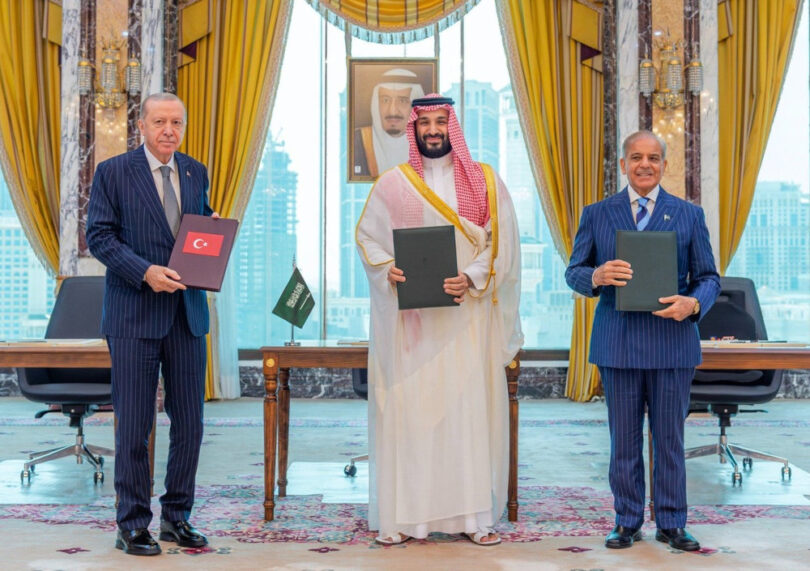
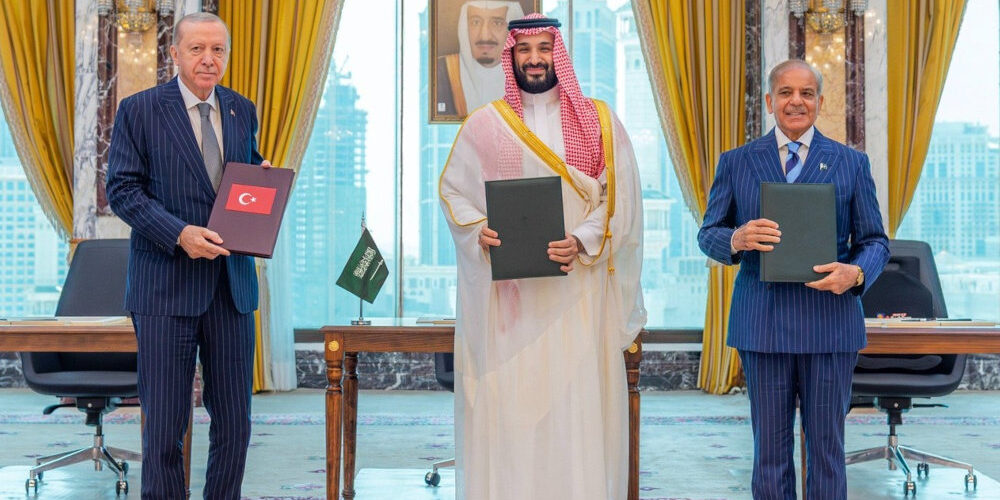
On 7 August 2026, Saudi Arabia, Turkey and Pakistan signed a trilateral successor of the SMDA. Furthermore, the Turkish officials dubbed it as “technically comparable to NATO’s Article 5.”
Atlantic Council experts have characterized it as “an inflection point in the emerging multipolar order in the Middle East and South Asia”.
In regards to Turkey, the signing of this agreement may be viewed as an extension of a Muslim collective-defence umbrella already covering Qatar, Syria and Libya.
On 31 August, officials from the three nations met in Istanbul and officially named the grouping as the Mecca Defence Alliance, announcing a secretariat in Riyadh whose first secretary-general would be from Pakistan. They further reported a new Strategic Political and Defence Committee which would turn the “that political declaration” into something operational. Al Jazeera reported “how its institutional structure will actually function, including when the mutual defence clause itself would be invoked, remains unclear.”
The Ratification Gap: Why the Pact Is Not Actually Executable
Set against Chaudhry’s “unconditional… to any extent,” the Mecca Joint Defence Agreement’s own institutional status tells a considerably more constrained story. These are set of specific, checkable facts reported independently across several outlets.
The text has never been published
First, “the text has not been released,” and a detailed policy analysis from the Arab Center Washington DC likewise has highlighted that “not only has the text of the accord not been made publicly available, but the agreement does not establish a joint command, standing forces, or any specified trigger mechanism.”
That same analysis records Turkish Foreign Minister Hakan Fidan’s own clarification that the agreement “identifies no common adversary” and “is not directed at Iran” and that preparations for it had in fact been under way “for well over two years,” a formulation explicitly designed.
It is not ratified — in at least one, and arguably two, signatory states
The Week, citing a Turkish official directly, reported that Turkey “has not yet submitted the agreement for parliamentary approval and may not do so until October” 2026 (two months after signing), while “Pakistan is also required to complete an internal approval process,” leaving Saudi Arabia as the only one of the three states to approve the pact unilaterally, by royal decree.
Even once ratified, it does not produce an automatic response
“According to experts, even after the alliance comes into force, an attack on one of the members will not automatically lead to a military response. Saudi Arabia will have to submit a formal request; the three countries will enter into consultations and decide on the type of assistance. Riyadh has not yet submitted such a request.” — The Week, 17 September 2026
The same Turkish official told The Week that joint defence and readiness plans, rules of operation, and coordination mechanisms between the three militaries simply do not yet exist — admitting “this may take several years.” This is why the “effectiveness and credibility… have come under question following the absence of a military response from Pakistan and Turkey to Houthi attacks.”
Pakistan’s structural constraints toward Iran are a separate, independent factor
The Arab Centre analysis situates Pakistan’s caution in terms independent of the pact’s institutional gaps.
Pakistan shares approximately 900-kilometre border with Iran. It has a substantial Shia population whose presence extends into the officer corps, and has experienced domestic unrest tied to sectarian tension. These issues are “structural and longstanding” rather than a result of the current crisis. These factors in presence of an institutionally unready pact, and independent structural issue, indicates Pakistan’s caution at confronting an Iran-aligned actor. Hence the reasons for Pakistani military action against the Houthis specifically.
The Foreign Office’s More Cautious Register
Pakistan’s Foreign Office has been cautious and used conditional language than either Chaudhry or Khawaja Asif. Spokesperson Sajjad Haider Khan called the Mecca pact “an umbrella agreement,” with the three states “currently focused on consolidating the alliance before putting in place mechanisms that would determine how it would function.” In response to the 18 September attack and whether Pakistan had developed a mechanism to respond to Houthi attacks, Khan said Islamabad remained committed to “the intent and spirit” of the pact, but that “when, how, where and what force will be used against what objectives, in which modes and matters — operational confidentiality requires us to be discreet at this stage.”
On the Houthis specifically, Khan stated that the discussions “basically revolve around bringing peace and stability through dialogue and diplomacy, and not through coercive measures.”
A Documented Historical Pattern
Pakistan’s behavioural pattern is not new. When Riyadh first requested Pakistani forces for Operation Decisive Storm in March 2015, Pakistan’s parliament, after five days of debate, passed a resolution expressing “neutrality in the Yemen conflict” while on the other hand affirming support for Saudi Arabia if its own territory were attacked. It may be regarded as a promise in words, deflection with regards through actions.
Then-Defence Minister Khawaja Asif, who is the same official now offering mixed remarks on the Mecca pact told parliament in 2015 that any violation of Saudi territorial integrity would draw a strong response, while declining to commit forces to the offensive campaign and terming the Houthis “non-state actors.”
In 2026, Pakistan’s responsive reaction has again been rather wordy diplomatically rather than the military reaction expected by Saudi.
Pakistani, Saudi and Iranian sources told Reuters that Pakistan delivered a Saudi warning to Iran “to rein in its Yemeni Houthi allies” on 9 September, with a senior Iranian official reportedly responding that “Iran does not control the Houthis.”
Field Marshal Asim Munir spoke by phone with Iranian Foreign Minister Abbas Araghchi on 11 September, the same night Araghchi also called Saudi Arabia’s foreign minister. Al Jazeera described Pakistan as functioning “as a communication channel between the two sides.”
Riyadh’s Quiet Turn to Jerusalem
Based on the reported evidence, the Mecca pact remains institutionally unbuilt. Saudi Arabia has at the same time turned to a very different ally for practical help against the Houthis - Israel.
Israeli public broadcaster Kan reported on 15 September that Israel had begun supplying Saudi Arabia with intelligence on Houthi forces and infrastructure, routed through U.S. Central Command (CENTCOM) as intermediary, after a Saudi request for American assistance. Neither Riyadh nor Jerusalem has confirmed the report on the record, and open reporting is cautious in describing the intelligence-sharing and threat-mapping support, however not Israeli military intervention, air strikes or a troop presence.
Since the meeting in Germany, organised by CENTCOM commander Adm. Brad Cooper, the cooperation was made public. The gathering consisted of military chiefs from Israel, Saudi Arabia, the UAE, Bahrain, Kuwait, Qatar, Jordan and Egypt.
Additionally, a regional diplomat cited by Kan told Breitbart’s Axios-sourced reporting that the Pakistan-Turkey-Saudi pact “is not expected to be activated against the Houthis at this stage” mentioning that it does not require an automatic military response and that the Houthis are not currently regarded as an existential threat to Saudi Arabia.
If the three countries just created a NATO-style pact that treats an attack on one as an attack on all, why is Riyadh looking to Jerusalem instead of Ankara and Islamabad? — Middle East Monitor analysis, 15 September 2026
These new developments, however do not translate to a shift or normalization. Saudi analyst Aziz Alshaabani told The Media Line the Germany meeting was “significant” but does not evidence Saudi Arabia moving toward direct military cooperation with Israel, calling any coordination “limited and pragmatic.” Independent analyst Alexander Portnoy told the same outlet that such contacts “ceased to be sensational news a long time ago” and that any Israeli contribution would remain intentionally discreet. A Jerusalem Post analysis took a more forward-leaning view, arguing the crisis “will likely push Israeli-Saudi security cooperation up several notches.” None of this is confirmed government policy on either side and may be regarded as a speculation clearly labelled as such in the underlying reporting.
Rhetoric Against the Verifiable, Institutional Record
- Overall Saudi security commitment (Pakistan)
Rhetoric: unqualified — “unconditional,” “to any extent,” extending explicitly to Makkah and Madinah.
Verified: 8,000–13,000 Pakistani troops and air-defence assets deployed inside Saudi Arabia (figures not reconciled across sources), alongside a pact that remains unratified in at least Turkey and unpublished in text.
- The Mecca pact’s institutional readiness
Rhetoric: described as “technically comparable to NATO’s Article 5” by Turkish officials at signing.
Verified: text unpublished is unpublished. Turkish ratification not expected before October 2026 at the earliest; Pakistan’s own internal approval process incomplete; no joint command, standing forces or trigger mechanism; no automatic response even once ratified. Riyadh has not submitted the formal activation request the mechanism would require.
- Direct combat role against the Houthis (Pakistan)
Rhetoric: notably unclaimed rather than expansive — Chaudhry declined to confirm or deny a Saudi request for this, and Khan cited “operational confidentiality.”
Verified: there is no confirmed Pakistani offensive participation against Houthi forces or territory, since 2015 to present.
- Practical Houthi-facing intelligence support (comparative)
Pakistan’s contribution here has been diplomatic pressure on Iran, not intelligence-sharing on the Houthis themselves. Saudi Arabia has, per Kan and multiple follow-on reports, begun receiving Houthi-specific intelligence support from Israel via CENTCOM.
- Nuclear dimension of the SMDA/Mecca commitment
Asif: capability “will be made available” (September 2025), later told Reuters it was “not on the radar” of the agreement. Chaudhry did not answer the question in his September 2026 remarks. The SMDA’s own text does not mention nuclear weapons, and no nuclear-sharing arrangement has been confirmed.
Assessment
Claims of “unconditional” support may overstate Pakistan’s willingness to act directly against the Houthis. Years of caution, shifting official statements, nuclear ambiguity, and Saudi Arabia’s parallel security engagement with Israel suggest a gap between rhetoric and operational intent. At the same time, the Mecca Pact may be narrower than often assumed. It appears to be a collective-defence arrangement focused primarily on attacks against member states’ sovereign territory, rather than a standing commitment to counter Houthi activity. From this perspective, Saudi cooperation with Israel represents a parallel security measure rather than evidence of the pact’s failure entirely.
The pact remains institutionally incomplete. It is unpublished, only partially ratified, lacks a joint command and activation mechanism, and has not been triggered by any formal Saudi request for intervention. Under these conditions, “unconditional” support reflects political intent, while references to operational constraints reflect institutional limitations. The absence of a Pakistani military response to Houthi attacks is therefore best comprehended as the consequence of an alliance that has yet to acquire the mechanisms necessary to act.
In practical terms, the Mecca Pact remains a political commitment seeking operational form. Until its command structures, activation procedures, and implementation mechanisms are fully established, expectations of a NATO-style response are likely to exceed the alliance’s actual capacity.
More on the Mecca Pact:
Bangladesh Post-Hasina Defence Strategy: A Three-Track Shift: https://www.thestrategicperspective.org/bangladesh-post-hasina-defence-strategy/
THE 26TH SCO SUMMIT AT 25 YEARS: https://www.thestrategicperspective.org/the-26-sco-summit-at-25-years/
18th BRICS Summit: https://www.thestrategicperspective.org/18th-brics-summit/
The Hormuz Squeeze: South Asia’s Energy Security Crisis Explained: https://www.thestrategicperspective.org/the-hormuz-squeeze/
Saudi Arabia Blocks Pakistan’s $5.5 Billion African Arms Push in Major Strategic Shift: https://www.thestrategicperspective.org/saudi-arabia-blocks-pakistans-5-5-billion-african-arms-push-in-major-strategic-shift/
Turkey Explores Joining Saudi–Pakistan Defence Pact: https://www.thestrategicperspective.org/turkey-explored-joining-saudi-pakistan-defence-pact/
Saudi–Pakistani Defence Pact: Operationalizing Hedging and Deterrence in 2026: https://www.thestrategicperspective.org/saudi-pakistani-defence-pact-operationalizing-hedging-and-deterrence-in-2026/